Home › Blog › Roof leaking during a monsoon: what to do right now
Roof leaking during a monsoon: what to do right now
When your roof leaks during a monsoon, stay off the roof, cut power to any wet light fixture, catch the drip in a bucket, move belongings, and relieve a small ceiling bubble only if it is safe. Photograph everything, then have the roof tarped once the storm passes and the attic dried. See roof leak water damage.
In this article
- What should you do the moment you see a roof leak during a storm?
- How do you catch and control the water inside?
- What do you do about a ceiling that is bulging or sagging?
- Should you go on the roof or tarp it during a monsoon?
- How do you tell where the water is really coming from?
- What should you check in the attic after the storm passes?
- How do you document a monsoon roof leak for insurance?
- Do you call a roofer or a restoration crew first?
- What mistakes make a monsoon roof leak worse?
- What should you do right now?
- Questions homeowners ask
What should you do the moment you see a roof leak during a storm?
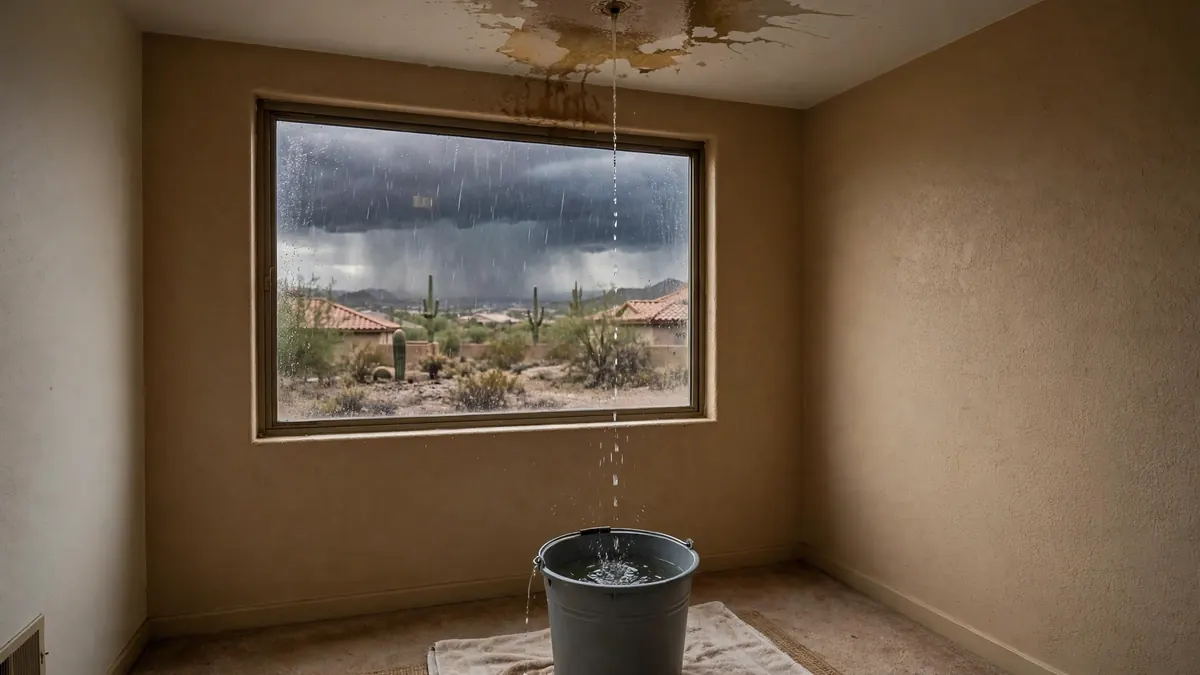
Deal with the electricity first, then the water. If the drip is coming through a light fixture, ceiling fan, or smoke detector, turn off that circuit at the breaker panel before you do anything else, and only if you can reach the panel standing on a dry floor. Then put something under the drip and start moving things out of the way.
A cell rolls across Casa Grande, the wind hits first, and a few minutes later water is coming through a ceiling that was dry an hour ago. Work in this order:
- Check for electrical risk. Water near a fixture, outlet, or the panel means power off to that area. If the panel itself is wet or you would have to stand in water to reach it, leave it alone and keep everyone out of the room.
- Put a container under the drip. A bucket, a storage tote, or a trash can. Lay an old towel in the bottom so the splashing does not spread water across the floor.
- Move what can be moved. Electronics, rugs, paperwork, and upholstered furniture first. Heavy pieces you cannot move can be covered with a plastic sheet or a trash bag.
- Look up. Check whether the ceiling around the drip is flat, stained, or starting to bulge. That decides your next step.
- Start taking photos. A short video of the water coming in, with the storm audible outside, is some of the best evidence you will ever have for a claim.
Do not go outside to look at the roof while the storm is still active. Nothing you can do up there in the dark helps more than catching the water inside.
How do you catch and control the water inside?
Catch it at the drip, keep it off the floor coverings, and stop it from wicking into the walls. A leak that drips into a bucket costs far less to deal with than one that soaks carpet pad for six hours.
- Use a string trick for a wandering drip. Water often runs along the ceiling before it falls, so the drip point moves. A piece of string tacked to the wet spot and hanging into the bucket gives the water a path straight down.
- Protect the floor around the bucket. Towels, a shower curtain, or a painter's drop cloth under and around the container catch the splash.
- Pull back carpet if water is reaching it. If a corner of carpet is getting soaked, lifting it off the tack strip and propping it up keeps the pad from turning into a sponge. Do not cut anything.
- Check closets and the rooms next door. On a tile roof, water can enter in one spot and come through the ceiling a room or two away. Walk the house with a flashlight and look at every ceiling.
Leave the AC running, since cool, dry air helps. The exception is a drip from a supply register or the air handler closet, which can mean water is in the ductwork, so turn the system off at the thermostat.
What do you do about a ceiling that is bulging or sagging?
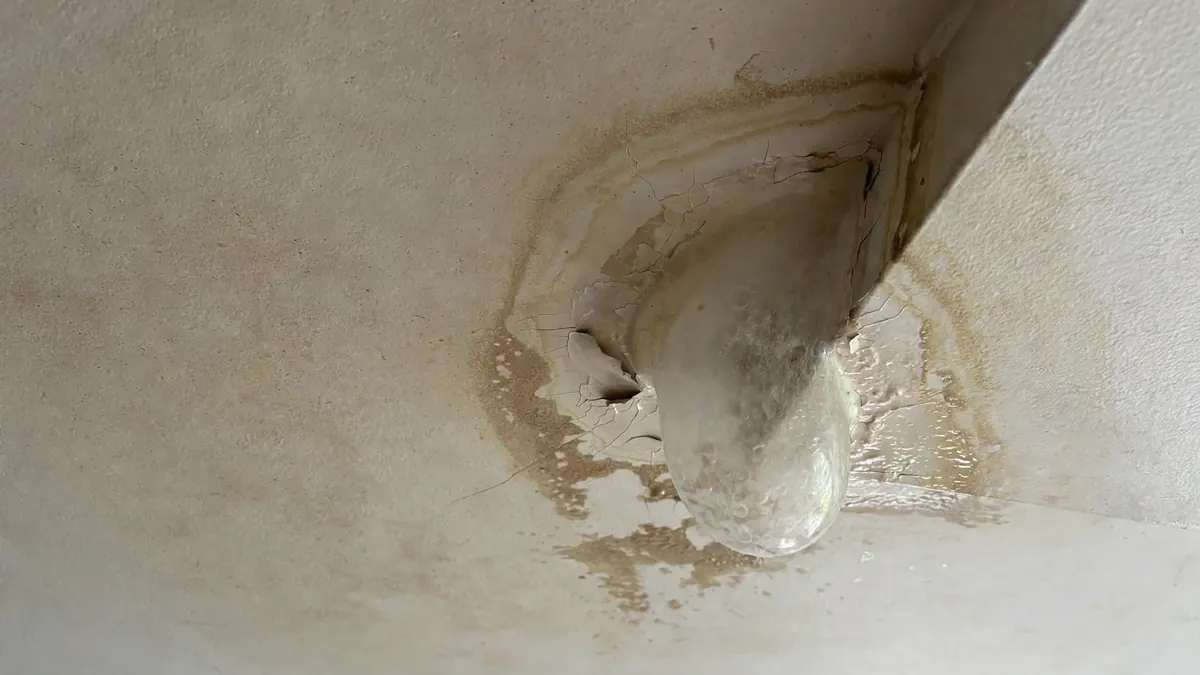
A ceiling that bulges downward is holding water on top of the drywall, and drywall soaked from above can give way without much warning. A small, soft bubble can sometimes be relieved on purpose. A large sag, a crack, or a ceiling that has pulled away from the walls means everyone leaves the room.
A small bubble in the paint or drywall
If the bulge is about the size of a dinner plate or smaller and the ceiling around it still looks flat and solid, you can drain it under control instead of waiting for it to burst:
- Turn off power to any fixture in that part of the ceiling.
- Put a large bucket or tote directly under the lowest point of the bulge, with towels around it.
- Stand to the side, not underneath, and use a long screwdriver or an awl on a step stool to poke one small hole at the lowest point.
- Let it drain into the bucket. The hole is easy to patch later, and it keeps the water from spreading across the top of the drywall to new areas.
A large sag or a cracked ceiling
Leave it alone. Close the door if the room has one, keep children and pets out, and do not stand under it to grab belongings. Wet drywall plus pooled water plus soaked insulation on top is heavy, and a whole section can come down at once. This is a job for a restoration crew, who drain it from a safe position, remove the wet section, and bag the insulation that comes with it. The site's page on ceiling water damage covers what that repair looks like afterward.
Never use a ladder under a sagging ceiling, and never poke a hole in a bulge that sits under a light fixture or ceiling fan. If you are not sure the bubble is small, treat it as a sag and keep people out.
Should you go on the roof or tarp it during a monsoon?
No. Do not climb onto a roof during a storm, and be very careful about doing it yourself after one. Roof tarping is a job for a crew with harnesses, the right ladders, and experience walking tile, which is slippery and cracks under the wrong step.
Gusts at the leading edge of a cell can come in hard with no warning, and lightning often keeps going after the heavy rain stops. Wet concrete tile is slick, summer sun makes it hot enough to burn, and a cracked tile under your foot opens a new leak. A single-story roof feels low and safe, but a fall onto concrete or landscaping rock is a serious injury.
What a proper tarp job looks like
- The tarp extends well past the damaged area and up over the ridge where possible, so water runs over it instead of under it.
- It is anchored with boards along the edges rather than nails punched through good roofing.
- On a tile roof, loose or broken tiles may be set aside so the tarp lies flat, then reset during the repair.
- On a flat roof, the crew checks that the scuppers and drains are clear so the tarp does not create a new pond.
If you have water inside and the roof needs covering, the storm damage and roof tarping page explains how tarping fits in with board-up and drying. From inside, the safe thing you can do is catch the water and keep the room clear.
How do you tell where the water is really coming from?
The spot where water drips into the room is usually not the spot where it gets through the roof. Water lands on the roof deck or underlayment, runs downhill along the sheathing, a truss, or a pipe, and drops wherever it finds a low point or a gap in the drywall. Knowing the likely entry points for your roof type helps you and the roofer find it.
| Roof type or feature | Where monsoon water usually gets in | What you see inside |
|---|---|---|
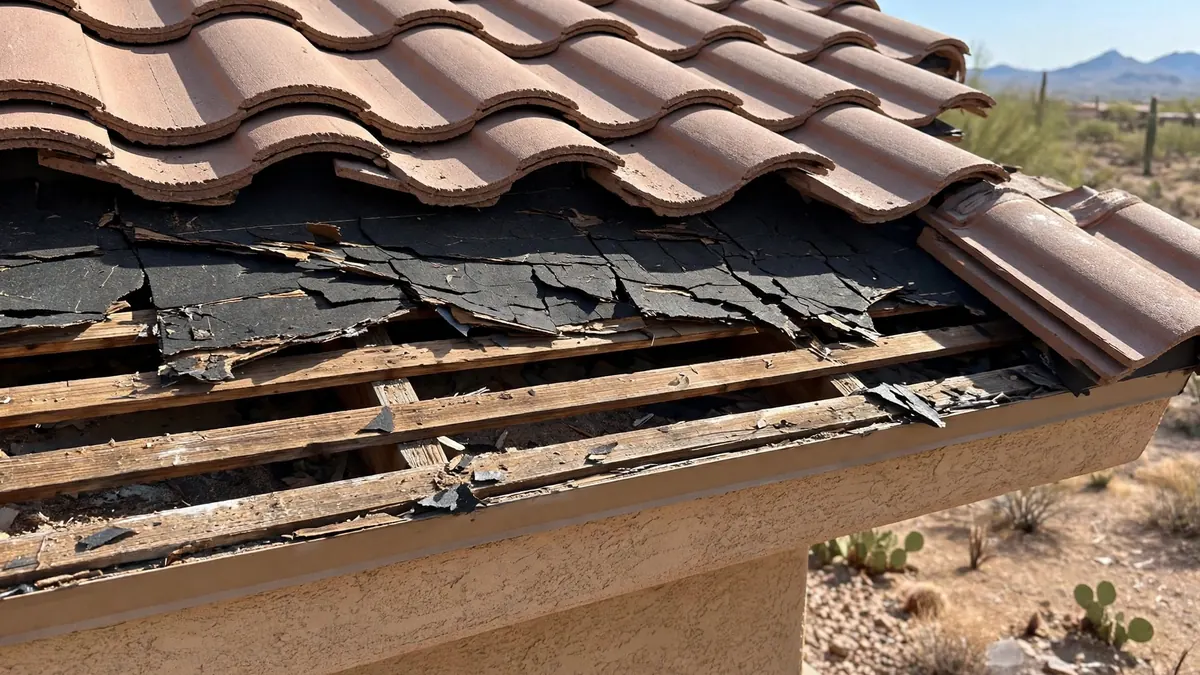
| Concrete tile, pitched | Cracked or slipped tiles, worn underlayment beneath them, valleys, and wind-driven rain pushed sideways under the tile | Drip or stain that can be several feet from the actual entry point, often near an exterior wall |
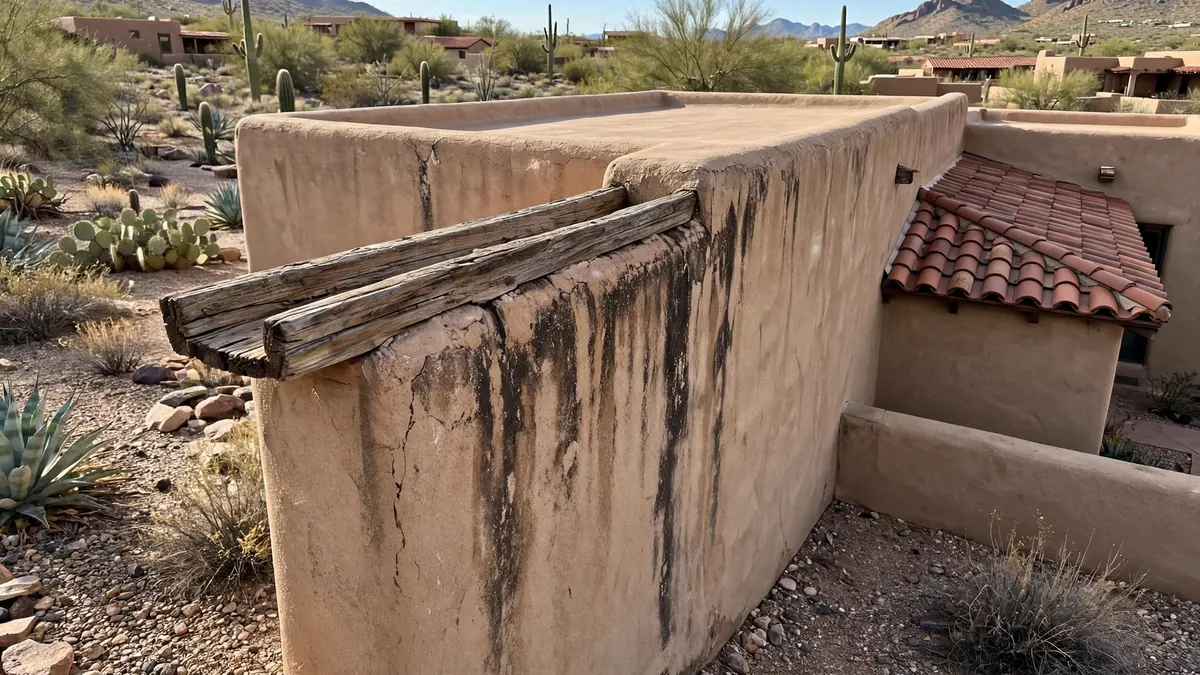
| Flat or low slope | Ponding water finding a crack in the coating, seams, and clogged scuppers backing up | Leak close to below the pond, often near the parapet wall or a corner |
| Evaporative cooler on the roof | The roof jack, the duct opening, and the curb around the cooler | Water around the cooler vent or in the hallway where the cooler drops in |
| Vents, pipes, and skylights | Cracked rubber boots, dried-out sealant, lifted flashing | Ring stain directly below or along the pipe path, sometimes in a bathroom |
| Wind-damaged areas | Tiles or shingles lifted by gusts and dust storms, debris punctures | A new leak in a spot that has never leaked before, starting during the wind |
Write down which room, how far from the walls, and when it started relative to the wind and the rain. A leak that begins during the gust front points to wind damage. One that starts only after heavy rain has pooled for twenty minutes points to drainage, ponding, or an old underlayment. That note helps the roofer, and it helps the adjuster understand whether the damage was sudden.
What should you check in the attic after the storm passes?
Check the attic once the storm is over and the lightning has moved off, ideally early the next morning before the summer heat builds up there. You are looking for how far the water spread, not trying to fix the roof.
Arizona attics in July and August get far hotter than the outdoor temperature, so keep the visit short, bring water, and do not go up alone. Step only on the joists or a walkway, never on the drywall between them. Watch for wiring, nails coming through the roof deck, and the air handler if your AC sits in the attic.
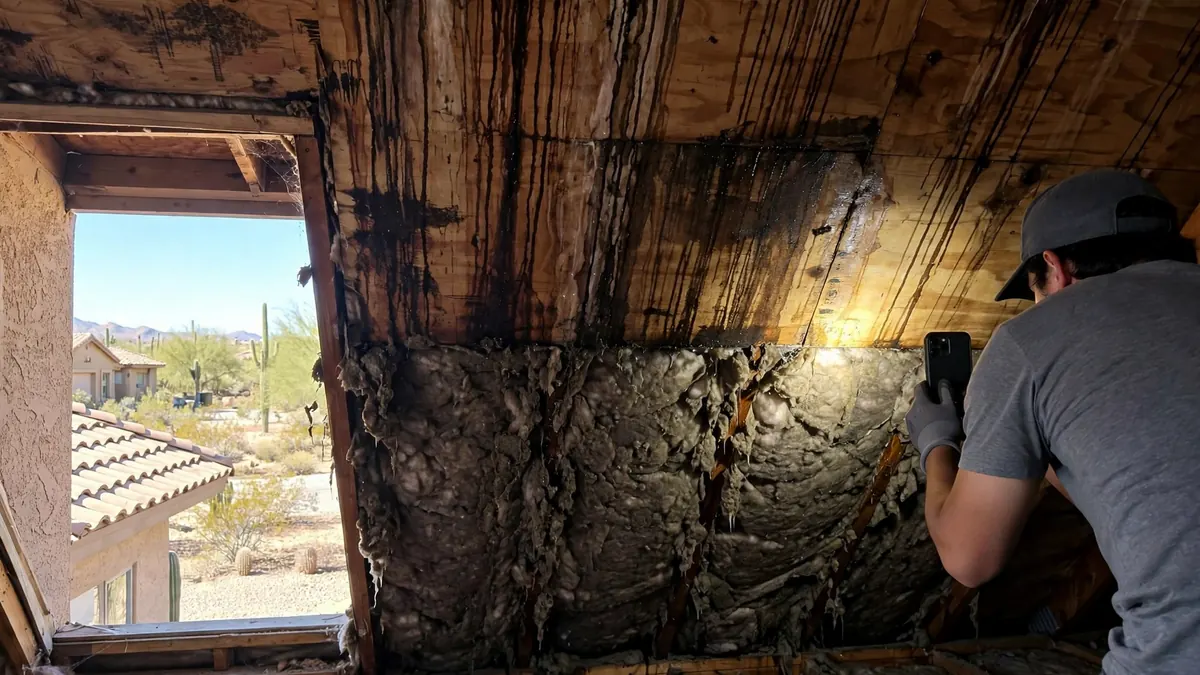
- Look at the underside of the roof deck with a strong flashlight. Dark, wet sheathing or streaks running down the wood show the path the water took.
- Find the wet insulation. Blown-in insulation that is matted down, darker in color, or clumped is soaked. Batts that sag or feel heavy are wet.
- Follow the trusses downhill. Water often runs along a truss chord before it drops, so the wet patch on the ceiling can be well down from the roof entry point.
- Check around the air handler and ducts. Water pooling in the AC drain pan or around a duct boot can mean roof water reached the system.
- Take photos of everything, including the wet insulation before anyone pulls it out.
Wet insulation rarely dries well where it sits. It compresses, holds water against the drywall below, and gives mold a place to start. A restoration crew typically removes and bags it, dries the framing and the back of the ceiling with air movers and dehumidifiers, and takes moisture readings until the wood is back to normal.
How do you document a monsoon roof leak for insurance?
Document the storm, the entry point, the interior damage, and every step you took to limit it. Most standard homeowners policies treat sudden storm damage differently from leaks caused by an old or poorly maintained roof, so your photos and notes are what show the adjuster which one this was.
- Time and date. Write down when the storm hit and when you first saw water. Your phone's photo timestamps back this up.
- Video of the active leak. Water dripping, the bucket filling, and the storm outside.
- Every affected room. Wide shots first, then close-ups of stains, the bulge, wet carpet, and damaged belongings.
- The roof from the ground. After the storm, photograph missing tiles, debris, or lifted flashing using your phone's zoom. You do not need to climb up.
- Steps you took. Policies generally expect you to take reasonable steps to prevent further damage. Photos of buckets, moved furniture, and the tarp show you did.
- Receipts. Tarp work, buckets, plastic sheeting, fans, and any emergency service invoices.
- Damaged items. Keep them until the adjuster has seen them or tells you otherwise, and list them as you go.
Check your declarations page for your deductible, since some policies carry a separate wind or hail deductible, and report the loss to your insurer soon after the storm. The restoration crew's moisture readings and drying logs become part of the file too. For how policies usually split storm, flood, and wear-and-tear damage, see the guide on whether homeowners insurance covers water damage in Arizona. Coverage always depends on your specific policy and the adjuster's findings.
Do you call a roofer or a restoration crew first?
If water is already inside, start with the restoration side, because the damage to your ceiling, insulation, and floors keeps growing until it is dried. The roofer makes the permanent repair, usually after the weather clears. Most monsoon leaks need both, and they do different jobs.
| Task | Restoration crew | Roofer |
|---|---|---|
| Emergency tarp to stop more water | Often, as part of the mitigation | Often, sometimes as part of the repair |
| Draining and removing a sagging ceiling | Yes | No |
| Removing wet insulation | Yes | No |
| Drying attic framing, walls, and floors | Yes, with readings logged daily | No |
| Finding the exact roof entry point | Helps with thermal imaging from inside | Yes, from the roof |
| Replacing tiles, underlayment, or coating | No | Yes |
| Rebuilding drywall and insulation | Many companies handle this after drying | No |
After a widespread monsoon night, roofers across Casa Grande, Maricopa, and San Tan Valley are often booked for a while. The interior drying does not need to wait for the roof repair as long as the roof is covered.
What mistakes make a monsoon roof leak worse?
The costly mistakes are usually waiting, guessing, or covering up. Each one turns a contained leak into a bigger repair or a harder claim.
- Waiting for the next storm to see if it leaks again. Monsoon cells can come through several days in a row. Each one adds water to insulation that never dried.
- Assuming the ceiling will dry by itself. The surface may look dry in a day or two in our dry air, while the insulation and framing above stay wet. Moisture readings tell the real story.
- Painting over the stain. A fresh coat of paint hides the evidence your adjuster needs and can trap moisture in the drywall.
- Ignoring a musty smell a week later. That usually means something above the ceiling is still wet.
What should you do right now?
Make the room safe, catch the water, and write down what happened. Then get the roof covered and the inside checked with a moisture meter.
- Turn off power to any wet fixture from a dry spot.
- Bucket under the drip, towels around it, belongings moved.
- Relieve a small bubble at its lowest point, or close off a room with a large sag.
- Take video and photos with the storm still going.
- Stay off the roof. Check the attic after the storm passes, in the cooler morning hours.
- Arrange tarping, then the roof repair, and have the attic, ceiling, and walls dried and measured.
- Report the claim and keep every receipt.
If the water is coming in faster than your buckets can handle, a ceiling is sagging, or the storm left insulation soaked across the attic, call (520) 380-1551. The line is open 24/7 and connects you with a local restoration crew serving Casa Grande and nearby Pinal County towns.
Questions homeowners ask
Should I poke a hole in a bulging ceiling?
Can I tarp my own roof after a monsoon?
Why is my roof leaking in a room far from where the damage is?
Will insurance cover a roof leak from a monsoon?
Do I need to replace wet attic insulation?
More from the blog
 Monsoon & RoofMonsoon flooding in Casa Grande: why homes flood and how to clean upCasa Grande homes flood in monsoon storms because hard, dry ground sheds heavy rain instead of absorbing it, and flat terrain sends runoff toward low lots,...
 Monsoon & RoofFlat roof leaks and clogged scuppers in ArizonaFlat roofs in Arizona usually leak because water cannot get off them. Scuppers and canales clog with dust and debris, water ponds against the parapet, and...
 Monsoon & RoofTile roof leaks: why Arizona tile roofs leak under the tileArizona tile roofs usually leak under the tile, not through it. The tiles shed most of the water, but the underlayment beneath them is the real...
Need help with damage right now?
Speak to a local restoration specialist on the 24/7 line, any time of day.
Call (520) 380-1551When you call: enter your ZIP code, then press 1 for water damage, 2 for fire damage or 4 for sewage backup.