Home › Blog › Flat roof leaks and clogged scuppers in Arizona
Flat roof leaks and clogged scuppers in Arizona
Flat roofs in Arizona usually leak because water cannot get off them. Scuppers and canales clog with dust and debris, water ponds against the parapet, and it finds cracks in a coating the sun has worn down. Rooftop coolers and AC curbs add more weak points. See roof leak water damage.
In this article
- Why do flat roofs leak in Arizona?
- How does water get off a flat roof?
- What is ponding water and when is it a problem?
- How do clogged scuppers cause leaks?
- Why do roof coatings crack in the Arizona sun?
- How do rooftop coolers and AC units cause flat roof leaks?
- What does flat roof leak damage look like inside?
- How do you keep a flat roof from leaking?
- Questions homeowners ask
Why do flat roofs leak in Arizona?
Flat roofs leak here for two connected reasons. The sun breaks down the coating or membrane over the years, and during monsoon storms the roof has to shed a lot of water in a short time through a few small openings. When those openings clog, water sits on the weakest part of the roof until it finds a way in.
Flat and low-slope roofs are common in Casa Grande on older block homes, Santa Fe and Pueblo style houses, patio covers, and room additions. They work well in a dry climate as long as the waterproof surface and the drainage path stay in good shape.
A flat roof has a gentle slope that moves water toward the edges or drains. Parapet walls hold the water in, so if an opening is blocked, the roof turns into a shallow tray.
How does water get off a flat roof?
Water leaves a flat roof through scuppers, canales, or interior drains, sometimes with a downspout below. Small raised ridges called crickets steer water around obstacles and toward those openings.
- Scuppers. Rectangular openings through the parapet wall at roof level. Water runs through them and drops off the side of the house.
- Canales. The long open channels that stick out from the parapet on Pueblo and Santa Fe style homes, carrying water away from the stucco. They are a type of scupper and often the most visible part of the roof.
- Conductor heads and downspouts. A metal box under the scupper that catches the water and feeds a downspout to the ground.
- Roof drains. Openings in the middle of the roof with a strainer on top, piped down through the building. More common on commercial roofs than on homes.
- Crickets and saddles. Small sloped ridges behind chimneys, cooler curbs, and along parapets that keep water from settling in corners.
A flat roof might have only a few scuppers for the whole surface, so one clog can back up water across a large part of it.
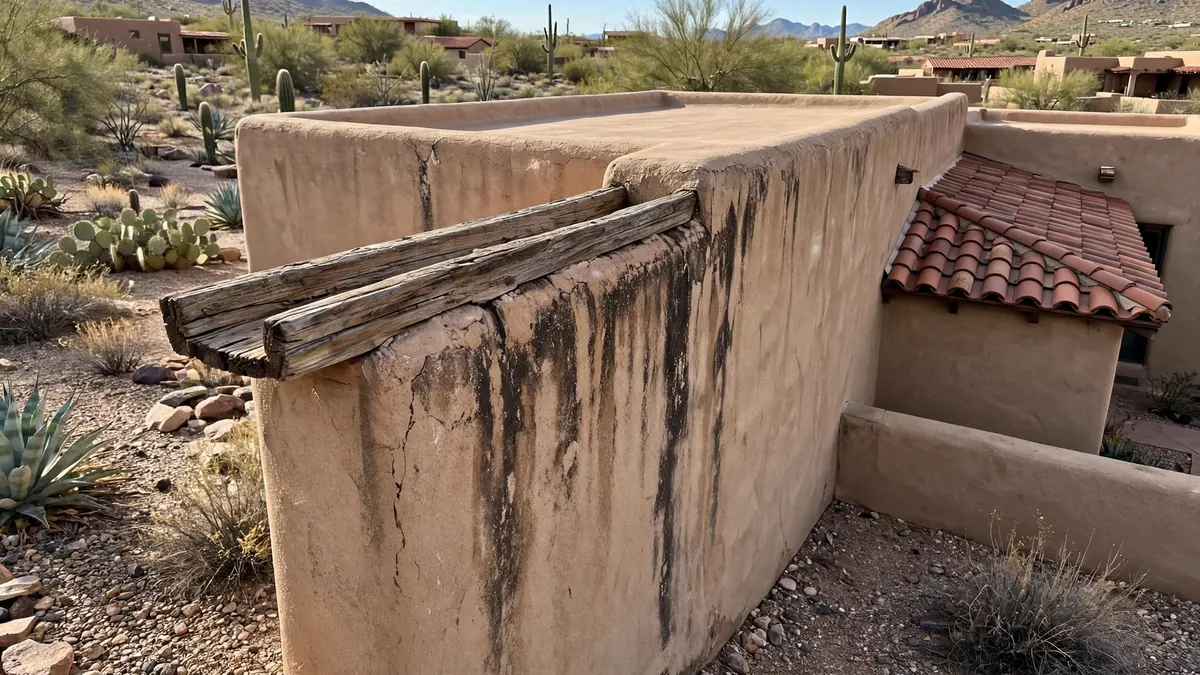
What is ponding water and when is it a problem?
Ponding is water that sits on a flat roof after the rain stops instead of draining away. Many roofers treat water still standing about two days after a storm as ponding. A few small puddles that dry out the same day are normal. Wide, deep, or long-lasting ponds are a sign the slope, the drains, or the roof structure has a problem.
Standing water wears the coating faster, its weight can make framing sag into a deeper low spot, and any crack under a pond has water on it for hours instead of minutes.
You can often see the evidence without climbing up. After a storm, look from a second-story window, a neighbor's yard, or a ladder at the eave for:
- Rings of dried dirt on the roof surface where water stood and evaporated.
- Dark, stained patches near the parapet walls and corners.
- Coating that looks blistered, cracked, or peeling in the same area as the stains.
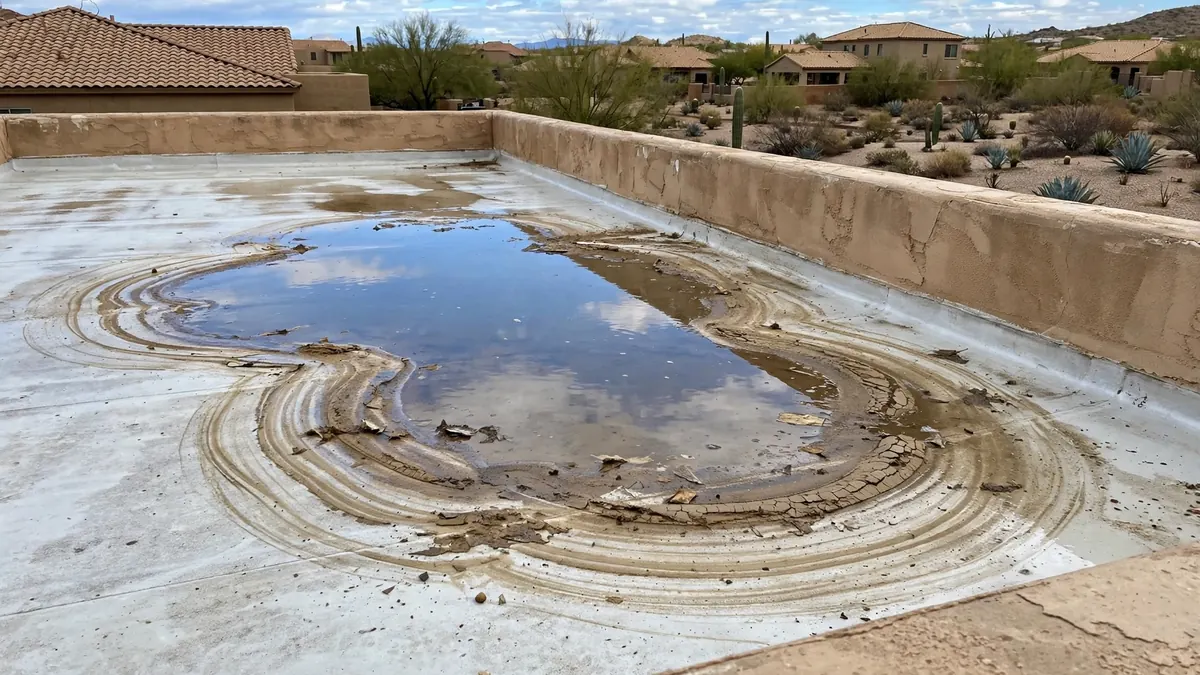
How do clogged scuppers cause leaks?
A clogged scupper backs water up against the parapet, the corner where the roof membrane turns up the wall. That joint is one of the easiest places for water to get in, and when the water level rises above the flashing, it runs down inside the wall or onto the ceiling.
Scuppers clog easily in this part of Arizona. Dust storms that come ahead of the monsoon rain blow dirt, tumbleweeds, palm fronds, leaves, and trash onto the roof and into the openings right before the water arrives. Birds nest in canales, and scale builds up at outlets.
How to check scuppers from the ground
- Watch during a storm. From a safe, covered spot, see whether each scupper is pouring water. One that stays dry while the others run is probably blocked.
- Look at the stucco below each scupper. White mineral streaks, dark stains, or peeling paint on the wall below an outlet mean water has been running down the wall instead of off it.
- Check the conductor heads. If water overflows the box instead of going down the downspout, the box or the spout is clogged.
- Look for debris piles. Leaves or dirt sticking out of a scupper opening, or a canale full of dirt, can often be seen with binoculars.
If the roof needs clearing, it is a job for dry weather and a ladder set up properly, or for a roofer. Do not climb onto a flat roof during or right after a storm, and avoid walking on it in summer heat, when the surface can burn you and soft coatings mark easily.
Why do roof coatings crack in the Arizona sun?
Roof coatings and membranes wear out because ultraviolet light and heat break them down, and the roof surface expands in the afternoon heat and shrinks overnight, every day for years. Over time the coating gets thin, chalky, and brittle, and hairline cracks open up, especially at seams and corners.
| Roof type | How it usually fails here | What to look for |
|---|---|---|
| Spray foam with a coating | Coating wears thin and exposes the foam, which breaks down in sunlight | Chalky or worn coating, yellow or brown foam showing, small holes from birds |
| Elastomeric or acrylic coating over another roof | Thins and cracks with age, peels where it never bonded well | Hairline cracks, peeling sheets, bare spots near ponding areas |
| Built-up roof with gravel | Gravel shifts away and exposes the layers, seams dry out | Bare patches without gravel, blisters, cracks at the edge flashing |
| Modified bitumen or rolled roofing | Seams separate and the surface cracks and blisters in the heat | Lifted seams, blisters, cracked or curled edges |
| Single-ply membrane | Seams and flashing details at walls and curbs pull loose | Open seams, loose flashing at parapets and equipment |
Coatings are designed to be maintained and recoated on a schedule. How often depends on the product and how thick it was applied, so ask the roofer who installed it, and keep the paperwork. A coating that has gone chalky or shows cracks is due before the next monsoon, not after.
How do rooftop coolers and AC units cause flat roof leaks?
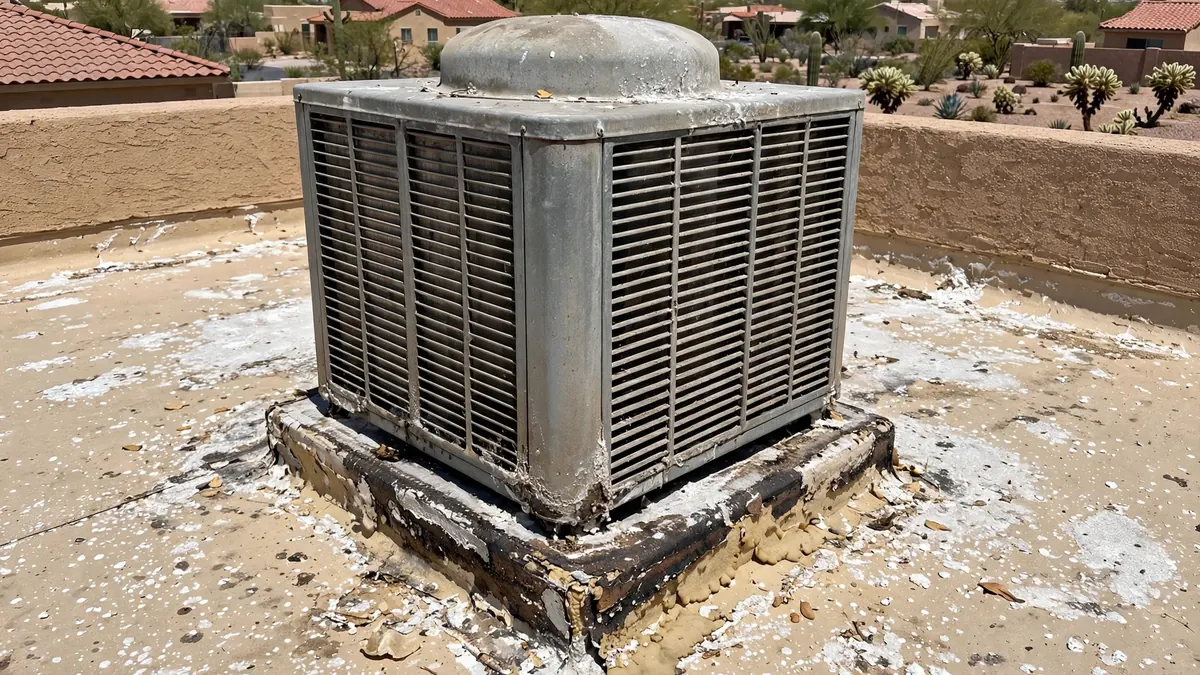
Every piece of equipment on a flat roof sits on a curb or stand that has to be sealed into the roof, and those seals are under constant stress from heat, vibration, and service visits. Evaporative coolers add water to the mix every day of the cooling season.
- Cooler pans and float valves. A rusted pan or a float valve stuck open can spill water onto the roof for weeks, and that water often runs toward the duct opening.
- The roof jack. The sheet metal transition where the cooler duct passes through the roof is a common leak point when its sealant dries out.
- Bleed-off lines. Coolers dump a little water to control mineral buildup. If the line drains onto the roof instead of to a proper outlet, it keeps one spot wet and leaves white scale.
- Foot traffic. Service visits wear paths through the coating and can puncture soft foam.
A cooler leak tends to show up on a dry, sunny day, which is a useful clue. If you have a ceiling stain near the cooler vent and it grows with no rain, the cooler is the likely source. The page on evaporative cooler leaks covers that damage in more detail.
What does flat roof leak damage look like inside?
Flat roof leaks usually show up along exterior walls, in corners, and near cooler vents, because that is where water collects on the roof. The damage spreads differently from a pitched roof, because many flat roofs have little or no attic space above the ceiling.
On a pitched tile roof, there is an attic where water can drip onto insulation and be seen with a flashlight. On many flat roofs, the ceiling drywall is attached directly to the roof joists, with insulation packed into the narrow spaces between them. Water that gets through the roof runs along the joist bays and soaks insulation you cannot reach without opening the ceiling.
- Stains along the top of exterior walls often mean a parapet or scupper flashing leak running down inside the wall.
- A long, narrow stain running in one direction usually follows a joist bay.
- Bubbling paint or soft drywall at the top of a wall below a scupper points to the scupper itself.
- A musty smell in one room after the monsoon ends can mean the insulation above the ceiling is still wet.
Drying a flat roof ceiling usually means opening small sections or drilling access holes so air can move through the joist bays, removing soaked insulation, and taking moisture readings in the framing until it is back to normal levels. A local restoration crew handles that interior drying, and the site's page on ceiling water damage describes the repair afterward. The roof repair itself belongs to a roofer.
Insurance generally treats a roof leak caused by a sudden event, like wind tearing the membrane, differently from one blamed on a worn-out coating or a scupper that was never cleared. Keep coating invoices and photos of your maintenance, and check your policy for how it handles wear and tear.
How do you keep a flat roof from leaking?
Keep the drainage open and the surface in good shape. Most flat roof leaks come from a missed cleaning or a coating that went too long without attention.
| When | What to do |
|---|---|
| Spring, before June | Have the roof inspected, scuppers and canales cleared, cracks and seams sealed, and the coating checked for recoating |
| After each big dust storm | Check scuppers and canales from the ground for debris, and have them cleared before the next rain if blocked |
| After monsoon storms | Look for ponding rings, new stains on stucco below scuppers, and any ceiling spots inside |
| Through the cooling season | Have the cooler pan, float valve, and bleed-off line checked, and the roof jack sealant looked at |
| Fall, after the monsoon ends | Walk through the house for musty smells or stains that appeared during the season, and schedule repairs while the weather is mild |
If a stain on your ceiling keeps growing, the drywall feels soft, or water is coming through near the cooler or a corner, call (520) 380-1551. The line is open 24/7 and connects you with a local restoration crew in Casa Grande and nearby Pinal County towns to dry out the inside while your roofer handles the roof.
Questions homeowners ask
What is a scupper on a flat roof?
Is some standing water on a flat roof normal?
How often does a flat roof coating need to be redone?
Can an evaporative cooler cause a roof leak?
More from the blog
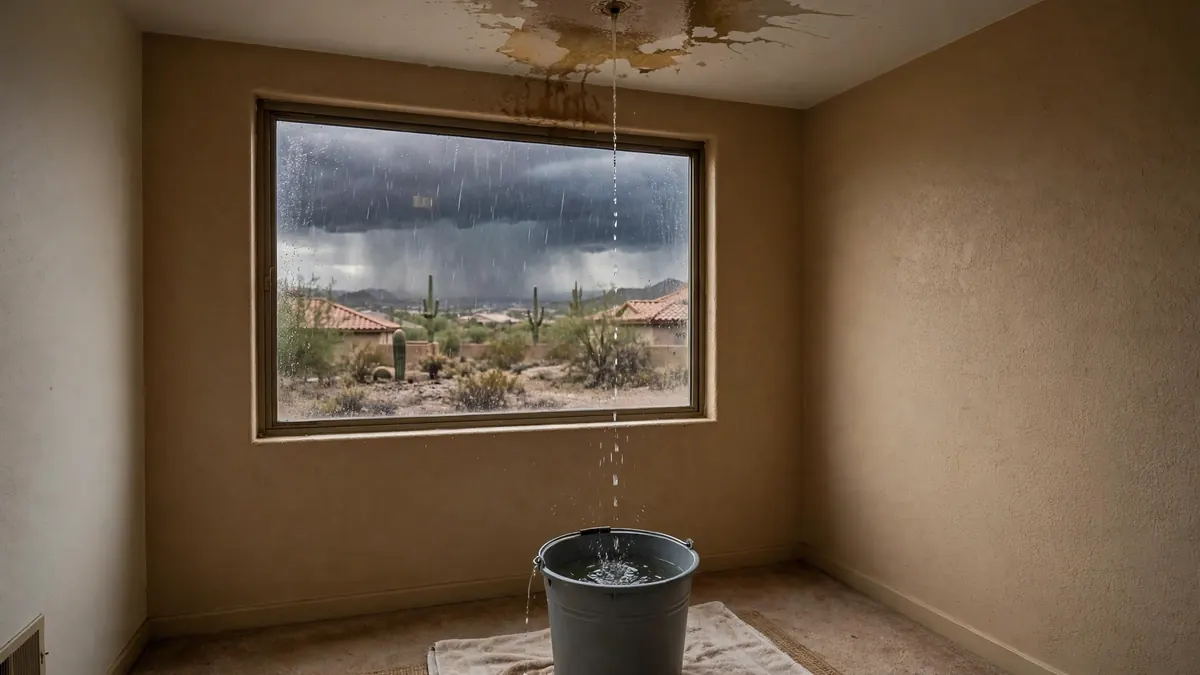 Monsoon & RoofRoof leaking during a monsoon: what to do right nowWhen your roof leaks during a monsoon, stay off the roof, cut power to any wet light fixture, catch the drip in a bucket, move belongings,...
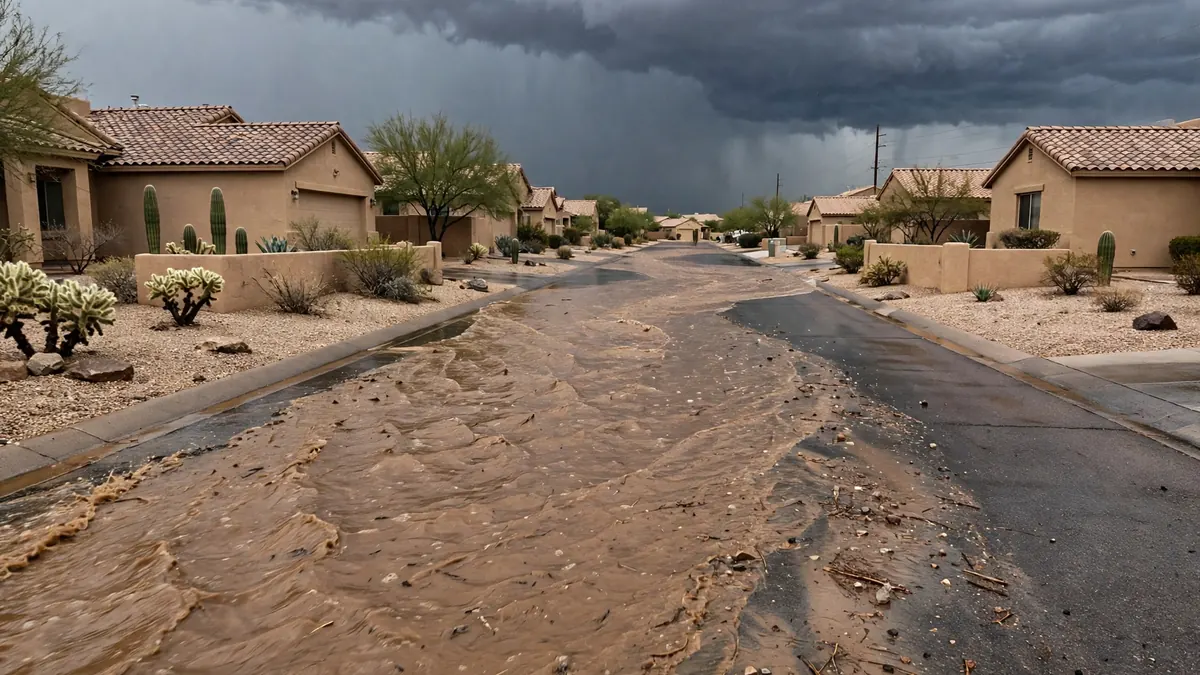 Monsoon & RoofMonsoon flooding in Casa Grande: why homes flood and how to clean upCasa Grande homes flood in monsoon storms because hard, dry ground sheds heavy rain instead of absorbing it, and flat terrain sends runoff toward low lots,...
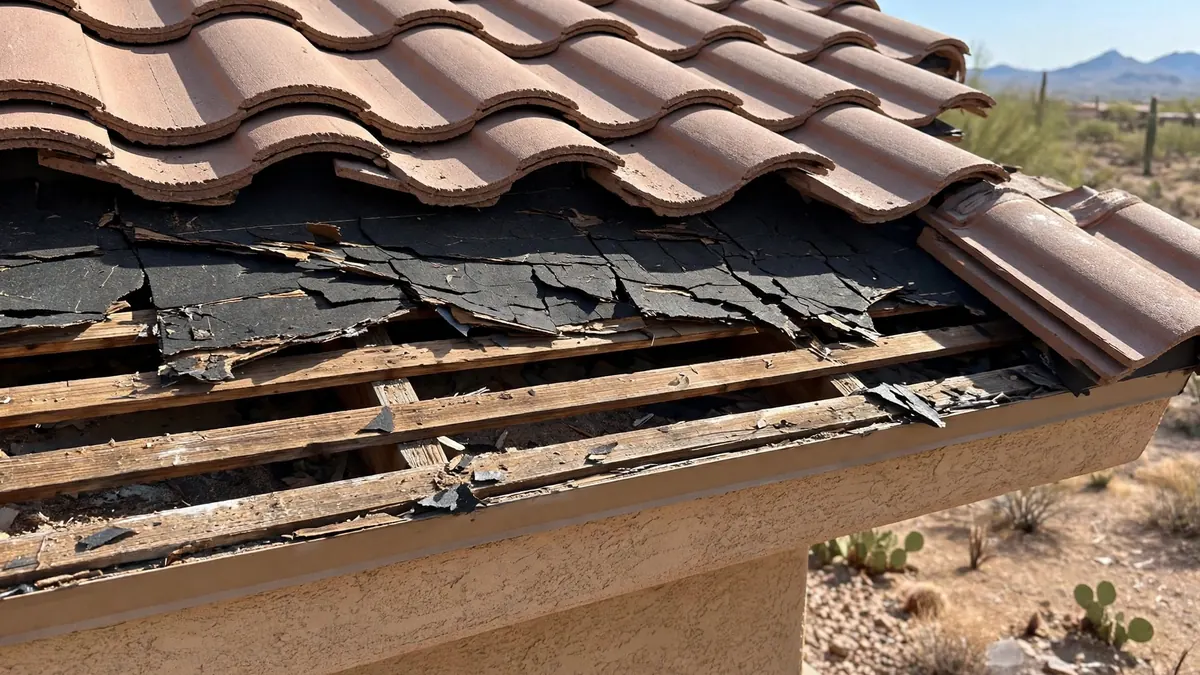 Monsoon & RoofTile roof leaks: why Arizona tile roofs leak under the tileArizona tile roofs usually leak under the tile, not through it. The tiles shed most of the water, but the underlayment beneath them is the real...
Need help with damage right now?
Speak to a local restoration specialist on the 24/7 line, any time of day.
Call (520) 380-1551When you call: enter your ZIP code, then press 1 for water damage, 2 for fire damage or 4 for sewage backup.