Home › Blog › Monsoon flooding in Casa Grande: why homes flood and how to clean up
Monsoon flooding in Casa Grande: why homes flood and how to clean up
Casa Grande homes flood in monsoon storms because hard, dry ground sheds heavy rain instead of absorbing it, and flat terrain sends runoff toward low lots, doors, and garages. Cleanup means treating the water as contaminated, removing mud and soaked porous materials, disinfecting, and drying to measured readings. See monsoon flood cleanup.
In this article
- Why do homes in Casa Grande flood during monsoon storms?
- Which homes and lots are most likely to flood?
- How does storm water get inside a slab home?
- What should you do while the water is coming in?
- Is monsoon flood water contaminated?
- How do you clean up mud and silt after a monsoon flood?
- What has to be thrown out and what can be saved?
- How do you dry the house once the water is out?
- How do you keep your home from flooding next monsoon season?
- What should you do right now if your home just flooded?
- Questions homeowners ask
Why do homes in Casa Grande flood during monsoon storms?
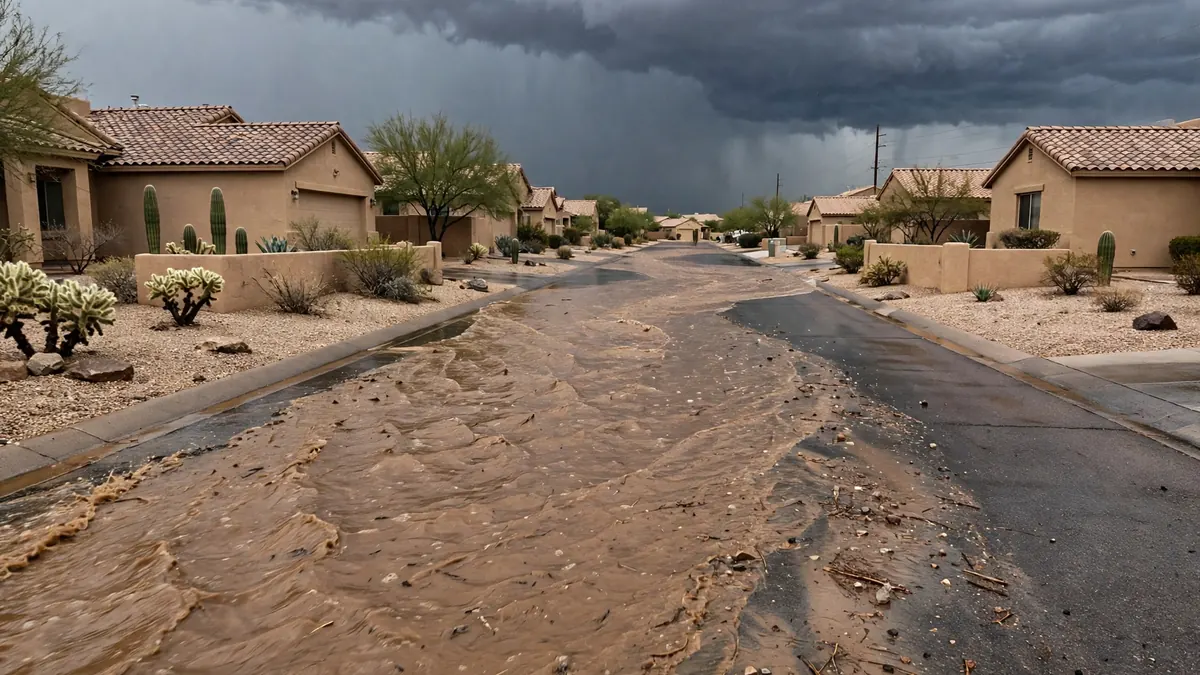
Homes flood here because a lot of rain falls in a short time on ground that cannot take it in. Desert soil and caliche that have baked since spring shed water like pavement, the land around Casa Grande is very flat, and neighborhood drainage is built for normal storms, not the worst twenty minutes of a strong cell.
Most of the year, rain is not a concern. Then monsoon season arrives, roughly mid-June to the end of September, and storms build over the mountains, collapse, and dump heavy rain on one part of town while the next neighborhood stays dry. That pattern explains a lot of what homeowners see:
- Intensity, not total rainfall. A short burst does more damage than a slow, steady rain of the same amount, because the water arrives faster than it can drain away.
- Hard ground. Dry desert soil and the caliche layer underneath it absorb very little at first. Most of the rain becomes runoff.
- Flat terrain. On flat ground, water does not drain off in one direction. It spreads out, pools in low spots, and follows whatever slight slope it finds, including your driveway and patio.
- Hardscape everywhere. Roofs, driveways, patios, block walls, and gravel yards over weed barrier all add to the runoff.
- Debris. The dust storm that often comes ahead of the rain fills scuppers, yard drains, and street gutters with dirt and tumbleweeds just before the water needs them.
Which homes and lots are most likely to flood?
The homes that flood most often are the ones that sit lower than the ground or street around them, or that have a yard sloping toward the house. Location near a wash or drainage channel matters, but lot grading is usually the bigger factor for an individual home.
- Lots below street level. If the street or the neighbor's yard is higher than your slab, storm water flows toward you.
- Homes near dry washes and drainage channels. Washes that sit empty for months can run hard within minutes and spill over into nearby lots and streets.
- End-of-street and cul-de-sac lots. Street flow collects at the low end, and if the storm drain or basin backs up, the water climbs the driveway.
- Older neighborhoods with flood irrigation. Some older Casa Grande properties take irrigation water into bermed yards. A storm on top of an irrigation turn, or a broken berm, can push water against the stem wall.
- Homes next to retention basins. Many subdivisions, from Villago to Cottonwood Ranch, route storm water into retention areas. Most of the time they work. When an inlet clogs or a basin fills, the lots beside it catch the overflow.
- Rural lots. Homes outside town toward Arizona City, Eloy, and Stanfield can get sheet flow across open desert or farm fields with no curb or gutter to direct it.
If you want to know your official flood zone, the FEMA flood map and the Pinal County flood control district are the places to check. A home outside a mapped flood zone can still take water from runoff, which is how most monsoon floods in town happen.
How does storm water get inside a slab home?
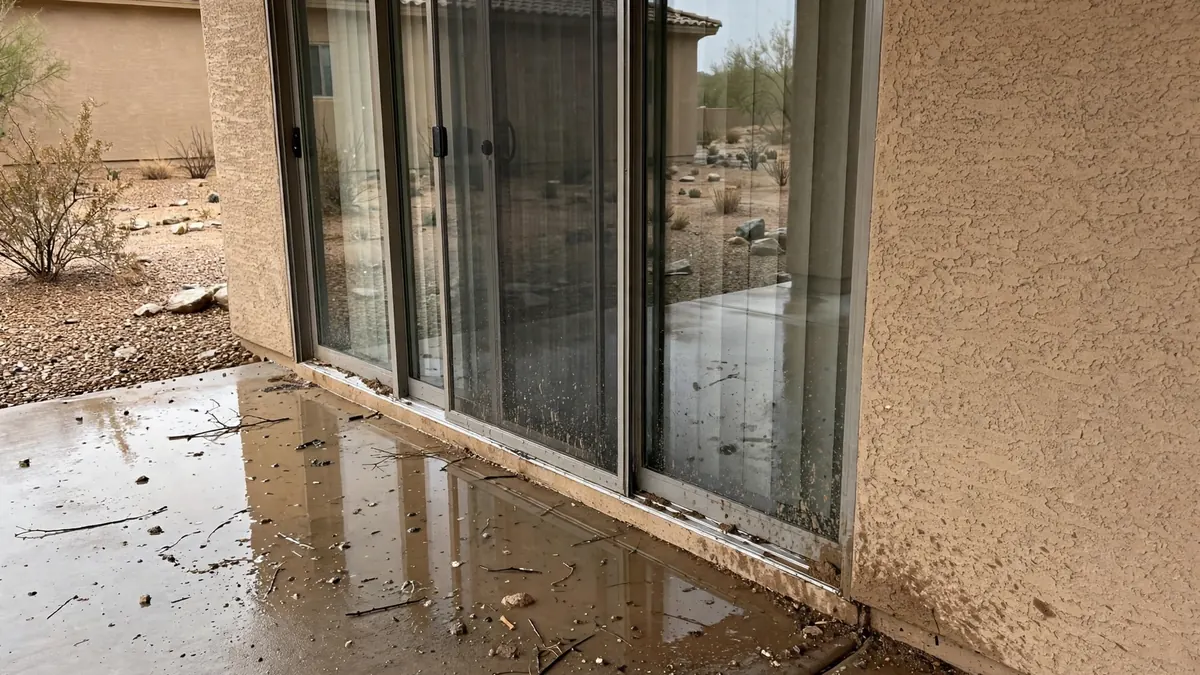
In a home with no basement, water comes in at ground level through the lowest openings: door thresholds, sliding door tracks, the garage door, and gaps where the stucco meets the slab. Knowing your entry points tells you where to put sandbags and towels next time, and where to look for hidden water now.
| Entry point | Why water gets in | Where it shows up inside |
|---|---|---|
| Garage door | Garage slabs sit lower than the house, and the bottom seal wears out or does not reach a cracked floor | Garage floor, then under the door into the laundry room or hallway |
| Sliding glass doors | The track sits at patio level, and patio water rises above the track and its weep holes | Carpet or tile right inside the slider, often wicking into the baseboard |
| Front and back door thresholds | Worn sweeps and thresholds set close to patio or walkway height | Entry tile, then along the floor to adjacent rooms |
| Stem wall and weep screed | Water ponding against the house rises to the gap where stucco ends and the slab begins | Bottom of interior drywall on exterior walls, damp carpet tack strip |
| Utility penetrations | Gaps around hose bibs, AC lines, and cable entries near grade | Inside walls behind the laundry or water heater |
| Roof and scuppers | Flat roof drains clogged by dust storm debris, causing ponding and overflow | Ceilings and the tops of walls rather than the floor |
Water on the floor also travels under things you cannot see. It runs under tile through the grout lines, under baseboards and into the bottom of drywall, and along the slab under carpet pad. A puddle at the slider can mean wet tack strip ten feet into the room.
What should you do while the water is coming in?
Keep people safe, slow the water at the door, and protect what you can without standing in moving water. Most monsoon flooding inside a home is shallow and short, so a few minutes of the right steps limits the cleanup a great deal.
- Stay out of water near outlets and cords. If you can reach the breaker panel from a dry floor, turn off power to the flooded rooms.
- Block the low opening. Sandbags, rolled towels, or a water barrier at the threshold or slider track can stop a shallow flow. Put plastic sheeting under the bags if you have it.
- Lift what matters. Get electronics, papers, rugs, and anything in cardboard boxes off the floor, especially in the garage.
- Clear what you safely can. If a patio drain or scupper outlet is clogged and you can reach it from the ground without going into the storm, clearing it can drop the water level against the house.
- Do not drive through flooded streets or washes. Arizona has a law that can make drivers who go around barricades into flooded washes pay for their own rescue, and moving water a few inches deep can move a car.
- Record it. Video of water coming in under the door, and of the street or yard outside, shows how the water entered.
That last step matters more than it seems. Water that rose from the ground and flowed inside is often treated very differently by insurance than rain that came through a storm-damaged roof. The guide to Arizona homeowners insurance and water damage explains how most standard policies draw that line, and your declarations page tells you what your own policy says.
Is monsoon flood water contaminated?
Yes. Storm water that ran across yards, streets, and open desert before coming inside is treated as contaminated, the same category restoration crews use for sewage. It carries soil, fertilizer and pesticide from lawns, animal waste, oil from driveways and streets, and whatever was sitting in the yard.
Restoration crews sort water into three categories based on where it came from. Clean water from a broken supply line is Category 1. Gray water from a washing machine is Category 2. Outside flood water that crossed the ground is usually Category 3, which changes what can be kept:
- Carpet and pad soaked by outside flood water are generally removed, because the pad cannot be reliably cleaned.
- Drywall that wicked up flood water is usually cut out above the wet line rather than dried in place.
- Hard surfaces like tile, sealed concrete, and metal can be cleaned and disinfected.
- Your skin and lungs need protection too. Wear rubber boots and gloves, wash your hands well, and keep children and pets out of the area until it has been cleaned.
In rural areas, a flood that overwhelms a septic system or reaches a livestock pen makes the water worse. If you smell sewage or the water came up through a floor drain or toilet, treat it as a sewage problem from the start.
How do you clean up mud and silt after a monsoon flood?
Get the mud out while it is still wet, then clean and disinfect the surfaces, then dry. Desert silt is fine and heavy, and once it dries in place it sets into a hard film in grout lines, door tracks, and the bottom of walls that is much harder to remove.
- Photograph before you clean. Wide shots of each room, the water line on the walls, and the mud on the floor.
- Put on protection. Rubber boots, heavy gloves, eye protection, and an N95 mask once the mud starts drying into dust.
- Shovel and squeegee the bulk out. Push wet mud toward the door with a flat shovel and a floor squeegee. A wet vac handles what is left on hard floors.
- Pull out wet porous items. Rugs, cardboard, upholstered furniture, and soaked bedding go outside to the driveway, photographed and listed.
- Wash hard surfaces from the top down. Clean walls and cabinet faces first, then the floor, using a detergent solution and stiff brushes. Rinse with clean water.
- Disinfect. Follow the product label for a household disinfectant on every surface the water touched. Never mix cleaning chemicals, especially bleach with ammonia.
- Clean the tracks and thresholds. Slider tracks, door weather stripping, and the garage door seal hold silt that keeps the doors from sealing next storm.
- Do not hose mud into the yard drain or street inlet. It clogs the very drains that protect you in the next storm.
Silt that dries inside wall cavities and under baseboards can keep a wall damp and smelling musty for weeks. If water reached the drywall, the baseboards usually need to come off so the wall behind them can be cleaned and dried.

What has to be thrown out and what can be saved?
Anything porous that soaked in outside flood water is usually discarded. Hard, non-porous items can usually be cleaned. Items in between depend on how long they sat wet and how much they are worth to you.
| Item | Usually | Why |
|---|---|---|
| Carpet pad | Discard | Absorbs contaminated water and cannot be sanitized |
| Wall-to-wall carpet | Usually discard after Category 3 water | Contamination soaks into the backing |
| Drywall below the wet line, plus a margin | Cut out and replace | Paper facing and gypsum hold contaminants and grow mold |
| Wall insulation that got wet | Discard | Stays wet and holds contamination |
| Tile, sealed concrete, stone | Clean and disinfect | Non-porous surface, though grout may need extra cleaning |
| Solid wood furniture | Often cleanable | Clean, disinfect, and dry slowly out of direct sun |
| Upholstered furniture and mattresses | Usually discard | Foam and fabric absorb contamination |
| Particleboard cabinets and furniture | Often discard if swollen | Swells and loses strength once soaked |
| Food, cosmetics, medicine touched by water | Discard | Packaging does not keep out flood water reliably |
| Photos and important papers | Rinse gently and air dry flat | Can often be recovered if handled soon |
Before anything goes to the curb, photograph it, write it down with an approximate age, and keep a small cut sample of carpet for the adjuster if you plan to file a claim.
How do you dry the house once the water is out?
Drying a flooded slab home takes more than open windows and fans. The concrete slab, the bottom plates of the walls, and the drywall all hold water, and they need air movers, dehumidifiers, and moisture readings to get back to normal levels.
Monsoon season adds a twist. Outdoor air during storm season is far more humid than the dry air most of the year, so opening the house up can slow drying rather than help it. Keep the house closed and the AC running, and let dehumidifiers pull the moisture out of the materials.
- Baseboards come off on wet walls so air can reach the drywall and the bottom plate behind them.
- Flood cuts remove the drywall a short distance above the highest wet reading, which opens the cavity for drying and cleaning.
- Tile on the slab slows drying of the concrete under it. Crews check the slab and grout, not just the surface.
- Daily readings show when the wood and drywall are back to dry levels. Rebuilding before then traps moisture behind new materials.
The structural drying page goes through the equipment and the dry standard crews work toward. Most homes reach that standard in several days, and longer when the slab soaked for a while or material removal was needed.
How do you keep your home from flooding next monsoon season?
Most prevention comes down to grading, drainage, and seals: get the ground sloping away from the house, give roof and yard water a clear path to the street or basin, and close the low openings. Do the work in spring, before the first storm.
- Check the grade. The soil and gravel next to the house should slope away from the walls. Landscaping rock piled up against the stucco over the years can bury the weep screed and direct water toward the slab.
- Clear scuppers, canales, and downspouts. Flat roofs depend on them, and one clog after a dust storm can put water on your ceiling.
- Extend downspout and scupper outlets. Splash blocks or extensions that carry water a few feet from the wall help a great deal.
- Open the block wall drain holes. Many yards have small openings at the base of the back wall to let water out. They get blocked with rock and debris.
- Replace door sweeps and the garage door bottom seal. These are inexpensive parts that matter on low doorways.
- Keep sandbags or a water barrier ready for sliders and doors that have flooded before.
- Report clogged basin inlets. If an HOA retention basin or street drain near you clogs every summer, tell the HOA or the city before the season.
For a full pre-season list that also covers roofs, coolers, and trees, see the monsoon preparation guide.
What should you do right now if your home just flooded?
Make it safe, document it, get the mud and contaminated materials out, and start drying. The longer outside flood water sits on a slab and in drywall, the more has to be removed.
- Power off to wet rooms, from a dry spot.
- Photos and video of the water, the entry point, and every room.
- Boots, gloves, and a mask before touching mud or flood water.
- Wet mud out, porous items out, hard surfaces washed and disinfected.
- Baseboards and wet drywall checked, house closed up with the AC running.
- Moisture readings until everything is dry, then repairs.
If the water reached more than one room, soaked the drywall, or came in with mud and debris, call (520) 380-1551. The line is open 24/7 and connects you with a local restoration crew serving Casa Grande and nearby Pinal County towns.
Questions homeowners ask
Why does my yard flood during monsoon storms but not in winter rain?
Can I clean up monsoon flood water myself?
Is it safe to open the windows to dry the house after a monsoon?
My home is not in a flood zone. Can it still flood?
How soon does mold start after a monsoon flood?
More from the blog
 Monsoon & RoofRoof leaking during a monsoon: what to do right nowWhen your roof leaks during a monsoon, stay off the roof, cut power to any wet light fixture, catch the drip in a bucket, move belongings,...
 Monsoon & RoofFlat roof leaks and clogged scuppers in ArizonaFlat roofs in Arizona usually leak because water cannot get off them. Scuppers and canales clog with dust and debris, water ponds against the parapet, and...
 Monsoon & RoofTile roof leaks: why Arizona tile roofs leak under the tileArizona tile roofs usually leak under the tile, not through it. The tiles shed most of the water, but the underlayment beneath them is the real...
Need help with damage right now?
Speak to a local restoration specialist on the 24/7 line, any time of day.
Call (520) 380-1551When you call: enter your ZIP code, then press 1 for water damage, 2 for fire damage or 4 for sewage backup.