Home › Blog › Evaporative cooler leaks: the roof damage you don't see
Evaporative cooler leaks: the roof damage you don't see
A swamp cooler leak usually damages the roof in places you cannot see: the roof jack where the duct passes through the roof, the roofing under the stand, and the deck under the bleed-off line. The water runs along sheathing and rafters for weeks before staining a ceiling. See evaporative cooler leaks.
In this article
- Where does a swamp cooler leak damage the roof?
- Why does cooler water travel so far before you see it?
- Is it the cooler, the roof or a monsoon leak?
- How do you check the attic under a cooler safely?
- How does mineral scale make cooler leaks worse?
- What does winterizing a cooler protect?
- What about an old cooler you no longer use?
- What should you do once water is inside?
- Will homeowners insurance cover cooler leak damage?
- Questions homeowners ask
Where does a swamp cooler leak damage the roof?
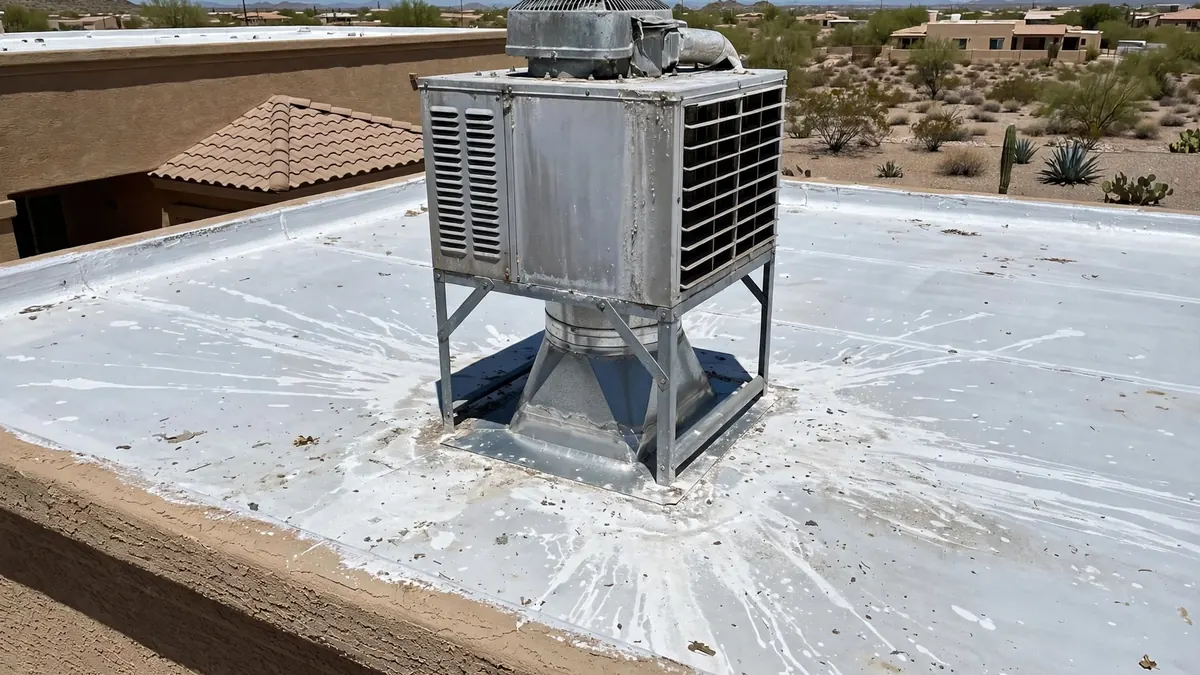
Most of the roof damage from an evaporative cooler happens in three places you cannot see from the yard: the roof jack where the duct passes through the roof, the roofing under and around the cooler stand, and the roof deck below the bleed-off line. Water that gets in at any of them runs along the sheathing and rafters before it ever stains a ceiling.
A down-draft cooler on a Casa Grande roof sits on a metal stand. Its air goes down through a short sheet-metal duct, called the roof jack, that passes through a cut opening in the roof deck and connects to the duct system in the attic. That opening is the largest hole in your roof, and it sits under a box that holds water every day of the cooling season.
- The roof jack. The flashing around the jack is sealed with mastic or roof cement. Years of sun, heat and the cooler's vibration crack that seal, and water from a dripping pan or a monsoon storm runs straight down the outside of the duct into the attic.
- The stand footprint. The legs of the stand press into the roofing. On a flat roof they can puncture or wear through the coating. On a pitched roof they lift or crack shingles and tiles. Water then reaches the underlayment and deck right under the unit.
- The bleed-off path. If the bleed-off line drains onto the roof, that spot stays wet for months and collects a white mineral crust. Constant water and scale break down roof coatings faster than sun alone.
The site's page on evaporative cooler leak water damage covers the pan, float valve and supply line failures inside the unit. This guide is about what happens to the roof and attic once that water escapes.
Why does cooler water travel so far before you see it?
Because the water enters at the top of the structure and has a long, hidden path down. It follows the roof deck to a rafter, runs along the rafter or the outside of the duct, soaks into insulation, and only drips onto the drywall when the insulation is saturated.
A cooler leak is usually slow and steady, a few drops a minute for the whole day while the unit runs. That kind of leak is worse for the structure than one heavy storm. The roof deck never dries out between events, the insulation never has a chance to give up water, and the wood stays damp in a dark, warm attic. By the time a ring shows on the ceiling, the sheathing above it may have been wet for weeks.
The water also follows the ductwork. The duct that carries cool air from the roof jack to your ceiling registers can carry water too. A brown ring around a supply register, or water dripping from the register itself, often points to the cooler rather than the roof.
Is it the cooler, the roof or a monsoon leak?
Look at when the stain grows. A stain that spreads on dry, sunny days while the cooler runs points to the cooler. One that appears only after storms points to the roof. Since cooler season overlaps with monsoon season, many people blame a storm for a leak the cooler caused.
| What you notice | Most likely source | Who fixes the source |
|---|---|---|
| Stain grows on dry days with the cooler on | Pan, float valve, overflow or supply line | Cooler service or HVAC technician |
| Stain or drip around a ceiling register | Water running down the duct from the roof jack | Cooler technician, then roofer for the flashing |
| Stain appears only after rain | Roof jack flashing or roofing around the stand | Roofer |
| Stain in winter with the cooler off | Open or uncovered roof jack, cracked flashing, or the roof itself | Roofer, plus a proper winter cover |
| White crust and soft roofing near the unit | Bleed-off line draining onto the roof | Cooler technician to reroute, roofer to repair |
| Rust streaks down stucco under a wall unit | Rusted pan or overflow on a wall-mounted cooler | Cooler technician |
One simple test: on a dry day, turn the cooler off and close its water supply for two or three days. If the stain stops growing and the area feels drier, the cooler is your source.
How do you check the attic under a cooler safely?
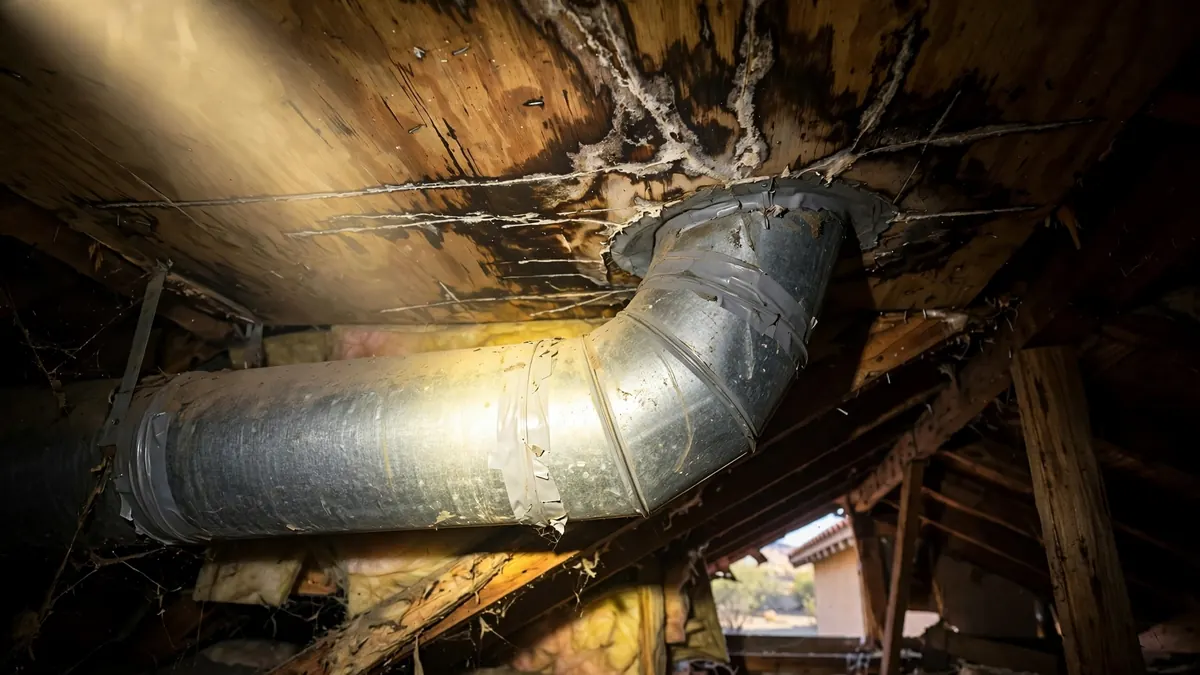
Check in the early morning, step only on the framing, and look at the underside of the roof deck around the duct with a strong flashlight. Do not go up in the afternoon in summer, and do not walk on a flat roof that feels soft.
- Go early. Arizona attics get dangerously hot by late morning in summer. Bring water and tell someone you are up there.
- Turn off the cooler. Shut off power to the unit and close the supply valve.
- Step only on joists or a walkway. Drywall will not hold you, and a wet ceiling holds you even less.
- Find the duct. Follow the large duct up to where it meets the roof. Look at the wood around it.
- Look for the signs: dark or stained sheathing, white mineral lines on the wood, rust on duct seams, matted or crusted insulation, or a damp, musty smell.
- Press the insulation gently under the stained area. Wet insulation feels heavy and cold.
- Take photos of everything before anything is moved or removed.
If the ceiling below is sagging, stay out of the attic over that spot and keep people out of the room. Pooled water can bring the drywall down.
How does mineral scale make cooler leaks worse?
Hard water is the main reason coolers in Casa Grande fail, and the scale does not stay inside the unit. As water evaporates off the pads, the minerals it leaves behind build up in the pan, on the float valve and in every line that carries water out of the cooler.
- A float valve that will not seat. Crust on the valve keeps it from closing, and the pan overfills all day.
- A blocked overflow. When scale plugs the overflow tube, extra water spills over the pan edge onto the roof instead of going where it is supposed to.
- Scale on the roof itself. Water from the bleed-off or a dripping pan leaves a white crust on the roofing that holds moisture against it and breaks down coatings.
- Faster rust. Scale traps water against the metal pan and duct, so seams corrode sooner.
The bleed-off line exists to fight this by draining off a little mineral-heavy water. It only helps if it is connected and routed to a drain or safe spot away from the roof and foundation.
What does winterizing a cooler protect?
Winterizing protects the roof as much as the cooler. A drained, covered cooler cannot leak water, and a sealed roof jack keeps winter rain and your heated air from passing through the largest opening in the roof.
- Close the water supply at the valve and disconnect or drain the supply line.
- Drain the pan fully and clean out the mineral crust while it is easy to reach.
- Close the damper or install the cover for the roof jack opening so rain cannot run down the duct.
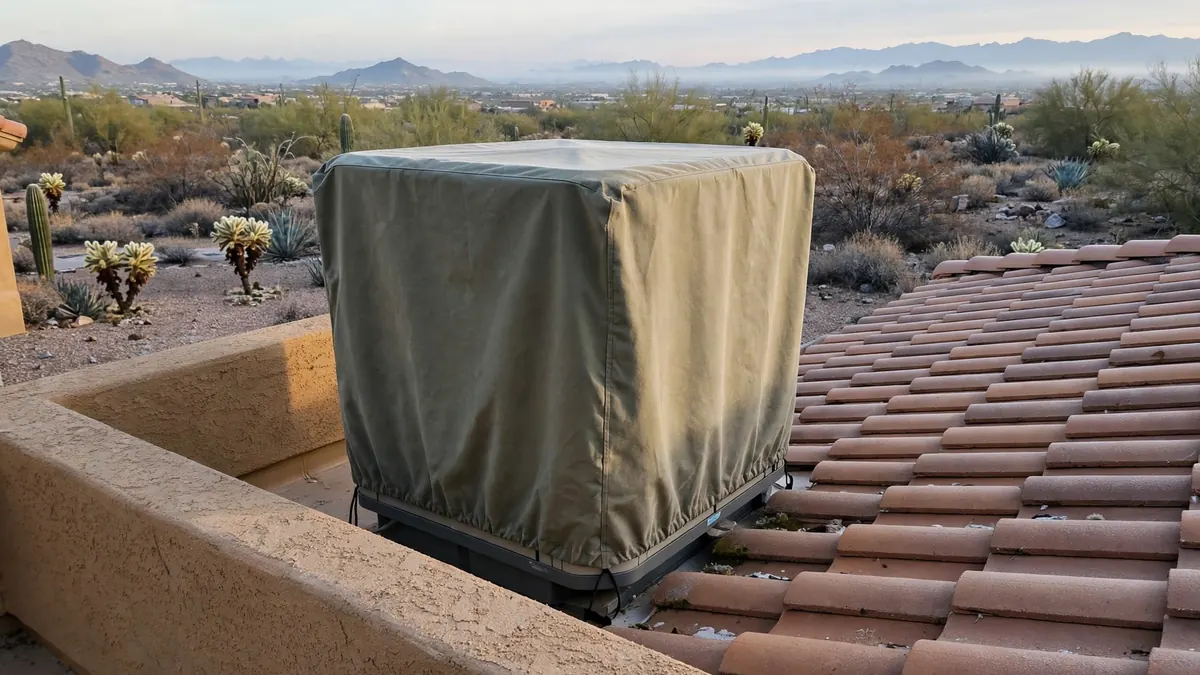
- Put a fitted cover on the cooler itself.
- Look at the flashing and the roofing around the stand while you are up there, before the winter storms.
Our winter freezes are rare and brief, but they do happen. A supply line left full on an exposed roof can crack on one of those nights and leak once the water comes back on in spring.
What about an old cooler you no longer use?
An unused cooler that was simply turned off and left in place is still a leak risk. The roof jack opening stays in the roof, the flashing keeps aging, and the stand keeps pressing into the roofing, but nobody checks it any more.
Many older homes in Casa Grande, Coolidge and Eloy switched to refrigerated air years ago and kept the old cooler on the roof. If that is your house, have a roofer look at whether the cooler should be removed and the opening framed, decked and roofed over properly. A rusted cabinet sitting over a cracked roof jack tends to show up as a ceiling stain after a monsoon storm, and the claim then gets a hard look as a maintenance issue.
What should you do once water is inside?
Stop the water at the cooler, get the roof jack or roofing covered if it is open, and have the attic and ceiling checked with a moisture meter. Wet insulation and ceiling drywall from a long, slow leak usually have to come out so the deck and rafters can dry.
- Turn off the cooler and its water supply. If water is coming through during a storm, a roofer or restoration crew can tarp the area.
- Map the moisture. The wet area in the attic is usually much larger than the stain on the ceiling.
- Remove what will not dry. Soaked blown-in insulation and sagging drywall are bagged and taken out.
- Dry the structure. Dehumidifiers and air movers dry the sheathing, rafters and top plates, with readings checked each day. This is structural drying, and it matters more than the patch.
- Check for mold. Cooler water sits in an open pan with dust and algae, so materials are cleaned, not just dried.
- Fix the source and the roof. The cooler technician fixes the unit, the roofer fixes the flashing or roofing, and only then is the ceiling closed up.
For what stains on the ceiling side mean, see ceiling water damage. For leaks from the roof itself, see roof leak water damage.
Will homeowners insurance cover cooler leak damage?
Sometimes. Most standard policies cover sudden, accidental water damage, but a cooler that leaked slowly for weeks, or a roof jack that cracked from age, is often treated as wear and tear or lack of maintenance. Damage from a storm that tore flashing loose is more likely to be treated as sudden.
Keep the cooler technician's or roofer's invoice that names the cause, photos of the unit and the attic, and the drying logs. Check your declarations page and the water damage section of your policy, or ask your agent, before you assume either way.
If a cooler leak has already stained a ceiling or soaked the attic, call (520) 380-1551. The 24/7 line connects you with a local restoration crew in Casa Grande and nearby Pinal County towns. Prices are set by the restoration company and vary with the job.
Questions homeowners ask
What is a roof jack on a swamp cooler?
Why is water dripping from my ceiling vent when the cooler runs?
Should I remove an old swamp cooler I don't use?
More from the blog
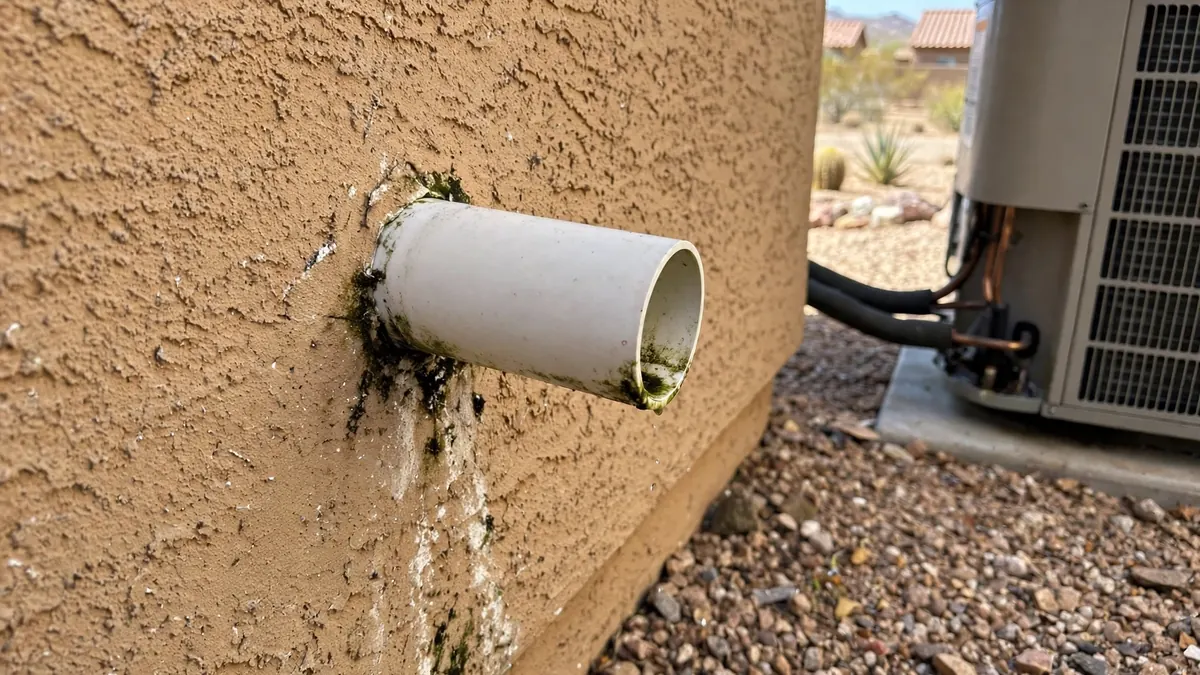 Summer & HVACAC condensate line clogged: how summer AC water damages Arizona homesAn AC condensate line clogs when algae, slime and dust build up in the small drain pipe and trap, so water backs into the pan and...
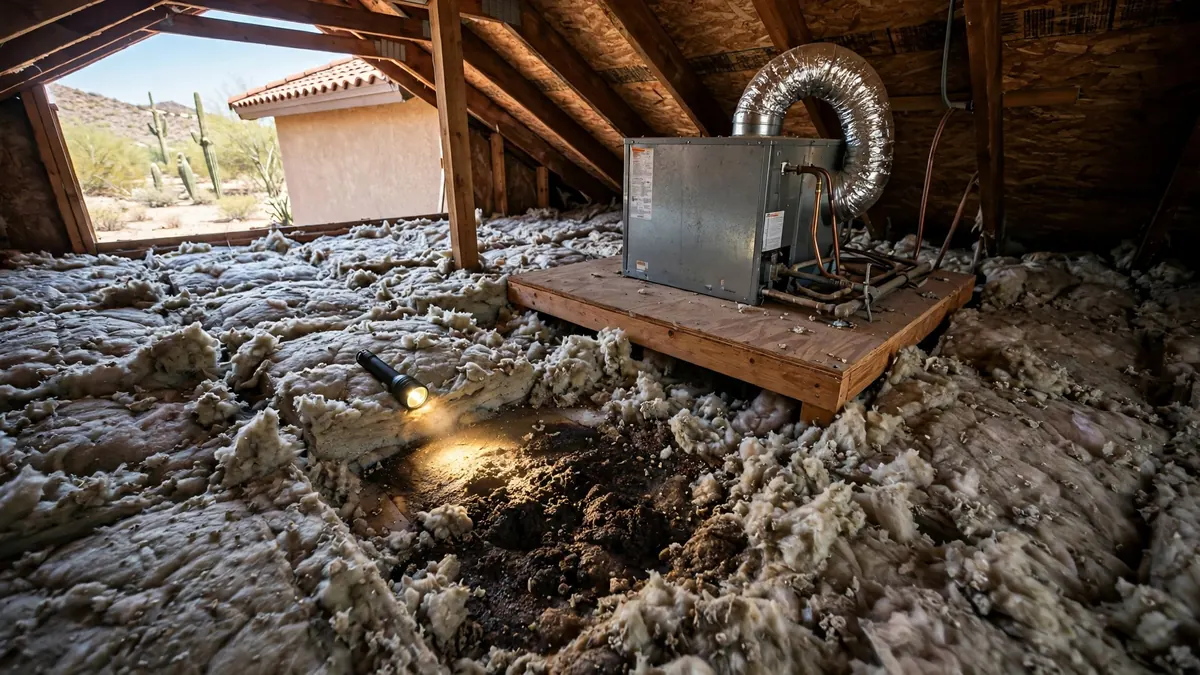 Summer & HVACAttic water damage in Arizona summersAttic water damage in Arizona summers usually comes from an AC air handler or its condensate drain, monsoon roof leaks, a rooftop cooler, or water lines...
 Fire & SmokeSmoke damage cleanup after a house fire: what to do firstStart smoke damage cleanup only after the fire department clears the house. Then keep the AC off, photograph everything, throw out exposed food, and do not...
Need help with damage right now?
Speak to a local restoration specialist on the 24/7 line, any time of day.
Call (520) 380-1551When you call: enter your ZIP code, then press 1 for water damage, 2 for fire damage or 4 for sewage backup.