Home › Blog › Smoke damage cleanup after a house fire: what to do first
Smoke damage cleanup after a house fire: what to do first
Start smoke damage cleanup only after the fire department clears the house. Then keep the AC off, photograph everything, throw out exposed food, and do not wipe soot with a wet rag. Soot is acidic and starts etching surfaces within days, so call a smoke cleanup crew early instead of scrubbing it yourself.
In this article
- Is it safe to go back inside after the fire department leaves?
- What do smoke and soot do to a house over hours and days?
- What should you do in the first 48 hours after a house fire?
- What can you clean yourself, and what should you leave alone?
- How does professional smoke damage cleanup work?
- What about the water left behind by firefighting?
- How do you document smoke damage for insurance?
- How much does smoke damage cleanup cost in Casa Grande?
- What is different about smoke damage in Casa Grande homes?
- When should you call for smoke damage cleanup help?
- Questions homeowners ask
A small house fire is over in minutes. The smoke damage is not. Once the trucks pull away, soot keeps eating at finishes, smoke odor keeps soaking into anything soft, and the water used to put the fire out keeps sitting in walls and carpet. What you do in the next two days decides how much of the house cleans up and how much has to be torn out and replaced.
Is it safe to go back inside after the fire department leaves?
Only when the fire department tells you it is. They decide whether the structure is safe to enter, and they often shut off power, gas, or water before they leave. Ask exactly what was shut off and whether anything needs a utility or an electrician before it comes back on.
Even with the all-clear, go in carefully and keep the first visit short:
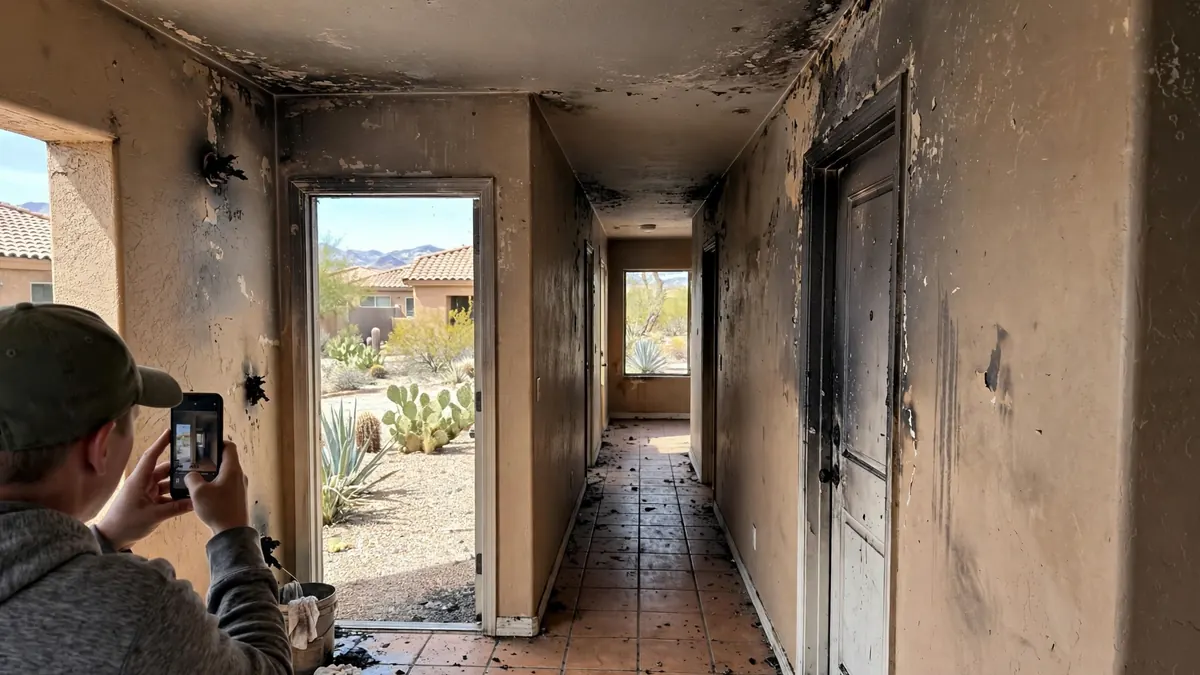
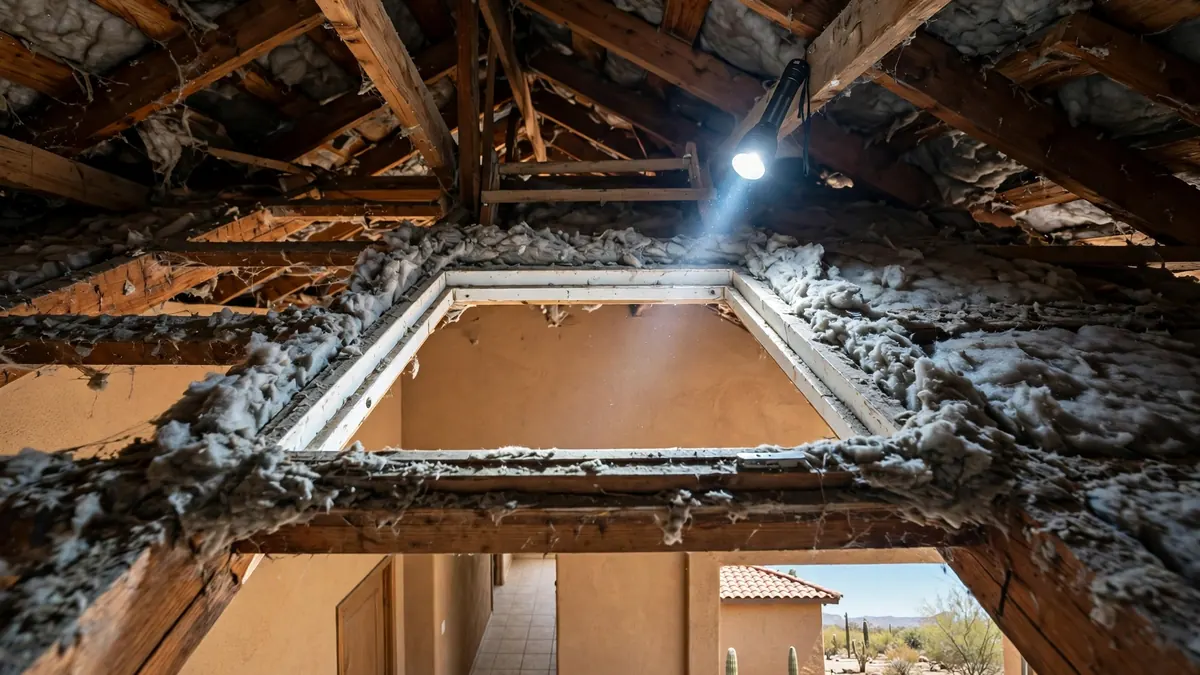
- Look up before you walk in. Ceilings that took firefighting water can sag and drop wet drywall and insulation. Stay out of any room where the ceiling is bowed or stained and soft.
- Watch for hot spots. If you see smoldering material or smell fresh smoke rather than stale smoke, get out and call 911. Fires can rekindle inside walls and attics.
- Protect your lungs and skin. Soot is a fine, oily particle that you do not want to breathe. Wear an N95 mask, long sleeves, gloves, and sturdy closed shoes.
- Do not flip breakers or plug things in until the power is confirmed safe.
Keep kids, pets, and anyone with asthma out. The first trip is for essentials, photos, and securing the house.
What do smoke and soot do to a house over hours and days?
Smoke damage gets worse with time because soot is acidic and smoke odor keeps moving into porous materials. A room that looks lightly gray on day one can have etched glass, pitted fixtures, and set-in stains by the end of the week.
The first few hours
Soot settles out of the air onto every horizontal surface, and onto cooler surfaces like windows, mirrors, and exterior walls. Fine particles are still floating, and any air movement carries them into rooms the fire never reached.
The first one to three days
The acid in soot starts working. Glass picks up a haze. Chrome and brass on faucets, door hardware, and appliance trim start to discolor and pit. Grout, marble, and unsealed stone absorb the residue and stain. Meanwhile, smoke odor is pushing into drywall paper, insulation, carpet pad, upholstery, mattresses, and clothing.
After the first week
Discoloration on many surfaces becomes permanent. Metal that could have been cleaned now needs refinishing or replacement. Odor has worked deeper, so items that could have been deodorized now have to go. If firefighting water was never dried, mold can start on wet drywall and framing too, which adds a second job on top of the smoke cleanup.
The AC is the biggest spreader. If the system runs after a fire, it pulls smoke and soot in through the return, coats the coil and the duct run, and blows residue out of every register in the house. Leave the thermostat off until the ducts have been checked.
What should you do in the first 48 hours after a house fire?
Focus on safety, documentation, and stopping further damage. Cleaning can wait for a crew. Here is the order that works for most homeowners:
- Get the all-clear from the fire department, and find out which utilities were shut off.
- Call your insurance company. Report the loss, get a claim number, and ask what your policy provides for temporary housing, often listed as additional living expenses.
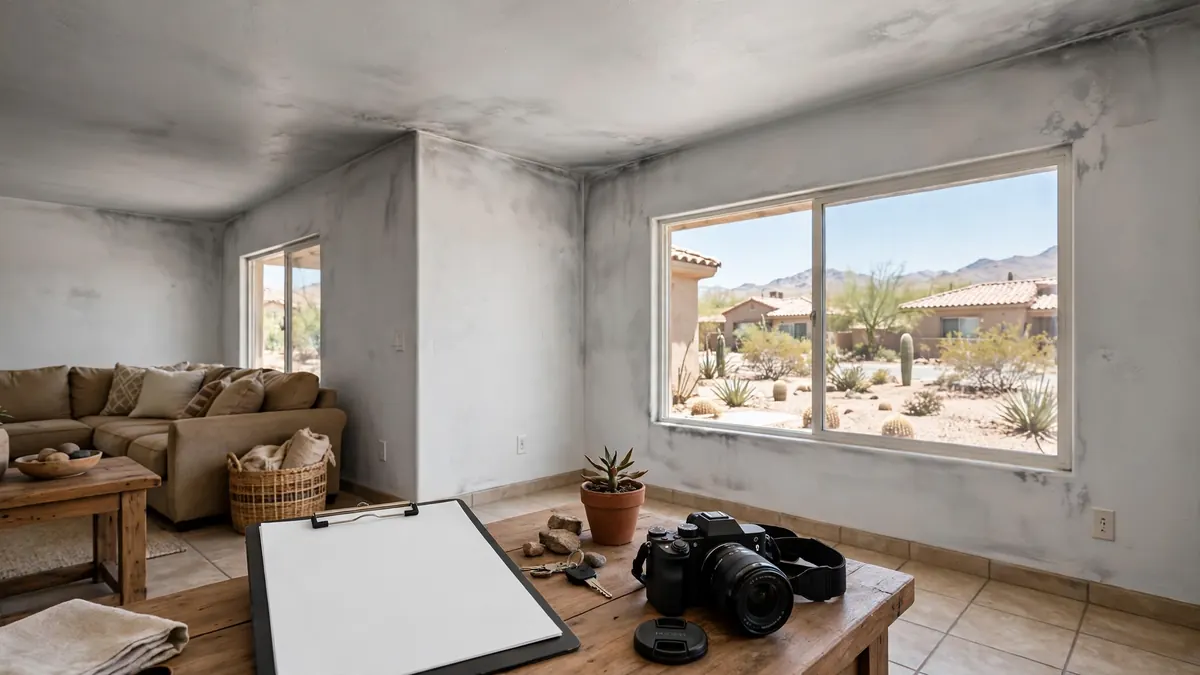
- Photograph and video everything before anything is moved, cleaned, or thrown out. Include rooms that only have smoke staining, the inside of closets and cabinets, and the HVAC registers.
- Turn off the HVAC system at the thermostat and leave it off. If you can reach the filter safely, pull it, bag it, and do not run the system with a new one until the ducts are inspected.
- Secure the property. Broken windows, forced doors, and roof openings need board-up and tarping. Most policies expect you to prevent further damage once you know about it.
- Throw out exposed food, drinks, and medicine. Anything that sat near heat, smoke, or firefighting water is not safe, even sealed packaging and canned goods that got hot.
- Do not turn on electronics that were exposed to heat, soot, or water.
- Start a list. Write down damaged rooms and items as you see them, and keep every receipt for hotel stays, meals, supplies, and board-up.
- Call a restoration crew to assess the soot, odor, and water before the acid and moisture have time to set in.
What can you clean yourself, and what should you leave alone?
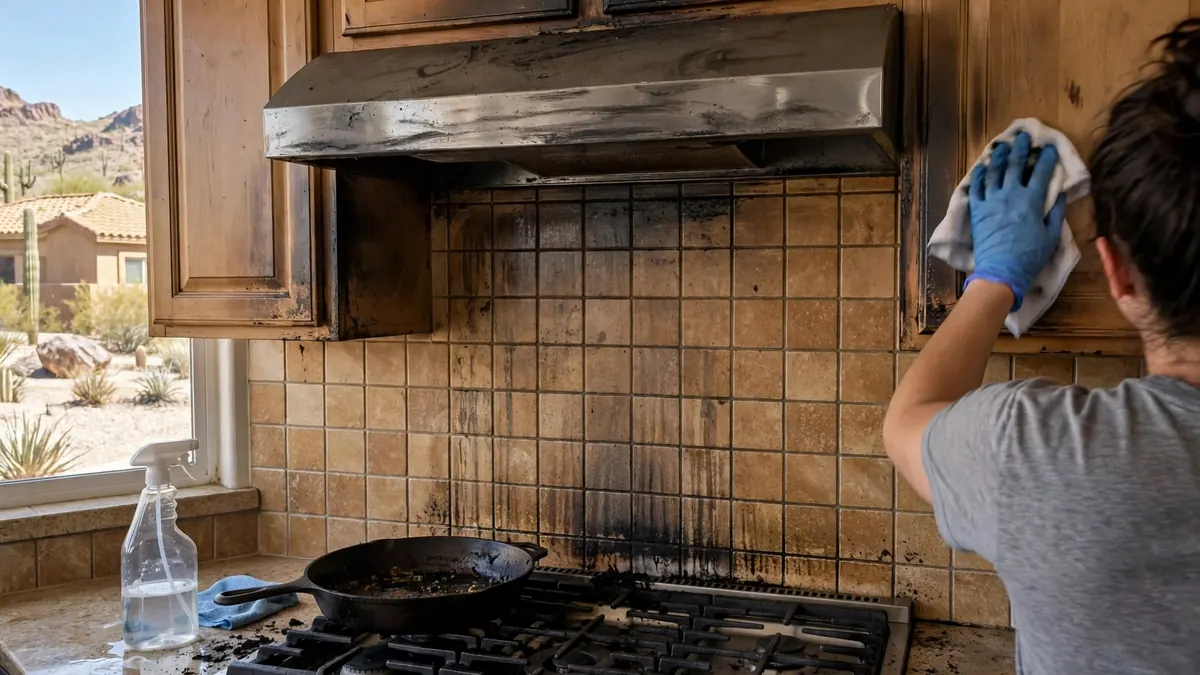
You can safely handle a short list of tasks: tossing exposed food, bagging clothing, pulling the HVAC filter, and keeping the system off. Most actual soot removal should wait for a crew, because the wrong cleaning method sets the stain and the smell permanently.
| Task | Homeowner OK? | Why |
|---|---|---|
| Throwing out exposed food and medicine | Yes | Heat and smoke contaminate it, even in sealed packages. |
| Bagging clothing and bedding for cleaning | Yes | Lightly affected washables may come clean with repeated washing. Heavily smoked items need professional cleaning or replacement. |
| Pulling and bagging the HVAC filter | Yes, with the system off | Removes one odor source. Do not restart the system until ducts are checked. |
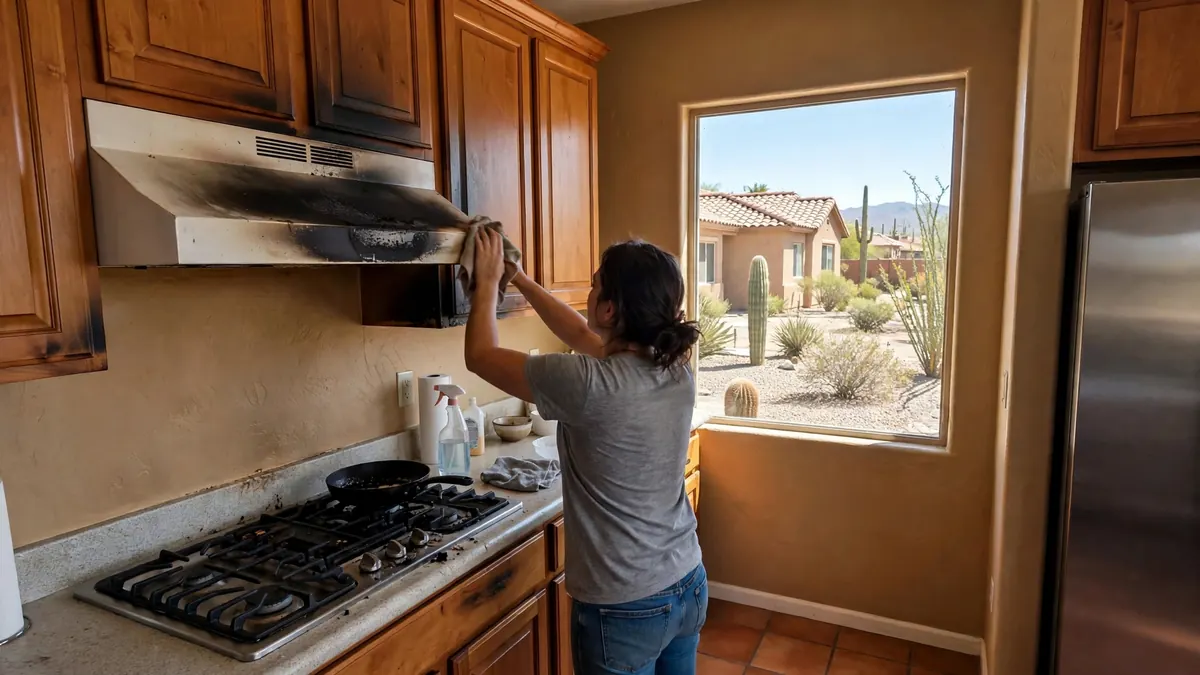
| Wiping walls, ceilings, or cabinets with a wet rag | No | Water and household cleaners smear soot into paint and wood, turning a cleaning job into a repaint. |
| Vacuuming soot with a household vacuum | No | A standard vacuum blows fine soot back into the air and through the house. Crews use HEPA vacuums. |
| Scrubbing upholstery or carpet | No | Rubbing pushes oily soot deeper into the fibers. |
| Painting over smoke stains | No | Odor bleeds through paint unless the surface is cleaned and sealed first. |
| Running a rented ozone machine | No | Ozone is a lung irritant, requires an empty house, and does little until the residue has been cleaned. |
Skip candles and odor sprays too. They cover the smell for an afternoon, then it returns because the residue is still there.
How does professional smoke damage cleanup work?
Professional smoke damage cleanup follows a set order: assess the residue, remove the worst-affected materials, clean surfaces with methods matched to the soot type, clean the HVAC system, and then deodorize what remains. Deodorizing before the soot is cleaned off wastes the treatment.
Assessment and testing
A crew walks every room, not only the one that burned, and maps where soot settled and where odor traveled. They test a small spot to see how the residue reacts before picking a method. Many restoration companies follow industry standards such as those published by the IICRC, which lay out how fire and smoke residue should be evaluated and cleaned.
Dry soot versus wet soot
Not all soot behaves the same, and this is the main reason homeowners should not guess:
- Dry smoke residue comes from a fast, hot fire in paper or wood. It is powdery and loose, so crews lift it with dry chemical sponges before any liquid touches the surface.
- Wet smoke residue comes from a slow, smoldering fire in plastic or rubber. It is sticky and black, smears under pressure, and needs solvent-based cleaners and more time.
- Protein residue comes from kitchen fires, usually meat or oil left on a burner. It is nearly invisible, a thin amber film on cabinets and ceilings, with an odor much stronger than the staining suggests.
HEPA vacuuming and air scrubbing
Loose soot is removed with HEPA vacuums, which trap fine particles instead of blowing them back into the room. Air scrubbers with HEPA filters run during the job to pull floating particles out of the air so they do not settle again on surfaces that were just cleaned.
Cleaning surfaces and contents
Hard surfaces and metal are usually cleaned first, since that is where the acid does permanent damage fastest. Walls, ceilings, cabinets, and fixtures are cleaned with the method that fits the residue. Badly affected insulation, carpet pad, and soft materials are removed, because no deodorizer beats taking out the material that holds the smell.
HVAC and ductwork
If the system ran during or after the fire, the filter is replaced and the ducts, registers, coil, and air handler are cleaned. Skipping this step is the most common reason smoke smell returns weeks after a cleanup.
Deodorization methods, in plain terms
- Thermal fogging. A machine heats a deodorizing liquid into a fine fog that drifts into the same cracks and gaps the smoke reached, and neutralizes odor there. The house needs to be empty while it runs and until the crew says it is clear to return.
- Hydroxyl generators. These use ultraviolet light to create reactive molecules that break down odor in the air and on surfaces. They work slowly, often over several days, but they are safe to run with people, pets, and belongings in the home.
- Ozone. Ozone works faster on strong odors, but it irritates the lungs. People, pets, and plants must be out of the house while it runs, and the house is aired out before anyone returns.
- Sealing. Framing or subfloor that still holds odor after cleaning gets an odor-blocking sealer before new drywall or paint goes on.
For more detail on the odor side of the work, see our page on smoke odor removal in Casa Grande.
What about the water left behind by firefighting?
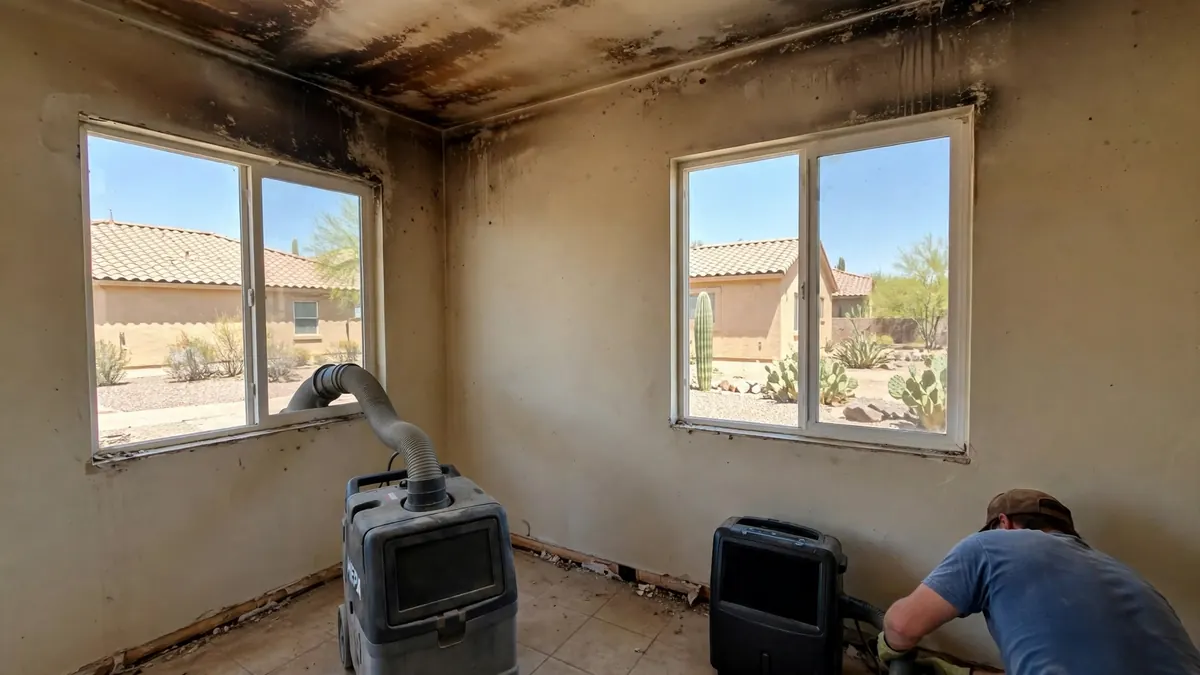
Treat it as a water damage job that has to happen alongside the smoke cleanup. Hose water runs into walls, soaks carpet and pad, and pools under cabinets. It is also dirty, since it has run through soot, ash, and burned materials.
In Casa Grande the outside air is dry, but the inside of a closed-up house after a fire is not. Wet drywall in a warm, shut house can start growing mold in 24 to 48 hours. Crews extract standing water, pull out wet insulation and pad that cannot be saved, and set up dehumidifiers and air movers with moisture readings taken as the house dries. Our page on structural drying explains how that drying is measured and when it is actually done.
How do you document smoke damage for insurance?
Photograph and video everything before cleanup, report the claim promptly, and keep a written record of every expense. Most standard homeowners policies cover sudden fire and smoke damage, including smoke that drifts in from a neighbor's fire, but the details depend on your policy, so check your declarations page and ask your agent.
- Wide shots and close-ups. Shoot each room from the doorway, then close-ups of soot on walls, ceilings, vents, cabinets, and contents.
- Do not throw out damaged items yet. Set them aside unless they are a health hazard like spoiled food.
- Make a contents list. Room by room, with approximate age and price.
- Keep every receipt. Hotel nights, meals out, board-up, supplies, and laundry can matter for additional living expenses if your policy includes them.
- Write down dates. When the fire happened, when you reported it, and when cleanup started. A clear start date helps show you acted to prevent further damage.
Restoration crews usually document the residue, affected rooms, and moisture readings in a way adjusters are used to reviewing. For how deductibles, secondary damage, and replacement cost work on Arizona policies, read whether homeowners insurance covers water damage in Arizona, which covers the water side of a fire claim as well.
How much does smoke damage cleanup cost in Casa Grande?
Smoke and soot cleaning alone, such as after a small kitchen fire or furnace puffback, often runs about $500 to $4,000. Jobs that combine fire, smoke, and firefighting water vary widely and are often $5,000 or more. Prices are set by the independent restoration company you work with and depend on the job.
| Type of job | Typical range | What drives it |
|---|---|---|
| Smoke and soot cleaning only (small kitchen fire, puffback) | About $500 to $4,000 | Number of rooms, residue type, whether ducts need cleaning |
| Fire and water damage combined | Varies widely, often $5,000+ | Burned materials, water extraction and drying, rebuild |
Costs climb with the number of rooms affected, duct cleaning, sticky wet or protein residue, and material removal. Waiting is the one driver you control, since acid damage and set-in odor turn cleaning into replacement.
Larger fires are usually priced as full restoration. Our fire damage restoration page covers board-up, rebuild, and the rest of that process.
What is different about smoke damage in Casa Grande homes?
Three local conditions change how smoke damage spreads and cleans up here: the AC runs most of the year, kitchen fires are the most common small fire, and desert dust is already on every surface before the soot lands.
The AC is usually on
From late spring into fall, Casa Grande homes run the AC nearly around the clock against 110°F afternoons. When a fire starts, the system is often already running, so smoke is pulled through the return and pushed into every room within minutes. That is why so many local smoke jobs include duct cleaning even when the fire stayed in one room. Plan to stay elsewhere rather than restart it early.
Kitchen fires and protein residue
A pan of oil left on a burner is one of the most common small house fires anywhere, and Casa Grande is no different. These fires are often out in a minute or two, but the protein residue they leave coats cabinets, ceilings, and vents across the house, and the sour smell outlasts the visible staining.
Desert dust mixed with soot
Fine dust gets in all year, more during monsoon dust storms. When soot settles on top of that dust, the mix is gritty and oily at the same time. Wiping it grinds the grit into finishes and smears the soot, which is one more reason to leave wiping to a crew with dry sponges and HEPA vacuums.
Electrical fires during storm season
In general, lightning strikes and power surges during summer storms can damage wiring and start electrical fires in attics, walls, and garages. They often smolder first and leave the sticky wet smoke residue that is hardest to clean. If you smell burning plastic after a storm and cannot find the source, treat it as a possible fire and call 911.
When should you call for smoke damage cleanup help?
As soon as the fire department clears the house. The first two days are when soot is easiest to remove and odor has not set deep into drywall and fabric.
For a kitchen fire, a puffback, or a larger fire with water damage, the restoration companies we work with handle smoke damage cleanup across Casa Grande, Coolidge, Eloy, Maricopa, Arizona City, and the rest of Pinal County. Call (520) 380-1551 any time on the 24/7 line to talk through what you are seeing.
Questions homeowners ask
Can I clean smoke damage myself after a small kitchen fire?
How long does smoke damage cleanup take?
Is it safe to sleep in a house with smoke damage?
Does homeowners insurance cover smoke damage cleanup?
Do I need my air ducts cleaned after a fire?
More from the blog
 Fire & SmokeHow to get smoke smell out of a house in ArizonaTo get smoke smell out of a house, remove the residue instead of covering it. Change the HVAC filter, wash soft goods, clean hard surfaces top...
 Fire & SmokeDoes homeowners insurance cover smoke damage in Arizona?Most standard Arizona homeowners policies cover sudden smoke damage, including smoke from your own fire, a neighbor's fire, or a wildfire, minus your deductible. Gradual buildup...
 Fire & SmokeFire damage restoration cost in Casa Grande: what drives the billIn Casa Grande, smoke and soot cleaning alone often runs about $500 to $4,000, while a fire that also left firefighting water behind is often $5,000...
Need help with damage right now?
Speak to a local restoration specialist on the 24/7 line, any time of day.
Call (520) 380-1551When you call: enter your ZIP code, then press 1 for water damage, 2 for fire damage or 4 for sewage backup.