Home › Blog › AC condensate line clogged: how summer AC water damages Arizona homes
AC condensate line clogged: how summer AC water damages Arizona homes
An AC condensate line clogs when algae, slime and dust build up in the small drain pipe and trap, so water backs into the pan and spills onto ceilings or floors. Shut the system off, vacuum and flush the line, test the float switch, and check for wet drywall. See AC condensation water damage.
In this article
- Why does an AC condensate line clog in Arizona?
- How is an AC condensate drain system put together?
- What are the signs your condensate line is clogged?
- How do you clear a clogged condensate line yourself?
- How do float switches work, and why do some fail?
- Why are attic air handlers the biggest risk?
- What should you do if the line already overflowed?
- Will insurance pay for AC condensate damage?
- How do you keep the condensate line from clogging again?
- Questions homeowners ask
Why does an AC condensate line clog in Arizona?
A condensate line clogs because the water running through it is warm, slow and full of what the air handler pulls out of your house: dust, pet hair, pollen and the spores that feed algae and bacterial slime. That growth sticks to the inside of a small PVC pipe, catches more debris, and eventually closes it off. In Casa Grande the system runs so many months a year that the line almost never gets a chance to dry out.
Two local conditions make it worse than in most of the country:
- Dust storms. A haboob pushes fine dust through every gap in the return side of the system, and a dirty or loose filter lets it reach the wet coil. That dust washes into the drain pan and settles in the trap.
- Monsoon humidity. For most of the year our air is dry and the coil makes only a modest amount of water. When monsoon moisture moves in from mid-June through September, the same system suddenly pulls much more water out of the air. A line that was partly blocked in May and coping fine can back up in the first humid week of July.
The clog usually forms in the trap next to the air handler, or in an attic run that has sagged and holds standing water.
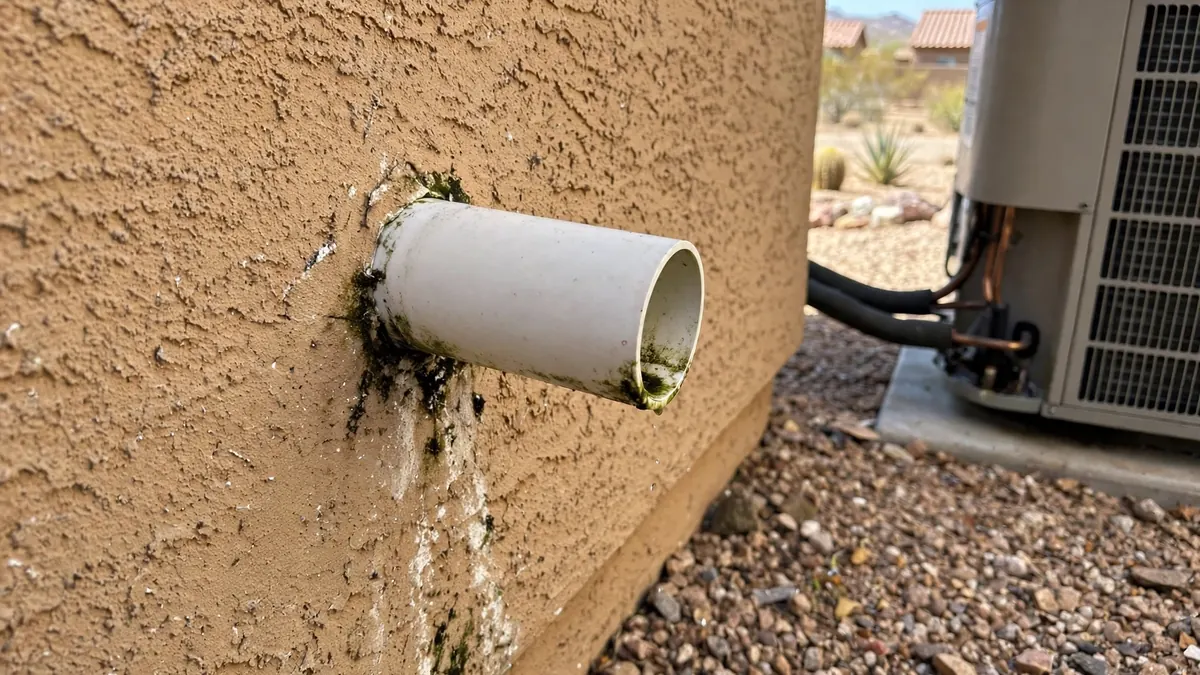
How is an AC condensate drain system put together?
Most systems have a primary drain for normal use and a backup that catches overflow when the primary fails. Knowing which pipe is which tells you how serious the problem is.
| Part | Where it is | What it does | What failure looks like |
|---|---|---|---|
| Primary drain pan | Built into the air handler under the coil | Collects water dripping off the coil | Rust or cracks inside the unit, water leaking out of the cabinet |
| Trap | On the primary line close to the unit | Holds a water seal so the blower does not pull air back up the drain | Slime plug, gurgling, water that will not drain while the blower runs |
| Cleanout tee | A capped tee on the primary line near the unit | Access point for flushing the line | Water standing in the tee when you open it |
| Primary line termination | Outside near the foundation, or into a drain or sink tailpiece | Where the water should come out | Dry when the AC has been running for hours in humid weather |
| Secondary pan | Under an attic or closet unit | Catches overflow if the primary system fails | Standing water, rust holes, a stain on the ceiling below |
| Secondary line | Often ends over a window, eave or patio where you will notice it | Drains the secondary pan and warns you | Dripping water, which means the primary is already blocked |
| Float switch | In the secondary pan, the cleanout tee, or the unit's backup port | Shuts the system off when water rises | Stuck float, bad wiring, or a house that stays warm with the thermostat calling for cool |
If you see water dripping from a short pipe over a window or under the eave, do not ignore it. That is usually the secondary line, and it means the primary drain has already stopped working.
What are the signs your condensate line is clogged?
The earliest sign is often outside, not inside: the primary line stops dripping during hot, humid afternoons when the system has been running for hours. Inside, you may notice the AC shutting off on its own, water in the secondary pan, or a damp smell near the indoor unit.
- The AC quits but the thermostat is still on. A float switch has tripped, and the house warms up.
- Water in the secondary pan. Any standing water in the attic pan means the primary drain is failing, even if it has not overflowed yet.
- Gurgling or bubbling near the unit. Air pulling through a dry or partly blocked trap.
- Water on the closet or garage floor around an indoor unit, with baseboards starting to swell.
- A ceiling stain under an attic unit. Water has gone past the pan into insulation and drywall. Our page on AC condensation water damage covers how those stains travel.
How do you clear a clogged condensate line yourself?
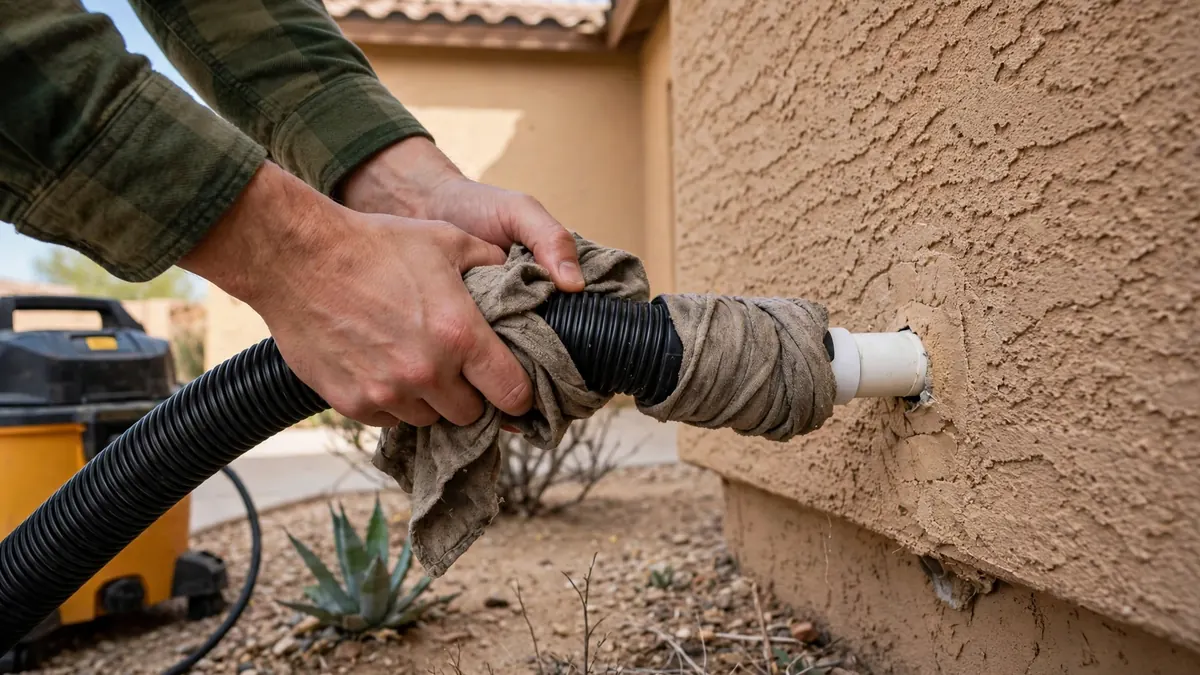
You can usually clear a simple clog by turning the system off, vacuuming the line from the outside end and flushing it from the cleanout tee. If the pan is overflowing, the line runs through a finished wall, or you cannot find the cleanout, stop and have an HVAC technician do it.
- Turn the system off at the thermostat and the breaker.
- Remove standing water from the secondary pan with towels or a wet/dry vacuum.
- Find the outside end of the primary line, usually a small PVC pipe near the foundation by the outdoor unit.
- Vacuum it. Wrap a rag around the wet/dry vacuum hose to seal it against the pipe and run it for a minute or two. You often pull out a plug of slime this way.
- Open the cleanout tee near the indoor unit. Look inside. If water is standing in it, the clog is still downstream.
- Flush slowly. Pour about a cup of plain white vinegar, or the cleaner your unit's manual recommends, into the tee. Follow it with warm water a little at a time and confirm it comes out the outside end. Never mix bleach and vinegar or other cleaners.
- Recap the tee and restore power. Run the system and check that the outside end drips within the next hour or so on a humid day, and that the secondary pan stays dry.
Do not blast compressed air into the line from the inside. It can blow apart a glued joint in the attic, and you will not know until the ceiling stains.
How do float switches work, and why do some fail?
A float switch is a small sensor that cuts power to the system's control circuit when water rises to a set level. It turns an overflow into a warm house instead of a wet ceiling. It only works if it is mounted right, wired in and able to move.
The common types
- Pan-mounted switches clip to the secondary pan and react once water is already in it.
- In-line switches sit in the cleanout tee and trip as soon as the primary line backs up, which is earlier.
Why they fail
- Slime and scale. The same growth that clogs the line can glue the float in the down position.
- Bypassed wiring. When a switch trips repeatedly, a system is sometimes rewired around it to get the cooling back on. The clog stays and the protection is gone.
- Attic heat. Plastic floats and connections bake in a summer attic and turn brittle.
Test a pan float by lifting it gently with the system running. The AC should shut off. If it keeps running, the switch is not protecting anything. Residential building codes generally call for some form of backup protection when an air handler sits where an overflow could damage the building, so ask your HVAC technician what yours has and whether it works.
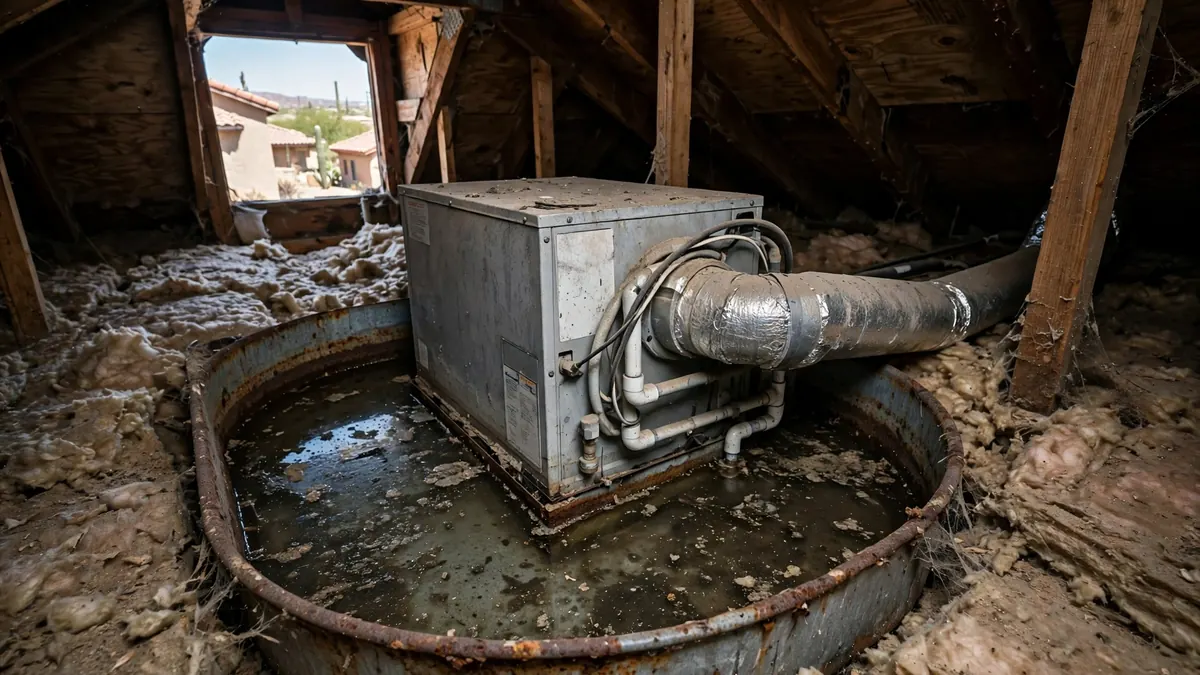
Why are attic air handlers the biggest risk?
An attic unit sits directly above drywall, insulation and living space, so any water that gets past the pans lands on your ceiling. Nobody sees it until the stain shows, and by then the water has often been running for days or weeks.
- Metal secondary pans rust. Older galvanized pans develop pinholes at the seams, so water drains through the pan instead of out of it.
- Insulation hides it. Blown-in insulation soaks up a lot of water before anything drips, then holds it against the drywall.
- Seasonal homes. In Mission Royale or Robson Ranch, an AC left running for an empty house can overflow in August and soak a ceiling for weeks before anyone is back.
What should you do if the line already overflowed?
Shut the system off, stop more water from reaching the ceiling, and then find out how far the water actually went. A wet pan with a dry attic floor is an HVAC repair. Wet insulation or a stained ceiling means water damage that needs drying.
- Turn off the system and empty the pan.
- If the ceiling sags, keep people and pets out from under it. It may be holding water.
- Photograph the pan, the unit, the ceiling and the line before anything is cleaned or replaced.
- Have the drain cleared and the float switch checked so the AC can run again safely.
- Get moisture readings on the ceiling, insulation and the top of the walls below. A surface that feels dry can still be wet inside.
Soaked ceiling drywall and insulation often have to come out, and the framing then needs structural drying with dehumidifiers until the readings are back to normal. Water that sat in a pan with slime and dust is not treated as clean water, so affected materials get cleaned as well as dried. If the leak ran for a long time, a mold assessment is worth having before the ceiling is closed up again.
Will insurance pay for AC condensate damage?
It depends on how the damage happened. Most standard homeowners policies cover sudden, accidental water damage, so a float switch that failed and a pan that overflowed once may be treated differently from a line that dripped slowly into the ceiling for months. Gradual leaks and lack of maintenance are common reasons for denial.
- Keep the HVAC technician's invoice that names the cause.
- Keep the failed part, such as a rusted pan, until the adjuster has seen it.
- Write down the date you found the water and the date drying started.
The HVAC repair itself is usually a maintenance cost. Check your declarations page or ask your agent, and see our guide to homeowners insurance and water damage in Arizona explains sudden versus gradual in more detail.
How do you keep the condensate line from clogging again?
Flush the line before cooling season and again before monsoon humidity arrives, and keep filters clean.
- Flush the cleanout tee in spring and again in late June.
- Change the filter on schedule, and sooner after a dust storm.
- Lift the float switch once a season to confirm it shuts the system off.
- Check that the outside end drips on humid days.
- If you leave for the summer, have someone check the pan during monsoon season.
If water from the AC has already reached your ceiling, walls or floor, call (520) 380-1551. The 24/7 line connects you with a local restoration crew in Casa Grande and nearby Pinal County towns who can check moisture and dry what got wet. Prices are set by the restoration company and vary with the job.
Questions homeowners ask
Why is water dripping from a pipe above my window?
Can I pour bleach down my AC condensate line?
How often should I clean my AC condensate line in Arizona?
More from the blog
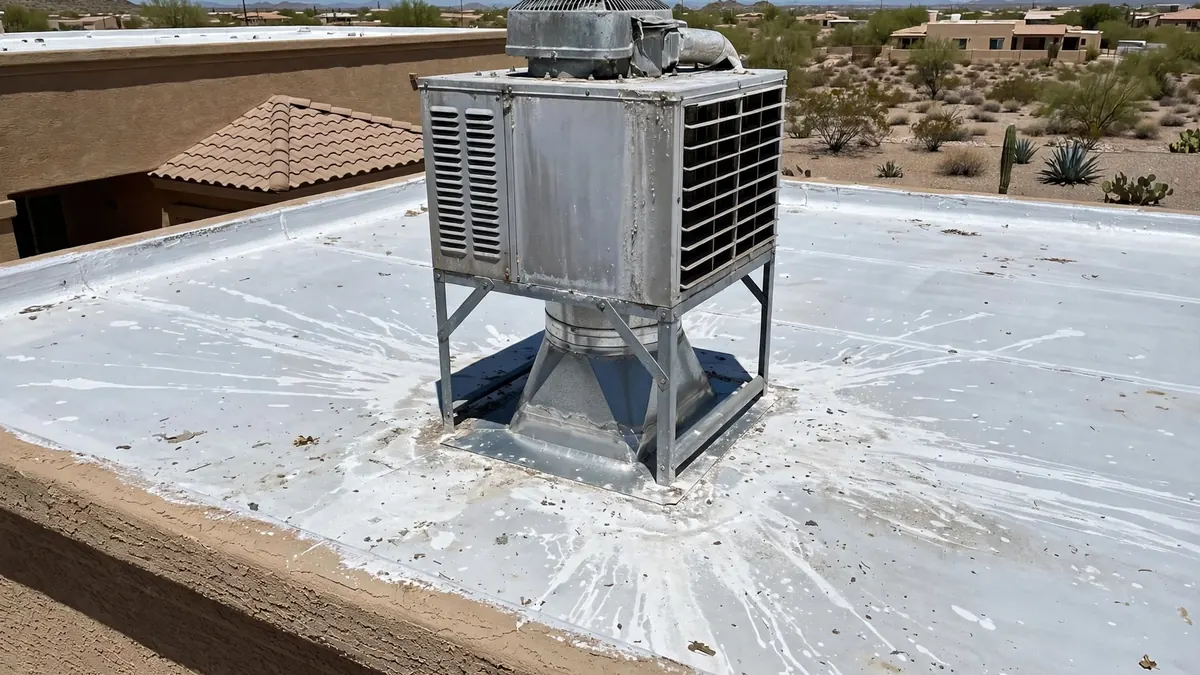 Summer & HVACEvaporative cooler leaks: the roof damage you don't seeA swamp cooler leak usually damages the roof in places you cannot see: the roof jack where the duct passes through the roof, the roofing under...
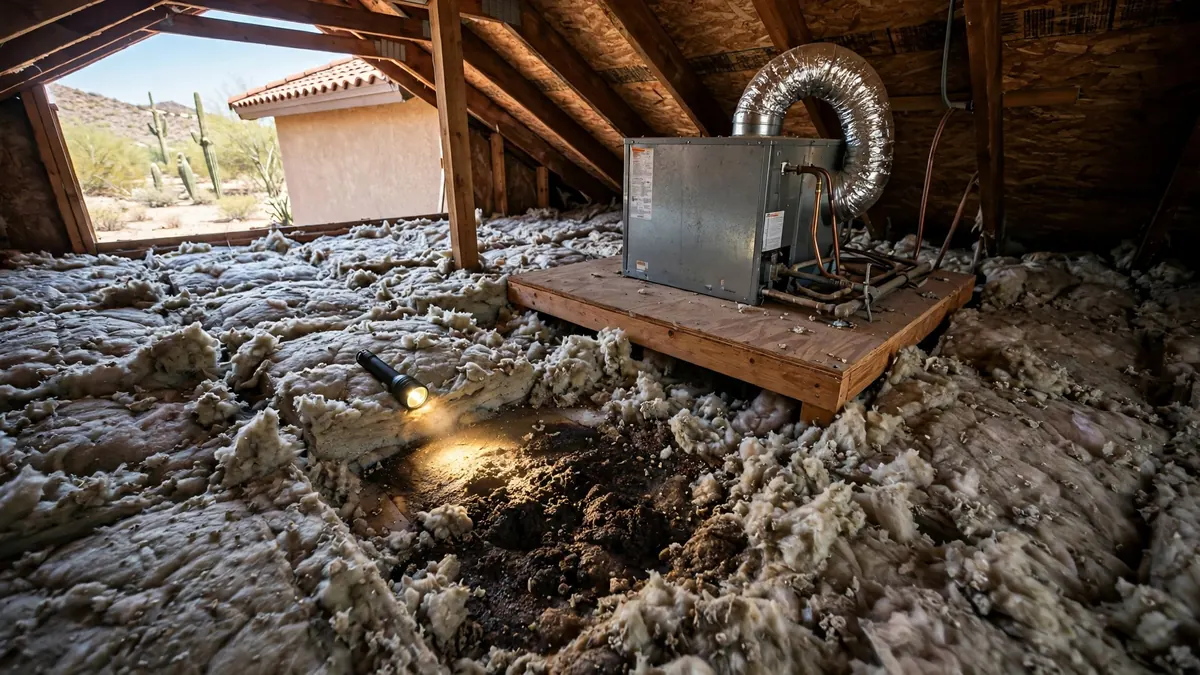 Summer & HVACAttic water damage in Arizona summersAttic water damage in Arizona summers usually comes from an AC air handler or its condensate drain, monsoon roof leaks, a rooftop cooler, or water lines...
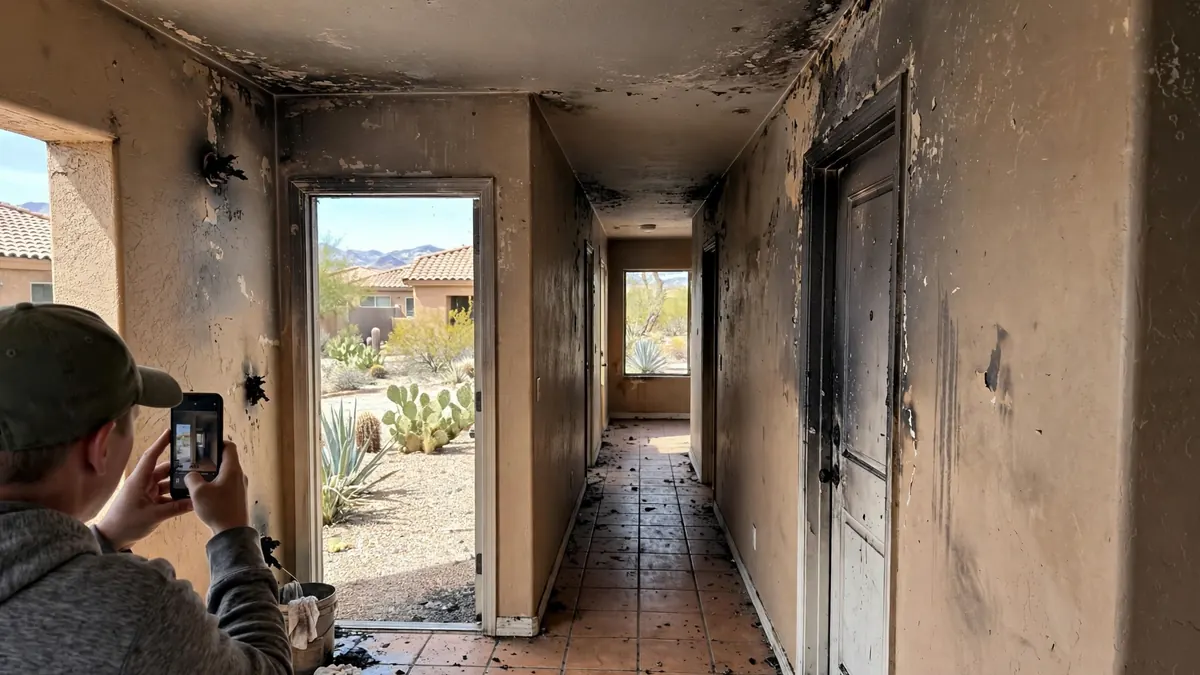 Fire & SmokeSmoke damage cleanup after a house fire: what to do firstStart smoke damage cleanup only after the fire department clears the house. Then keep the AC off, photograph everything, throw out exposed food, and do not...
Need help with damage right now?
Speak to a local restoration specialist on the 24/7 line, any time of day.
Call (520) 380-1551When you call: enter your ZIP code, then press 1 for water damage, 2 for fire damage or 4 for sewage backup.