Home › Blog › Water heater leaking from the bottom: what to do and what it means
Water heater leaking from the bottom: what to do and what it means
A water heater leaking from the bottom may have a failed tank, but the water often comes from the drain valve, the relief valve, a fitting on top, or condensation. Shut off the cold water and the gas or breaker, then trace the source. A leak from the tank itself means replacement. See water heater leak cleanup.
In this article
- Is a water heater leaking from the bottom always a failed tank?
- What should you do first when you see water under the heater?
- How do you find where the water is coming from?
- What does it mean if the relief valve is leaking?
- How can you tell the tank itself has failed?
- How old is your water heater, and does age matter?
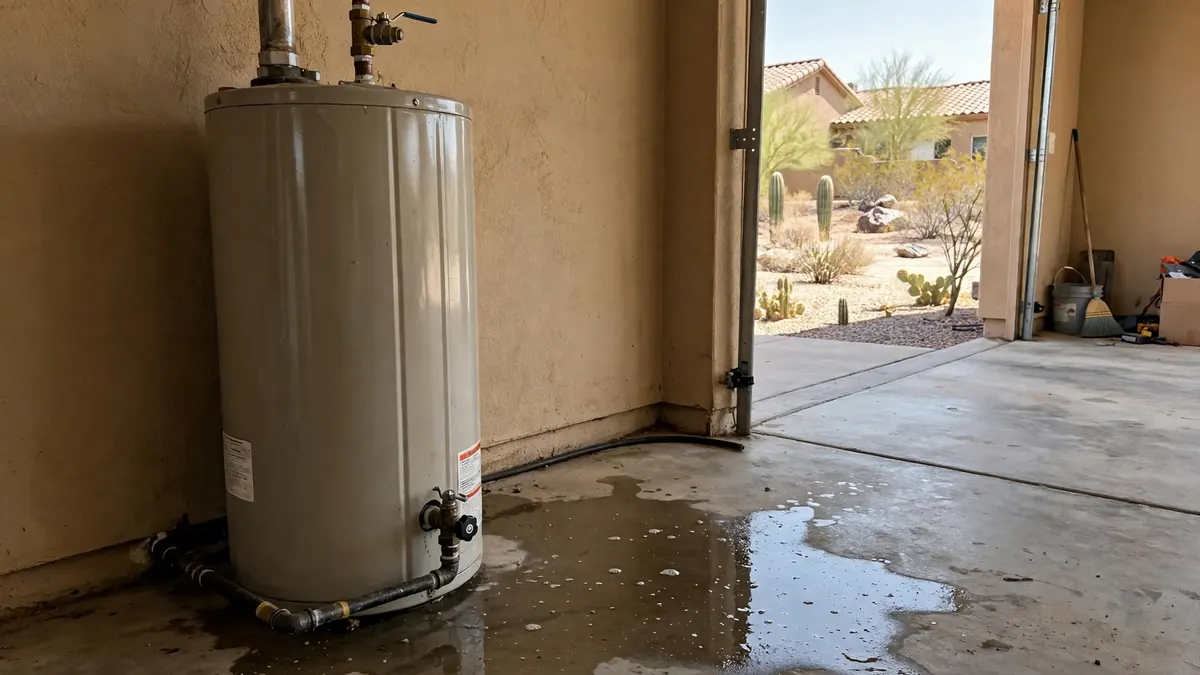
- Why does it matter whether the heater is in the garage or a closet?
- What happens to the water that already leaked?
- Will insurance pay for a leaking water heater?
- Questions homeowners ask
Is a water heater leaking from the bottom always a failed tank?
No. Water at the base of a heater can come from the tank, but it also commonly comes from the drain valve, the temperature and pressure relief valve, a fitting on top that drips down the side, or condensation. The tank itself is the one cause you cannot repair. Everything else usually can be fixed.
Water runs down. A slow drip at the cold inlet on top of the tank can travel down the jacket, under the insulation, and show up as a puddle at the bottom that looks exactly like a failed tank. So before you decide the heater is done, take a few minutes to find where the water actually starts. You will want that answer for the plumber and for your insurance claim anyway.
What should you do first when you see water under the heater?
Turn off the water to the heater, then turn off its energy source, gas or electric. That stops new water from feeding the leak and keeps the heater from firing on an empty or damaged tank. Then dry the floor enough to see where the water is coming from.
If it is an electric water heater
- Do not step into standing water near the heater until the power is off.
- Go to the breaker panel and switch off the water heater breaker. It is usually a double breaker, since most electric heaters run on 240 volts. If it is not labeled, the main breaker shuts off everything.
- Close the cold water shutoff valve on the pipe going into the top of the heater. Turn it clockwise, or a quarter turn if it has a lever handle.
If it is a gas water heater
- Turn the dial on the gas control valve, the box near the bottom of the tank, to OFF. On many models you push in slightly while turning.
- If you want to stop gas to the heater completely, close the gas shutoff on the supply line beside it. A lever valve is closed when the handle sits across the pipe.
- If you smell gas, leave the house and call the gas utility from outside. Do not flip switches.
- Close the cold water shutoff on the line into the top of the heater.
If the cold shutoff will not turn, which is common on older heaters in hard water homes, close the main shutoff to the house instead. Do not force a seized valve hard enough to snap it.
The water in the tank can be very hot for hours after you shut it down. Do not open the drain valve or the relief valve to empty it until you are sure the water has cooled and you have a hose run to a safe spot outside.
How do you find where the water is coming from?
Dry the outside of the tank and the floor, then watch and feel for fresh water at each likely point, working from the top down. It usually takes only a few minutes to narrow it down.
| Where you find water | Likely source | What it usually means |
|---|---|---|
| Wet pipes or fittings on top of the tank | Cold inlet, hot outlet, or supply connectors | A loose or corroded connection that can usually be repaired |
| Water at the end of the pipe running down the side | Temperature and pressure relief valve discharge | The valve is opening, or the valve itself is worn |
| Drips from the spigot near the bottom | Drain valve | A worn or scaled valve that does not seal, often replaceable |
| Beads of water all over a gas tank, mostly after a big hot water draw | Condensation | Often normal, especially in cooler months |
| Water coming from under the jacket or the burner area with dry fittings above | The tank itself | The inner tank has rusted through and needs replacing |
| Rust streaks and flaking at the base | Long-term corrosion | The tank is near or past the end of its life |
Press a dry paper towel against each fitting and the drain valve. Whatever comes back wet first is the leading suspect.
What does it mean if the relief valve is leaking?
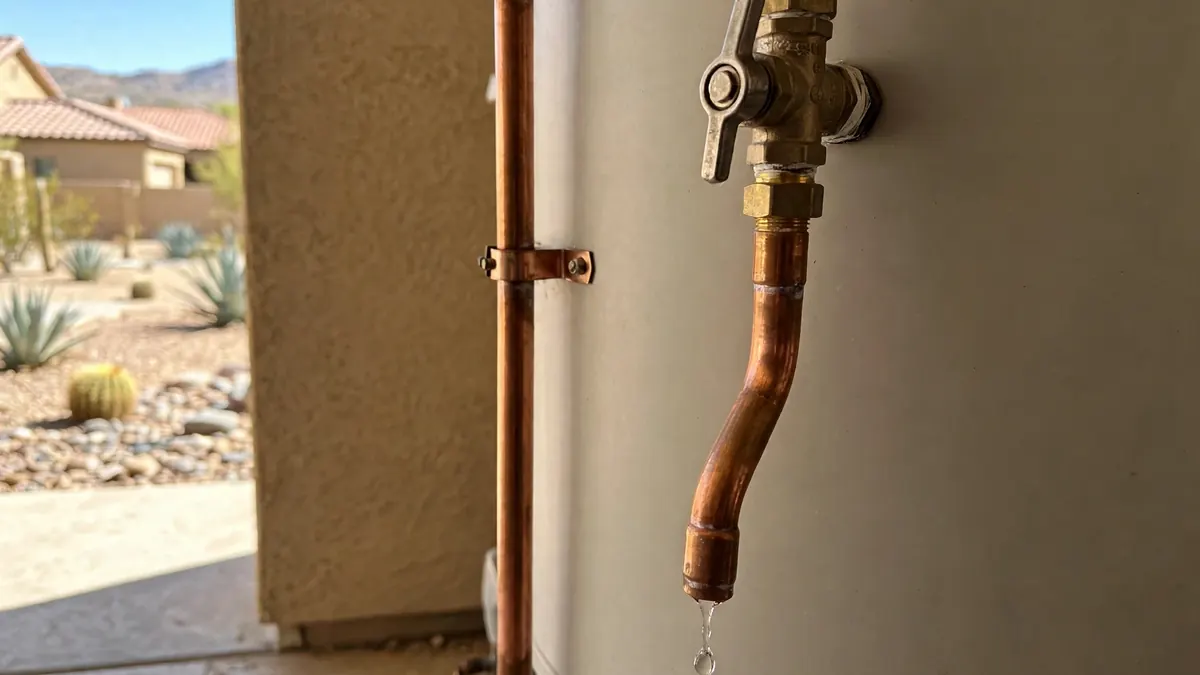
The temperature and pressure relief valve, often called the T&P valve, is a safety device that opens to release water if the tank gets too hot or the pressure inside gets too high. If water is coming out of its discharge pipe, either the valve is doing its job because pressure or temperature is too high, or the valve has worn out and is leaking.
The valve sits on the top or upper side of the tank and has a pipe that runs down to a few inches above the floor, or outside. Common reasons it discharges:
- Thermal expansion. Water expands when it heats. If your home has a check valve or pressure regulator at the main, that extra pressure has nowhere to go. An expansion tank on the water line is the usual fix.
- High house water pressure. A plumber can test it and check or replace the pressure regulator.
- Thermostat set too high or failing. The tank overheats and the valve opens.
- A worn valve. Scale from hard water can keep the valve from seating after it opens, so it drips constantly.
Never cap, plug, or remove the discharge pipe to stop the drip. That valve is what keeps a tank from failing violently. Shut the heater down and have a plumber find out why it is opening.
How can you tell the tank itself has failed?
If the fittings, relief valve, and drain valve are dry and water still appears under the heater, the tank has almost certainly rusted through. That cannot be patched. The heater needs to be replaced.
Signs that point to the tank:
- Water seeping from under the outer jacket or from the burner compartment on a gas unit.
- Rust-colored water from the hot taps in the days or weeks before the leak.
- Rumbling or popping sounds, which come from sediment baked onto the tank bottom.
- A heater past ten years old in a hard water home.
A tank leak often starts small and gets worse. A heater that is weeping today can open up much further without warning, so do not leave the water on to it hoping it will hold until the weekend.
How old is your water heater, and does age matter?
Age matters a lot in Casa Grande, because hard water shortens tank life. Many tanks here wear out somewhere around eight to twelve years. You can usually find the age from the label on the side of the heater.
Look for the manufacturer's rating plate. Some labels print a manufacture date. Others hide it in the serial number, where a pair of digits or a letter code stands for the year and month. The code differs by brand, so ask the plumber if you cannot read it. Write the age down, since an adjuster may ask about it.
A leaking drain valve on a three-year-old heater is a repair. The same leak on a fourteen-year-old tank in a hard water home is usually a sign to replace the whole unit before the tank fails for real.
Why does it matter whether the heater is in the garage or a closet?
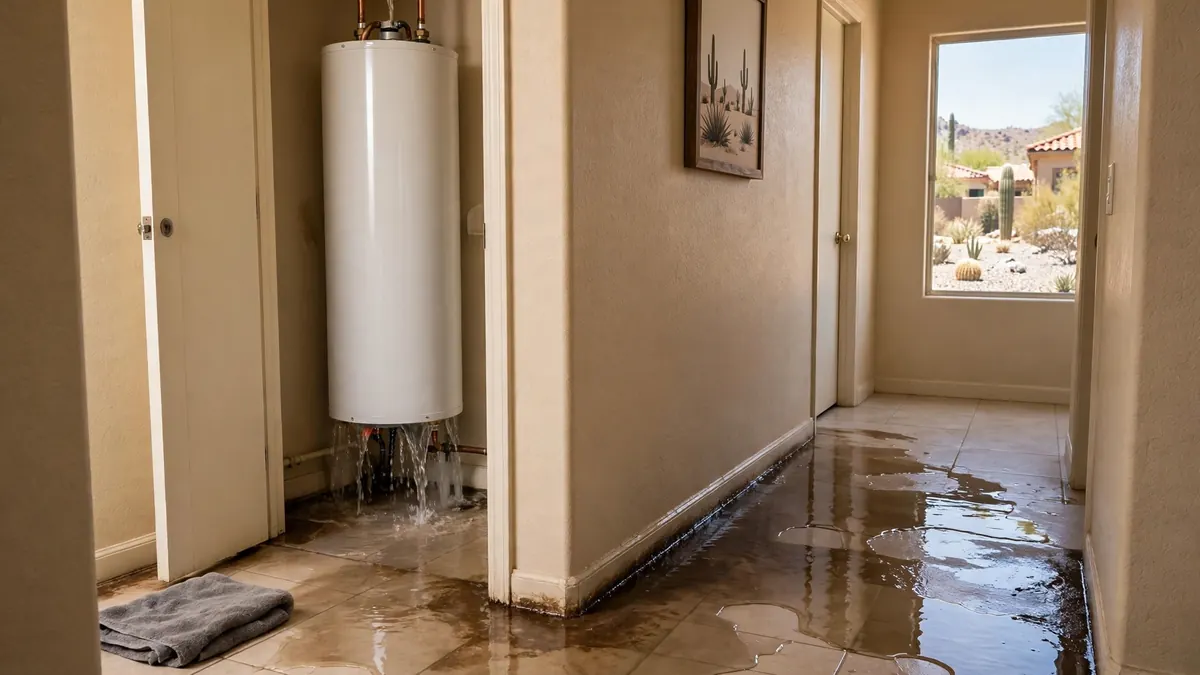
Location decides how much of your house the water reaches. A garage heater usually floods the garage slab and the base of the wall it shares with the house. A heater in a hall or utility closet sends water straight into finished rooms.
- Garage heaters. Common in most Casa Grande tract homes. Gas units in garages often sit on a raised platform. Water runs across the slab, soaks the drywall on the house side, and can slip under the door into a laundry room or hallway.
- Closet heaters. Found in some older homes and in many manufactured homes. Water goes under the closet door into carpet, tile, and baseboards in the hallway and nearby rooms. On a slab, it spreads under flooring and can reach rooms you would not expect.
- Attic or upstairs heaters. Less common here, but when one leaks the water comes through a ceiling.
A drain pan under the heater, piped to a drain or outside, catches small leaks and relief valve drips. It will not hold a tank that empties all at once, but it buys time for slow leaks. It is worth asking about when the heater is replaced, especially for an indoor closet location.
What happens to the water that already leaked?
The water you can see is only part of it. Water from a heater soaks the bottom of nearby drywall, wets baseboards and tack strip, and runs under tile, laminate, and carpet. Moisture readings show how far it went, and that wet material needs proper drying.
Clean water from a tank is treated as Category 1, so most materials can be dried in place if work starts early. Left sitting in Casa Grande's warm indoor air, it can start feeding mold within 24 to 48 hours. A restoration crew maps the moisture, extracts standing water, and sets air movers and dehumidifiers. Our page on structural drying explains how that works, and the water heater leak cleanup page covers what crews see after a tank fails in a garage or closet.
Will insurance pay for a leaking water heater?
Most standard homeowners policies cover sudden water damage from a heater that fails, minus your deductible, but not the heater itself. A slow leak that went on for weeks, or one you knew about, is often treated as maintenance and denied.
Before anything gets thrown out, photograph the heater, the rating plate, the leak point, and every wet area. Keep the failed part or ask the plumber to note the cause on the invoice. Check your declarations page and the water damage section of your policy, and see our guide to whether homeowners insurance covers water damage in Arizona for how adjusters look at sudden versus gradual leaks.
If the water has already reached drywall, flooring, or the next room, call (520) 380-1551. The line is open 24/7 and connects you with a local restoration crew to extract and dry what the heater left behind.
Questions homeowners ask
Can a water heater leaking from the bottom be fixed?
Is it safe to keep using a leaking water heater?
Why is my new water heater dripping?
Should I drain the water heater myself?
More from the blog
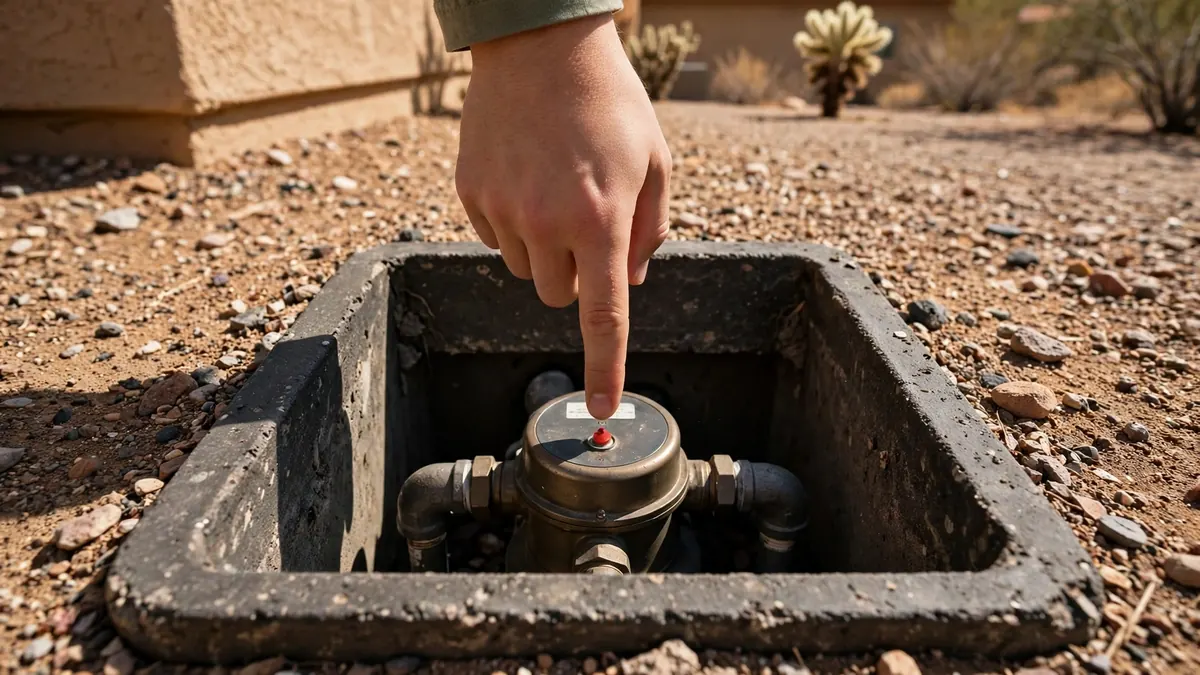 Leaks & PipesHow leak detection works: finding hidden leaks without tearing up your homeLeak detection finds hidden leaks without tearing up your home by narrowing the search step by step. A meter test confirms water is escaping, pressure tests...
 Leaks & PipesSlab leak signs in Casa Grande homes and what each one meansThe clearest slab leak signs are a warm spot on the floor, a water bill that rises with no change in habits, running water sounds with...
 Leaks & PipesBurst pipe in your house: what to do in the first 15 minutesIn the first 15 minutes after a pipe bursts, shut off the water at the main, keep away from water near outlets and cut power only...
Need help with damage right now?
Speak to a local restoration specialist on the 24/7 line, any time of day.
Call (520) 380-1551When you call: enter your ZIP code, then press 1 for water damage, 2 for fire damage or 4 for sewage backup.