Home › Blog › Water damage after a fire: why firefighting water needs drying too
Water damage after a fire: why firefighting water needs drying too
Yes, it does. Fire hoses and sprinklers soak ceilings, insulation, walls and the slab with water that has run through soot and ash, so crews treat it as dirty water. A restoration crew extracts it, removes what cannot be saved, and dries the structure with dehumidifiers and daily moisture readings while soot cleaning goes on. See fire damage restoration.
In this article
- Why does a house need water damage drying after a fire?
- How much water does firefighting leave behind?
- Where does firefighting water end up in a slab home?
- Why is firefighting water treated as dirty water?
- Does drying come before or after soot cleaning?
- How fast can mold start after a house fire in Arizona?
- Why do board-up and tarping matter for the drying?
- What gets dried and what gets torn out?
- Does insurance pay for the water side of a fire claim?
- What should you do about the water in the first two days?
- Questions homeowners ask
Why does a house need water damage drying after a fire?
Because putting out a fire usually leaves more water in a house than most plumbing failures do, and that water keeps causing damage after the smoke clears. If nobody extracts and dries it, you end up with warped floors, fallen ceilings and mold on top of the fire damage.
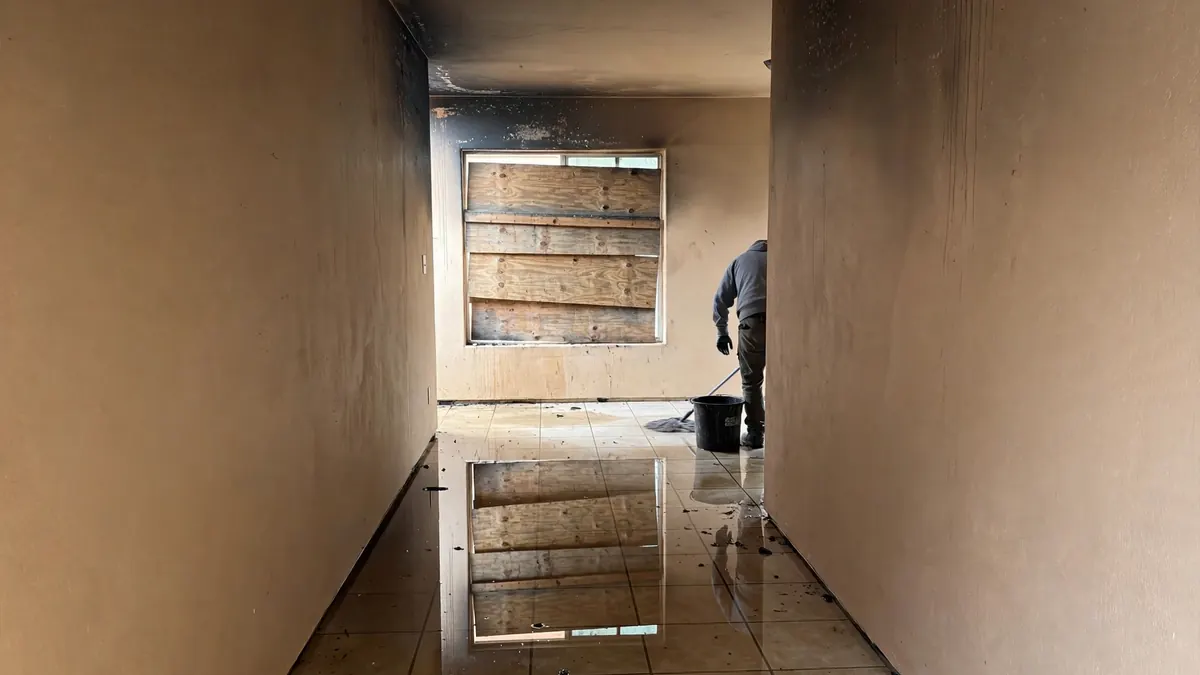
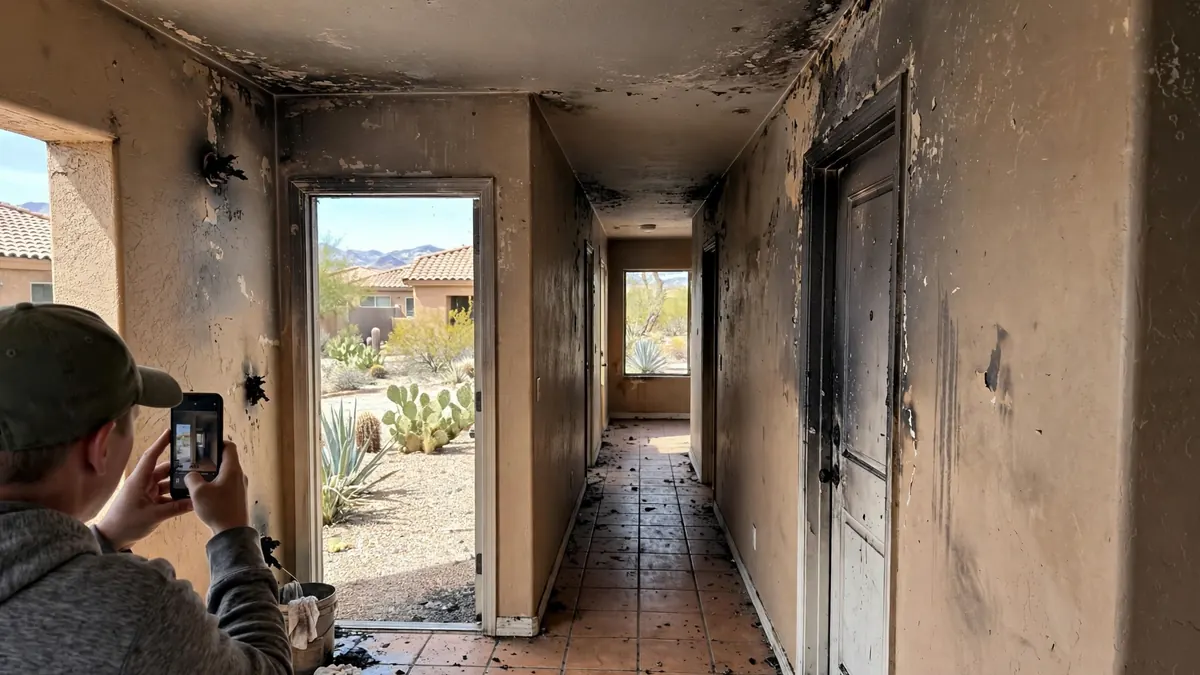
Most people walk back into a burned home and look at what is black. The rooms that look fine are often the wettest. Water from the hose line runs under walls, along the slab and down through light fixtures, and it does its damage quietly over the next few days. The fire department's job ends when the fire is out. Drying is left to you, your insurer and a local restoration crew.
How much water does firefighting leave behind?
A lot more than most homeowners expect. A single fire hose moves far more water per minute than any pipe in your house, and a few minutes of interior firefighting can put hundreds of gallons into a room, plus whatever goes in through the roof and windows.
How much stays in the house depends on a few things:
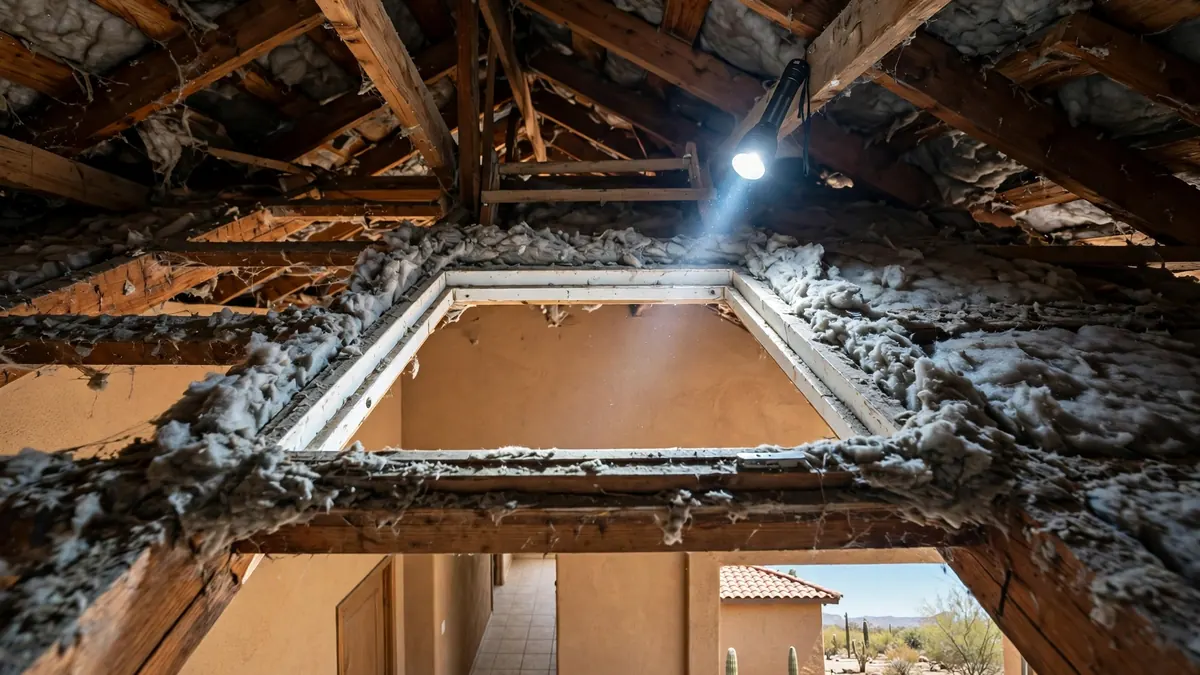
- How long the attack lasted. A kitchen fire knocked down in a minute leaves a wet kitchen. A fire that reached the attic means water sprayed onto blown-in insulation and the back of the ceiling drywall.
- Overhaul. After the main fire is out, firefighters open walls and ceilings to find hidden embers and wet down anything still smoldering. It is necessary work, and it adds water where the fire never reached.
- Sprinklers. An open sprinkler head keeps flowing until someone shuts the system valve. That water sits in the pipes for years, so it often comes out dark, rusty and foul smelling, and crews usually treat it as contaminated.
Where does firefighting water end up in a slab home?
It runs down and away from the fire room until something stops it, and in a Casa Grande home that is the concrete slab. From there it spreads sideways under flooring, into the bottom of the walls and under cabinets in rooms the fire never touched.
Ceilings and attic insulation
Most homes here have drywall ceilings under blown-in insulation, which gets heavy fast when wet. Watch for sagging or brown water dripping from light fixtures, and stay out from under any ceiling that sags.
Wall cavities
Water runs down inside walls, collects on the bottom plate and wicks up the drywall. The paint can look dry while the wall is wet a foot or more up.
Floors on the slab
Carpet pad soaks water up in minutes. Under tile, water sits on the concrete, and laminate or vinyl plank traps it where it barely evaporates. Many newer homes in Villago, Mission Royale and McCartney Ranch have plank flooring over a post-tension slab, and that combination hides water well.
Cabinets and built-ins
Most cabinet boxes are particleboard sitting right on the floor. Water under the toe-kick swells them within a day or two, often in a kitchen that only had smoke.

Why is firefighting water treated as dirty water?
Because it does not stay clean. Hose water picks up soot, ash, burned plastic and insulation on its way through the house, and it turns into a gray-black, acidic slurry that stains whatever it soaks into.
Restoration companies sort water by how contaminated it is. Water that has run through a burned room has picked up combustion residue and debris, so crews generally handle it as Category 2 at least, and as Category 3 where it mixed with burned contents or damaged drain lines, or sat for days. That changes what can be saved. Carpet pad and insulation soaked with soot-laden water are usually removed rather than dried, because the residue and the burnt smell stay in them after the water is gone. That is also why odor treatment fails when wet materials are left in place.
Does drying come before or after soot cleaning?
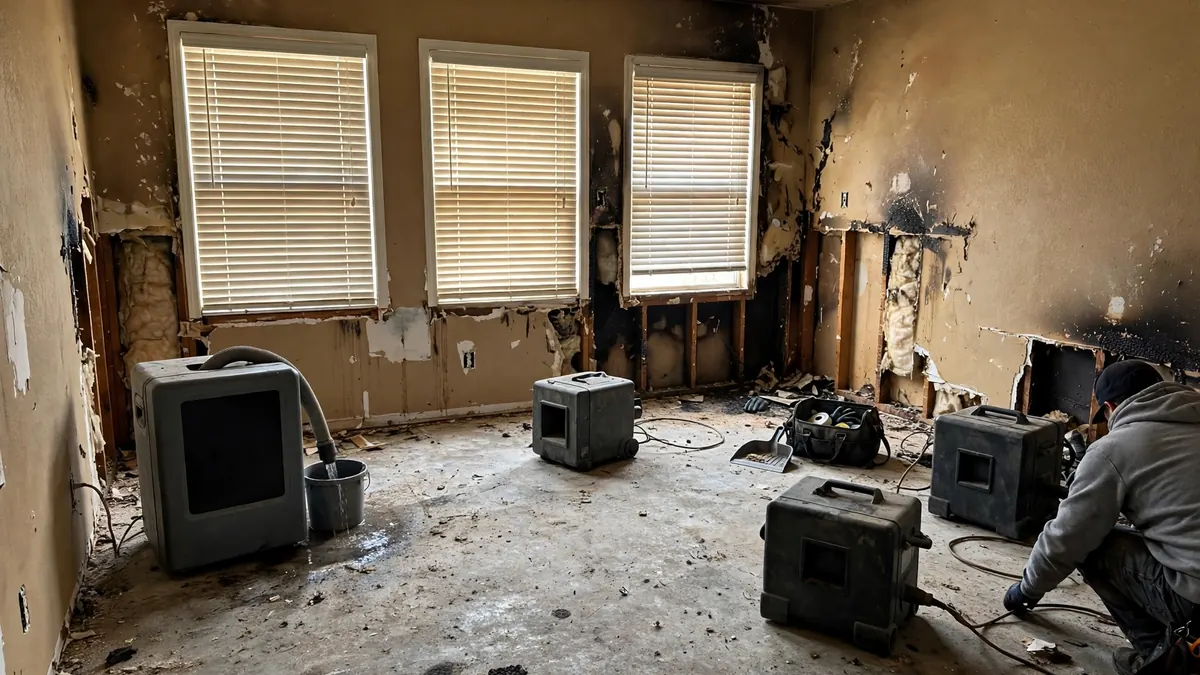
Both happen on the same job, in a set order. Loose soot comes off dry where possible, standing water is extracted, wet materials that cannot be saved come out, drying equipment goes in, and wet cleaning and odor treatment finish once the structure is drying.
- Make the building safe and close it up. Board-up, a roof tarp, and a check of power and gas.
- Remove loose, dry soot. HEPA vacuuming and dry chemical sponges on surfaces that did not get wet, before drying equipment raises the humidity and before air movers blow residue around.
- Extract standing water. From carpet, pad, tile and low spots on the slab.
- Remove what cannot be saved. Burned or soaked drywall, wet insulation, carpet pad and swollen cabinet panels, photographed for the claim.
- Set drying equipment. Dehumidifiers and air movers sized to the wet area, with air filtration running so soot is not pushed through the house.
- Clean surfaces and contents. Wet cleaning of the walls and ceilings that stay, and pack-out of belongings for off-site cleaning.
- Treat odor and seal. Once materials read dry, any remaining odor is treated and framing is sealed before rebuild.
The order matters. Air movers aimed at soot-covered walls blow residue into every room, and odor sealer brushed onto wet framing traps moisture inside the wall. For how crews set dry targets and decide when drying is finished, see our page on structural drying.
How fast can mold start after a house fire in Arizona?
Wet drywall, wood and pad can start growing mold in about 24 to 48 hours in a warm house, and a burned house is almost always warm. The power is often off, the AC is not running, and summer heat pushes the inside of a closed home well past comfortable.
The dry desert air outside does not help much. A boarded-up house with wet insulation overhead and wet pad underfoot is its own humid box. Power is the other practical problem. If service was cut, drying equipment needs a generator or temporary power until an electrician clears the panel, so ask about it early. If mold has already started by the time you get back in, that becomes a separate step covered on our mold remediation page.
If you cannot get back into the house right away, write down the date you were cleared to enter and the date drying started. A delay with a reason, such as a fire investigation or no power, reads very differently to an adjuster than a delay with no explanation.
Why do board-up and tarping matter for the drying?
Because you cannot dry a house that is open to the weather. Firefighters vent roofs and break windows to release heat and smoke, and until someone covers those openings, rain, dust and outside air keep getting in.
During monsoon season, from mid-June to the end of September, an open roof is the bigger risk. One storm cell can pour water through a vent hole onto insulation that is already wet, and a dust storm pushes grit into every damp surface. The rest of the year, an open house means the dehumidifiers are drying the neighborhood instead of a closed room.
It matters to the claim too. Most policies expect you to protect the property from further damage, and a dated board-up invoice is good proof that you did. The fire damage restoration page covers board-up and the rest of the fire process.
What gets dried and what gets torn out?
That depends on the material, how wet it got, and whether the water carried soot into it. This is how it commonly breaks down after a fire, though the crew's moisture readings and your adjuster have the final say.
| Material | What firefighting water does to it | Usual outcome |
|---|---|---|
| Blown-in attic insulation | Soaks, packs down, holds soot and odor | Removed and replaced |
| Ceiling drywall | Sags under wet insulation, stains through | Removed if sagging, stained through or soaked with dirty water |
| Wall drywall | Wicks water and soot up from the floor | Lower section often cut out near the fire, walls farther away may dry in place |
| Carpet pad | Absorbs dirty water fast | Almost always removed |
| Carpet | Holds residue and odor | Sometimes cleaned in lightly affected rooms, often replaced |
| Tile on the slab | Water sits under it and in the grout | Usually stays, slab dried through the grout lines |
| Laminate and vinyl plank | Traps water underneath | Often lifted so the slab can dry |
| Particleboard cabinet boxes | Swells and comes apart | Replaced once swollen |
| Framing and the slab | Absorbs water slowly, gives it up slowly | Dried in place, checked with meters, sealed if odor remains |
Wet materials in rooms that only had smoke are the best candidates for saving, as long as drying starts early.
Does insurance pay for the water side of a fire claim?
On most standard homeowners policies, water used to put out a covered fire is treated as part of the fire loss, not as a separate water claim. That usually means one claim and one deductible for the fire, the smoke and the water. Check your declarations page and ask your adjuster how your carrier handles it.
Keep photos of standing water and sagging ceilings before anything is removed, the crew's daily moisture logs, photos of what was torn out, and dated invoices for board-up and temporary power. Mold that grows because the house sat wet for a long stretch can be treated as secondary damage and reduced or denied, the same as after a burst pipe. Our guide on how Arizona homeowners insurance handles water damage explains secondary damage, deductibles and replacement cost.
What should you do about the water in the first two days?
Once the fire department clears the building, report the claim, get the house closed up, and start the water side of the job alongside the smoke cleanup instead of after it.
- Stay out of rooms with sagging or dripping ceilings.
- Leave the power off until an electrician or the utility says it is safe.
- Photograph every wet room, including rooms with no fire damage.
- Do not run the HVAC system, since it spreads soot and moisture through the ducts.
The restoration companies we work with handle fire, smoke and water as one job, from board-up through drying and cleaning. If firefighting water is sitting in your home in Casa Grande or nearby Pinal County, call (520) 380-1551. The line is open 24/7.
Questions homeowners ask
Is the water left after a fire clean water?
How long does it take to dry a house after a fire?
Will the fire department pump out the water?
Is firefighting water damage a separate insurance claim?
More from the blog
 Fire & SmokeSmoke damage cleanup after a house fire: what to do firstStart smoke damage cleanup only after the fire department clears the house. Then keep the AC off, photograph everything, throw out exposed food, and do not...
 Fire & SmokeHow to get smoke smell out of a house in ArizonaTo get smoke smell out of a house, remove the residue instead of covering it. Change the HVAC filter, wash soft goods, clean hard surfaces top...
 Fire & SmokeDoes homeowners insurance cover smoke damage in Arizona?Most standard Arizona homeowners policies cover sudden smoke damage, including smoke from your own fire, a neighbor's fire, or a wildfire, minus your deductible. Gradual buildup...
Need help with damage right now?
Speak to a local restoration specialist on the 24/7 line, any time of day.
Call (520) 380-1551When you call: enter your ZIP code, then press 1 for water damage, 2 for fire damage or 4 for sewage backup.