Home › Blog › Does homeowners insurance cover smoke damage in Arizona?
Does homeowners insurance cover smoke damage in Arizona?
Most standard Arizona homeowners policies cover sudden smoke damage, including smoke from your own fire, a neighbor's fire, or a wildfire, minus your deductible. Gradual buildup from candles, fireplaces, or smoking is usually not covered. The claim rests on proof of physical residue, so document soot before fire and smoke cleanup begins.
In this article
- Does homeowners insurance cover smoke damage in Arizona?
- How does a standard HO-3 policy treat fire and smoke?
- Is smoke from a neighbor's fire or a wildfire covered?
- What smoke damage is usually not covered?
- What does additional living expense pay for after smoke damage?
- How do you document soot and smoke damage for a claim?
- How do you build a contents inventory after a fire?
- What happens when the adjuster inspects smoke damage?
- What if you disagree with the insurer's smoke damage estimate?
- When should you call a restoration crew during a smoke claim?
- Questions homeowners ask
Smoke claims confuse people because the damage is often hard to see. A house can look almost normal and still smell like a campfire in every closet, with a film of soot on the ceilings and inside the ducts. Insurers deal with smoke claims all the time, but how smoothly yours goes depends on what caused the smoke, what your policy says, and how well the damage is documented.
This is general information about how standard policies usually work, not insurance advice. Your own policy and carrier decide what is paid, so keep your declarations page and policy booklet next to you as you read.
Does homeowners insurance cover smoke damage in Arizona?
Usually, yes, when the smoke damage is sudden and accidental. Fire and smoke are among the most commonly covered losses on a standard homeowners policy. That includes a kitchen fire, a furnace puffback, an electrical fire in the garage, and smoke that drifts in from a fire next door.
The questions an adjuster will focus on are simple:
- Was there a sudden event, such as a fire or a puffback, or did the residue build up slowly over time?
- Is there physical damage, meaning residue, staining, or odor in materials, and not only a smell in the air that faded?
- Did you take reasonable steps to protect the home from further damage once you knew about it?
- Is the damage listed or excluded in your policy form?
If the answer to the first two is yes, most standard policies treat it as a covered loss, minus your deductible.
How does a standard HO-3 policy treat fire and smoke?
On the most common homeowners form, called an HO-3, the house itself is covered for any direct physical loss that is not excluded, and your belongings are covered for a list of named perils. Fire and smoke appear on that list, so both the structure and the contents are normally covered for sudden smoke damage.
A standard policy is split into coverage parts, and a smoke claim can touch all of them:
| Coverage part | What it covers in a smoke claim | Typical examples |
|---|---|---|
| Coverage A, dwelling | The structure and attached parts | Soot cleaning on walls and ceilings, sealing, repainting, insulation replacement, duct cleaning, firefighting water damage |
| Coverage B, other structures | Detached buildings on the lot | A detached garage, shed, or casita that took smoke |
| Coverage C, personal property | Your belongings | Clothing, furniture, electronics, rugs, and the cost of cleaning them or replacing what cannot be cleaned |
| Coverage D, loss of use | Extra costs while the home cannot be lived in | Hotel or rental, extra food costs, pet boarding, extra mileage |
Many standard forms define the smoke peril as sudden and accidental smoke damage, and specifically include puffback from a furnace or other heating equipment. The same forms often exclude smoke from agricultural smudging or industrial operations. Look for the word smoke in the named perils section of your booklet to see the exact wording your carrier uses.
If you have an HO-5 policy, belongings are usually covered more broadly. Condo owners with an HO-6 and renters with an HO-4 have their own forms, where the association's master policy or the landlord's policy often covers the structure.
Is smoke from a neighbor's fire or a wildfire covered?
Usually, yes. Most standard policies do not require the fire to start on your property. If smoke from a neighbor's house, a vehicle fire, or a brush fire gets into your home and leaves residue or odor in your walls, ducts, and belongings, that is generally treated the same as smoke from your own fire.
Two things make these claims harder than a fire inside your own home:
- Proving physical damage. With your own fire, the damage is obvious. With outside smoke, the adjuster may want evidence that residue actually landed in the house. Sooty HVAC filters, gray film on window sills, ash in the cooler pads, and a smell that comes back on hot afternoons all help. Some insurers and restoration companies use surface samples sent to a lab to confirm soot or ash.
- Timing. Odor from outside smoke can seem to fade and then return in the heat. Report it when you first notice residue rather than waiting to see if it clears, because a late report makes it harder to tie the damage to the fire.
In Pinal County, brush and desert fires near the edges of Casa Grande, Eloy, Arizona City, and the farm areas can push smoke into homes miles away, especially when an evaporative cooler is pulling outside air inside. If the neighbor's fire was caused by their negligence, your insurer may pay you and then try to recover the money from the neighbor's carrier. That process, called subrogation, happens between insurers and usually does not change how you file.

What smoke damage is usually not covered?
Smoke damage that builds up slowly is usually not covered, because it is not sudden and accidental. Policies treat it as wear, maintenance, or a long-term condition.
| Situation | Usual treatment | Why |
|---|---|---|
| Kitchen grease fire, furnace puffback, garage fire | Usually covered | Sudden event with physical residue |
| Smoke from a neighbor's house or a wildfire | Usually covered | Sudden event, the fire does not have to start on your lot |
| Ghosting from years of candles | Usually not covered | Gradual buildup, treated as wear |
| Soot from a fireplace that has always drafted poorly | Usually not covered | Long-term condition and maintenance |
| Tobacco or nicotine film | Usually not covered | Gradual, not an accident |
| Smoke from agricultural smudging or industrial operations | Often excluded by name | Specific exclusion in many standard forms |
| Damage that got worse because the house was left open or wet | Often reduced or denied | Policy duty to prevent further damage |
The line can blur. A fireplace that suddenly backs up and fills a room with smoke is an event. A fireplace that slowly darkened the ceiling over ten winters is not. If you are unsure which side your damage falls on, report it and let the adjuster decide, rather than guessing and missing a deadline.
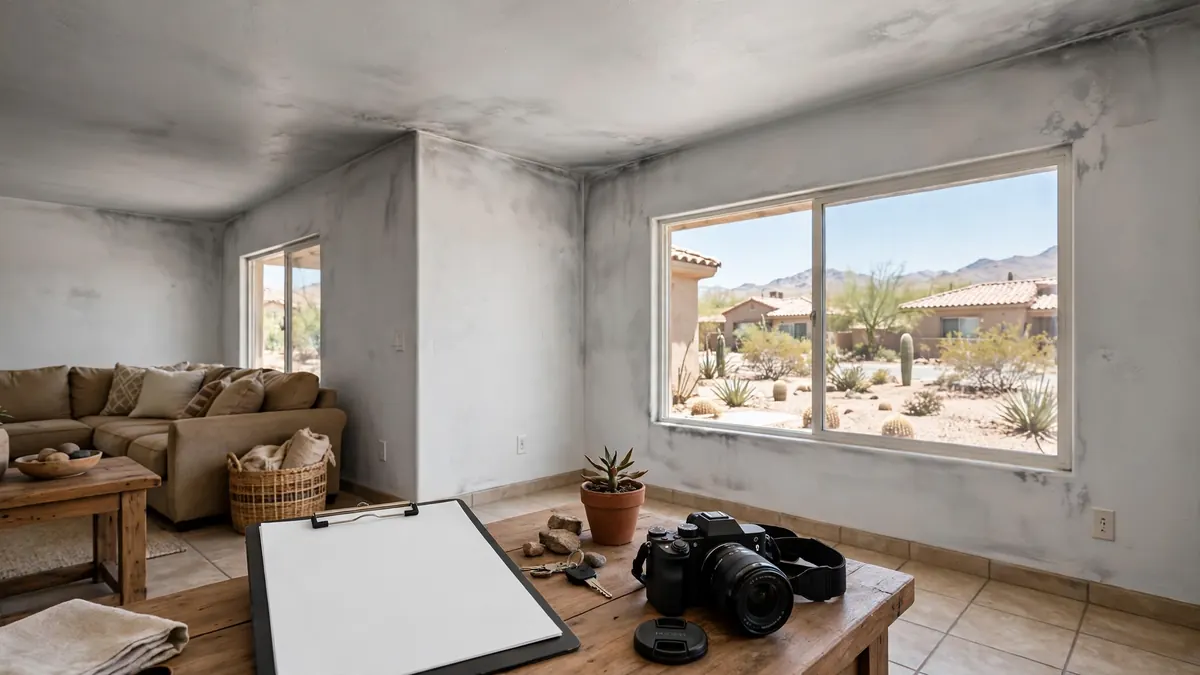
Gray or black lines along carpet edges, on ceilings above vents, or along the framing behind drywall are often candle or fireplace ghosting. They are easy to mistake for fire soot or even mold. Tell the adjuster honestly what you know about the source.
What does additional living expense pay for after smoke damage?
Additional living expense, often called ALE and part of Coverage D, pays the extra cost of living somewhere else while your home is not fit to live in after a covered loss. It covers the difference between your normal costs and your costs while displaced, not your whole budget.
Smoke damage can make a home unlivable even when nothing burned. Heavy odor, soot in the ducts, and cleaning that involves ozone or thermal fogging can all require you to stay elsewhere. Things ALE commonly pays for:
- A hotel, short-term rental, or apartment while the house is cleaned and repaired
- Restaurant meals above what you normally spend on groceries
- Extra mileage if you are staying farther from work or school, for example in Maricopa or Coolidge while your Casa Grande home is worked on
- Pet boarding if your temporary housing does not allow pets
- Laundry and some extra utilities
Check your declarations page for the ALE limit, which may be a dollar amount, a percentage of the dwelling limit, or a time limit. Many standard forms also pay loss of use for a limited time when a civil authority orders you out of your home because of a covered fire nearby, which can matter during a wildfire evacuation. Ask your adjuster up front how ALE will be paid, whether as an advance or by reimbursement, and keep every receipt.
How do you document soot and smoke damage for a claim?
Photograph and video every room before anything is cleaned, thrown out, or moved, including rooms that look fine at first glance. Smoke claims are won or lost on showing where residue actually went.
- Shoot each room from the doorway for a wide view, then move in for close-ups of ceilings, walls, and corners.
- Do a wipe test on camera. Run a white cloth or paper towel lightly across a shelf, window sill, or ceiling fan blade in each room and photograph the result next to a clean one.
- Photograph the HVAC. The filter, the return grille, the supply registers, and the area around them. Bag and keep the old filter.
- Open closets and cabinets and photograph the inside, including hanging clothes and stacked dishes.
- Check the attic hatch and photograph any staining on the insulation you can see from the ladder. Do not walk the attic.
- Write down the smell. Note which rooms smell, when it is strongest, and whether heat makes it worse. Smell is hard to photograph, so a written log helps.
- Record dates. When the fire happened, when you noticed smoke, when you called the insurer, and when cleanup started.
- Keep damaged items until the adjuster has seen them, unless they are a health hazard like spoiled food.
Restoration crews usually add their own documentation: residue type, affected rooms, photo logs, and moisture readings if firefighting water is involved. That record is useful to adjusters, and our guide on homeowners insurance and water damage in Arizona explains deductibles, secondary damage, and replacement cost, all of which apply to the water side of a fire claim.

How do you build a contents inventory after a fire?
Go room by room and list every damaged item with a description, rough age, where you bought it, and what it cost or would cost to replace. It is slow work, but the contents portion of a smoke claim often ends up larger than people expect, because odor affects every soft item in the house.
A few ways to make it manageable:
- Use a spreadsheet with columns for room, item, brand, age, quantity, original price, and replacement price.
- Pull records you already have. Online order history, credit card statements, warranty registrations, and old photos from your phone show what you owned.
- Separate cleanable from non-cleanable. Many items can be cleaned. Your insurer may pay for cleaning instead of replacement when cleaning works, so note which items you think are beyond cleaning and why.
- Ask about a pack-out. On larger losses, a restoration company can inventory, photograph, and move belongings off-site for cleaning. That inventory becomes part of the claim.
- Know your valuation. If your contents are covered at actual cash value, depreciation is taken off. If they are at replacement cost, you may get the depreciated amount first and the rest after you replace the item and show the receipt.
Electronics deserve their own line. Soot is acidic and conductive, so a TV or computer that turns on today can fail weeks later. Do not power on electronics that sat in heavy smoke until they have been checked, and list them even if they seem to work.
What happens when the adjuster inspects smoke damage?
After you report the claim, an adjuster contacts you, inspects the home, and writes an estimate of what it will cost to clean and repair. On smoke claims, the inspection usually covers every room, the HVAC system, the attic, and contents.
The process on a typical smoke claim looks like this:
- Report and claim number. Call your carrier or agent, describe what happened, and write down the claim number and the adjuster's name.
- Emergency mitigation. Board-up, tarping, water extraction, and stopping further damage usually happen right away, before the full estimate. Keep the invoices.
- Inspection. The adjuster walks the house, takes photos, and may take samples or ask for a test of the residue on an outside-smoke claim.
- Estimates. The adjuster writes a scope of work. Your restoration company writes its own. The two are compared line by line, which is normal.
- Contents review. Your inventory is reviewed, and the insurer decides what is cleaned and what is replaced.
- Payments. Checks for the structure often include your mortgage company as a payee, which adds a step before the money reaches the contractor. ALE and contents checks usually come to you.
- Final payment. On replacement cost policies, held-back depreciation is often released after the work is finished and documented.
Some insurers ask for a signed, sworn proof of loss by a deadline in the policy. Read any letter that mentions proof of loss carefully and ask questions if the deadline is unclear.
What if you disagree with the insurer's smoke damage estimate?
Start by asking for the adjuster's estimate in writing and comparing it line by line with your restoration company's scope. Many disagreements on smoke claims are about scope, not coverage: whether a room was affected at all, whether ducts need cleaning or replacing, and whether walls can be cleaned or need sealing and paint.
- Send evidence, not frustration. Wipe-test photos, a sooty filter, lab results on residue, and the crew's notes carry more weight than a phone argument.
- Ask for a re-inspection if rooms or the attic were not looked at.
- Read the appraisal clause. Many policies include an appraisal process for disputes about the amount of a loss, where each side picks an appraiser.
- Consider outside help. Public adjusters work for the policyholder for a fee, and an attorney can advise on larger disputes. Arizona's Department of Insurance and Financial Institutions takes consumer complaints about how claims are handled.
No one can promise how a claim will turn out. A clear record of the residue, the dates, and the work done gives you the strongest footing.
When should you call a restoration crew during a smoke claim?
Call as soon as the fire department clears the house and you have reported the claim. You do not need to wait for the adjuster to start protecting the home, and most policies expect you to prevent further damage. Early cleaning also keeps acidic soot from etching glass, metal, and finishes, which keeps more of the claim in the cleaning column instead of replacement.
The restoration companies we work with handle fire and smoke cleanup and smoke odor removal across Casa Grande and Pinal County, and many can work directly with your insurer on documentation. Prices are set by the company doing the work. If you want to talk through a smoke loss and what to document, call (520) 380-1551 any time on the 24/7 line.
Questions homeowners ask
Does homeowners insurance cover smoke damage from a wildfire?
Will insurance pay for a hotel after smoke damage?
Is candle soot covered by homeowners insurance?
Do I have to use the restoration company my insurer recommends?
Should I clean smoke damage before the adjuster comes?
More from the blog
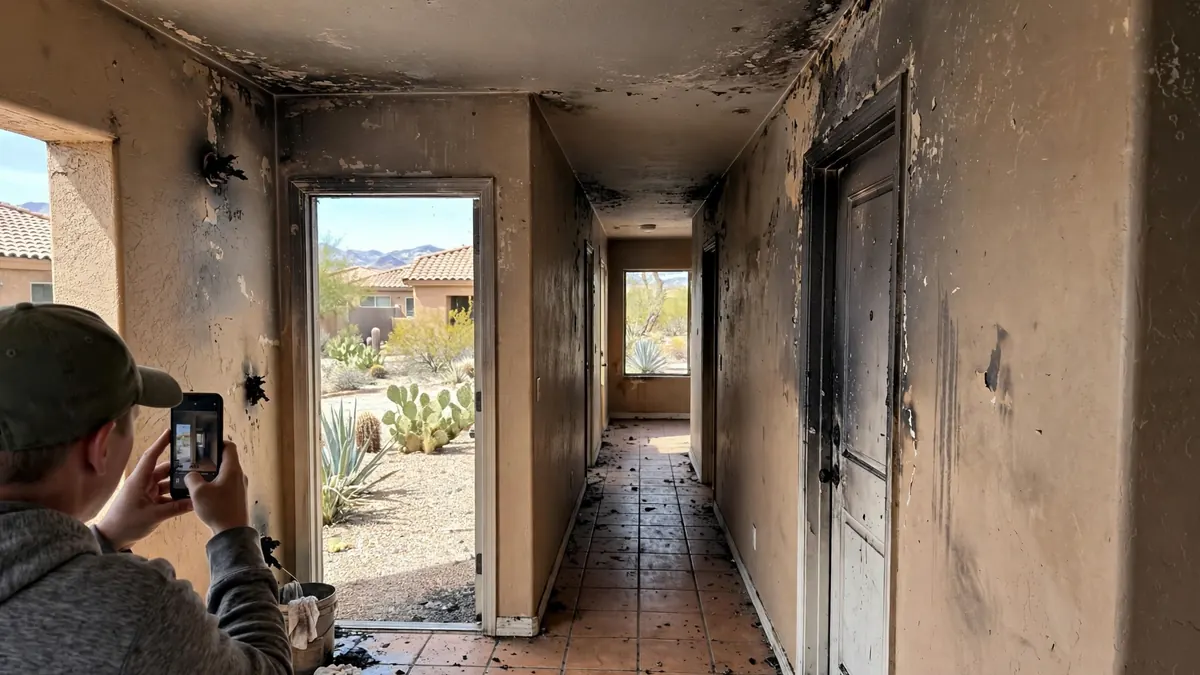 Fire & SmokeSmoke damage cleanup after a house fire: what to do firstStart smoke damage cleanup only after the fire department clears the house. Then keep the AC off, photograph everything, throw out exposed food, and do not...
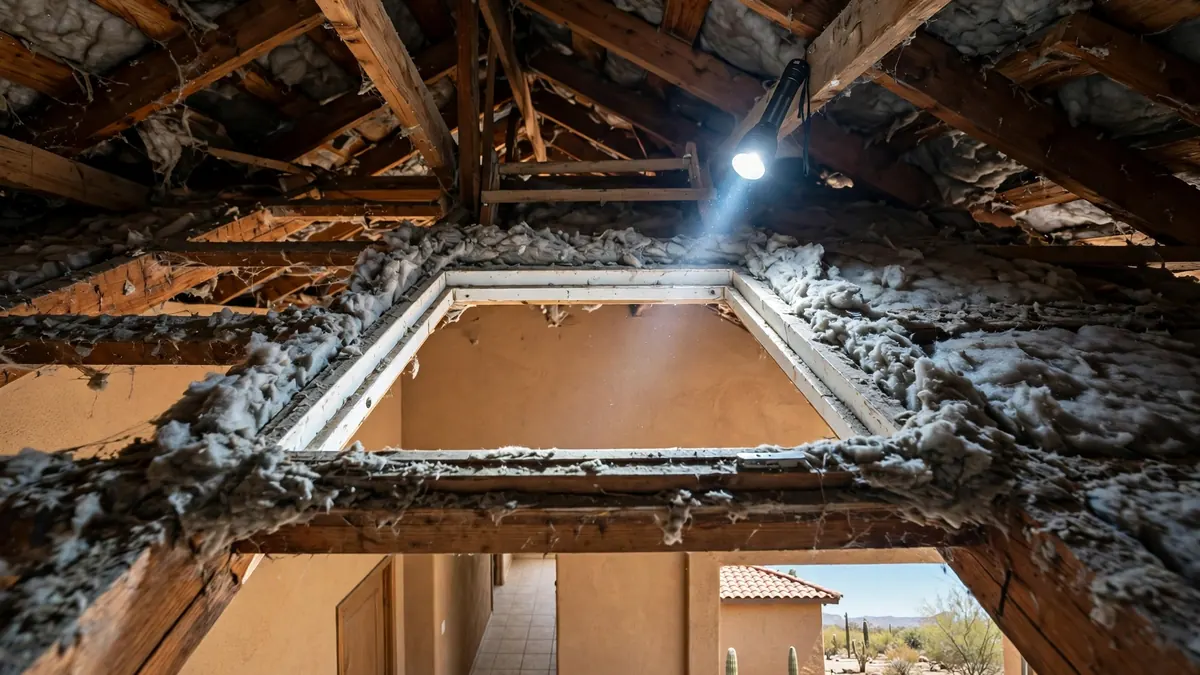 Fire & SmokeHow to get smoke smell out of a house in ArizonaTo get smoke smell out of a house, remove the residue instead of covering it. Change the HVAC filter, wash soft goods, clean hard surfaces top...
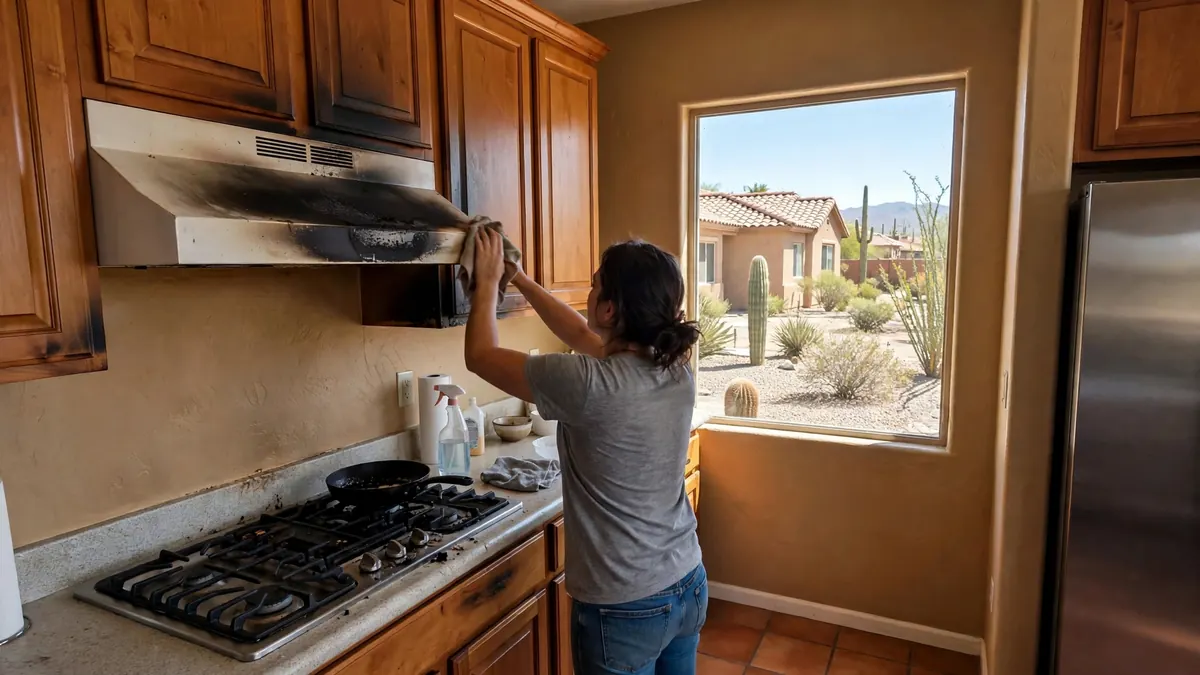 Fire & SmokeFire damage restoration cost in Casa Grande: what drives the billIn Casa Grande, smoke and soot cleaning alone often runs about $500 to $4,000, while a fire that also left firefighting water behind is often $5,000...
Need help with damage right now?
Speak to a local restoration specialist on the 24/7 line, any time of day.
Call (520) 380-1551When you call: enter your ZIP code, then press 1 for water damage, 2 for fire damage or 4 for sewage backup.