Home › Blog › PEX vs copper pipes in Arizona homes: which leaks and why
PEX vs copper pipes in Arizona homes: which leaks and why
Neither pipe is leak-proof, they just fail differently. Copper in older Arizona homes tends to develop pinhole leaks over years as water chemistry wears the pipe from inside. PEX in newer homes rarely fails along the tubing but can leak at fittings, especially poorly crimped ones or brass fittings, and it is damaged by sunlight before installation.
In this article
- Which leaks more in Arizona homes, PEX or copper?
- Why does copper get pinhole leaks here?
- Where does PEX fail?
- Does Arizona sun and heat damage PEX?
- What kind of pipe does your house have?
- How do copper and PEX leaks look different?
- How can you lower the risk of a leak?
- What should you do if your pipes leak?
- Questions homeowners ask
Which leaks more in Arizona homes, PEX or copper?
Neither one is clearly better at not leaking. They fail in different places and for different reasons. Copper tends to leak along the pipe itself as it thins with age. PEX tends to leak at the joints, where the tubing meets a fitting. Which one gives you trouble depends more on the age of the house, the quality of the install, and the water than on the material alone.
In Casa Grande, the split mostly follows when the house was built. Older homes in central Casa Grande, Coolidge, Eloy, and Florence were commonly plumbed in copper, often run under the slab. Newer subdivisions such as Villago, McCartney Ranch, Mission Royale, Cottonwood Ranch, Ghost Ranch, and Desert Sky were largely plumbed with PEX. That means two different sets of warning signs depending on which side of town you live on.
This article covers how each one fails, how to tell which you have, and what you can do about it. It is not a sales pitch for either. Both are used widely and both can last a long time when installed well.
Why does copper get pinhole leaks here?
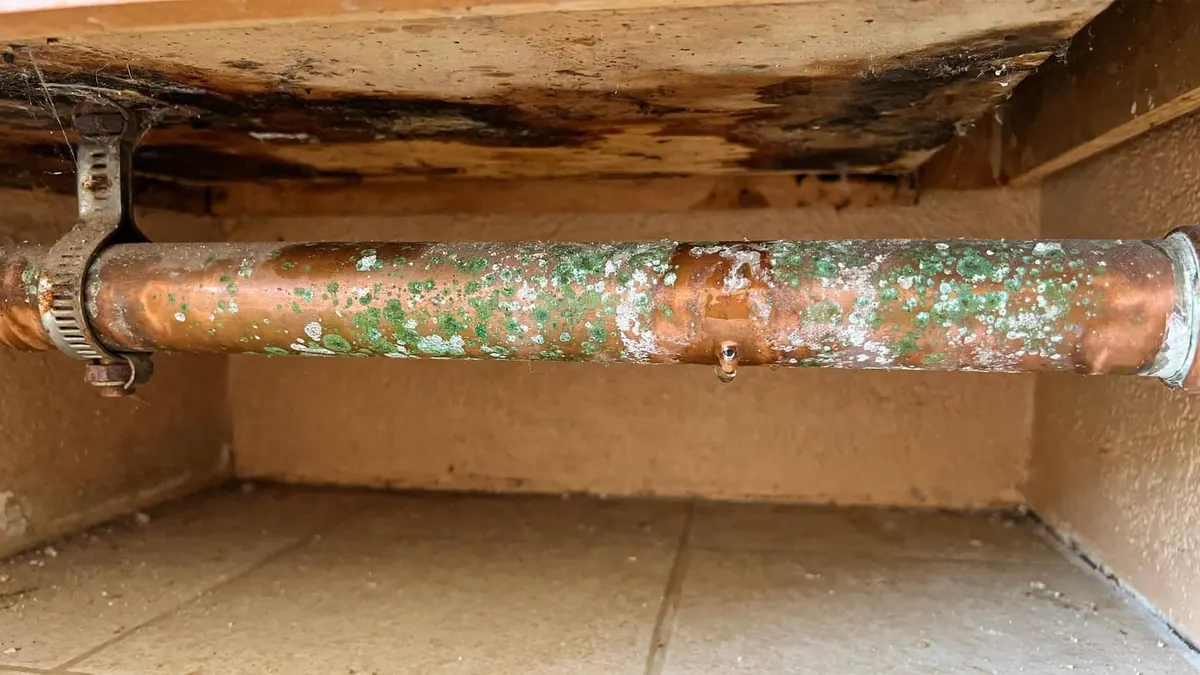
Pinhole leaks form when the inside wall of a copper pipe wears through in one small spot. Over years, water chemistry, the minerals the water carries, the disinfectants used to treat it, and the speed of the water all play a part. The result is a hole about the size of a pin that sprays or weeps.
A few things make this more likely in Pinal County homes:
- Hard water. Local groundwater carries a lot of calcium and magnesium, which leaves the white scale you see on faucets. Scale inside a pipe is uneven, and corrosion can concentrate under deposits and at spots where the protective layer breaks down.
- Thin-wall copper. Many older homes used the thinnest common grade of copper tubing for supply lines. It works fine for years, but there is less wall to lose before a hole appears.
- Flow and turbulence. Water moving fast through elbows, tees, and undersized lines wears the inside of the bend. Hot water recirculation loops that run constantly can add to this.
- Heat and movement. Hot lines expand and contract each time hot water runs. Under a slab, where the pipe touches gravel or concrete, that small motion can rub through the wall over time.
The most important thing to know about copper pinholes is that they rarely come alone. When one appears, the rest of that pipe has usually been through the same conditions for the same number of years. That is why a second leak in the same line is common, and why plumbers often suggest rerouting a line instead of patching it again. For what a leak under the floor looks like and how it is handled, see our page on slab leak detection and cleanup.
Where does PEX fail?
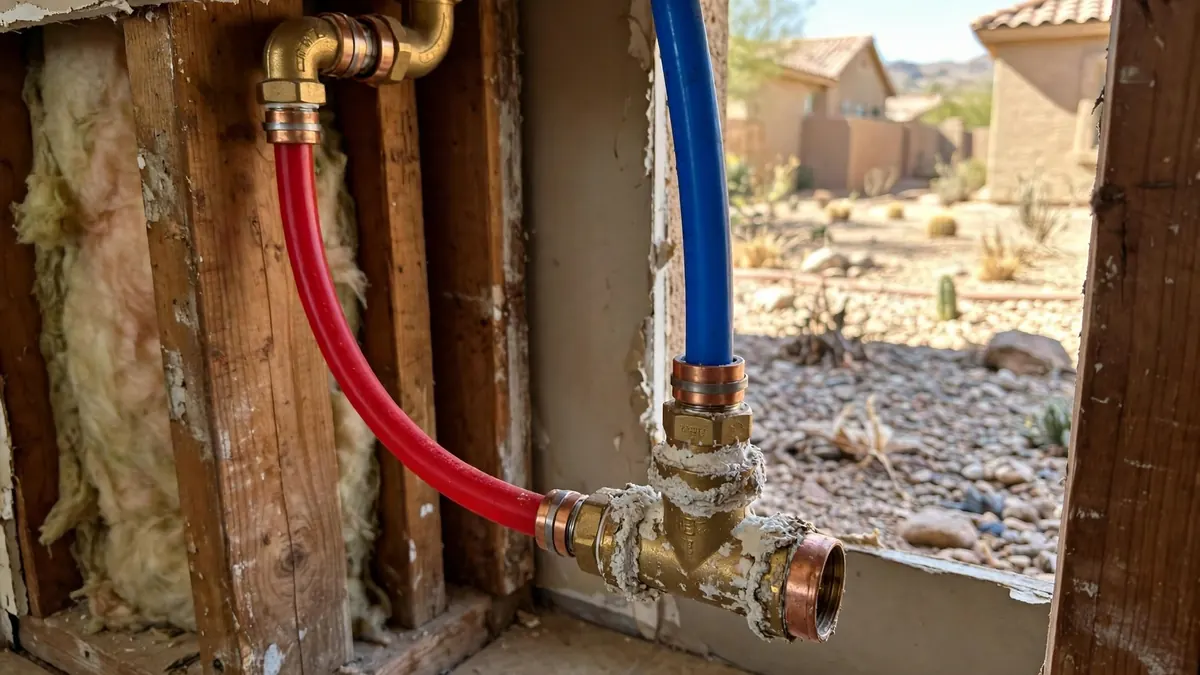
PEX tubing itself is flexible, tolerates hard water well, and is much less prone to bursting from a freeze than copper. When PEX leaks, it is almost always at a fitting, a connection to a fixture, or a spot where the tubing was damaged before or during installation.
- Crimp and clamp rings. Many PEX systems join tubing to fittings with a metal ring squeezed by a tool. A ring that is crimped crooked, set in the wrong spot, or made with a tool that is out of adjustment can hold for months or years and then start to weep.
- Brass fittings. Some brass fittings contain zinc, and certain water conditions can pull the zinc out over time. The fitting gets weak and crusty, often with white or blue-green buildup, and can crack or leak. Plastic fittings and lower-zinc brass are used partly to avoid this.
- Kinks and abrasion. PEX bent too sharply, pulled over a rough edge, or rubbing against framing or a metal strap can weaken in that spot.
- Transitions. The places where PEX connects to copper stub-outs, the water heater, a softener, or a fixture valve are common leak points, because two materials and two kinds of joint meet there.
- Pests. In attics and garages, rodents sometimes chew plastic lines. It is not common, but it happens.
A PEX fitting that lets go inside a wall or ceiling behaves much like a burst copper line. Our page on burst pipe cleanup covers what happens after that.
Does Arizona sun and heat damage PEX?
Sunlight does. Heat, within the pipe's rating, mostly does not. PEX is sensitive to ultraviolet light, and manufacturers limit how long it can sit in the sun. Tubing left on a job site or a pallet in the Arizona sun for too long can turn brittle, and that damage does not show until later.
What this means in practice:
- PEX does not belong outdoors in sun. Exposed runs on a roof, to an evaporative cooler, or along an exterior wall should be in conduit, wrapped, or replaced with a material made for sun exposure.
- Construction-site storage matters. In fast-growing areas, tubing and fittings sometimes sit outside before they are installed. You cannot see this damage in a finished house, which is one reason documenting early leaks in a new home is worth doing.
- Attic heat is a different issue. PEX is rated for hot-water temperatures, and summer attic heat is usually within its limits. Lines should still be under insulation, away from the roof deck, and clear of heat sources like the water heater flue.
If you see PEX running across your roof to a cooler or along an outside wall with no cover, have it looked at. Sun-damaged tubing can split with little warning.
What kind of pipe does your house have?
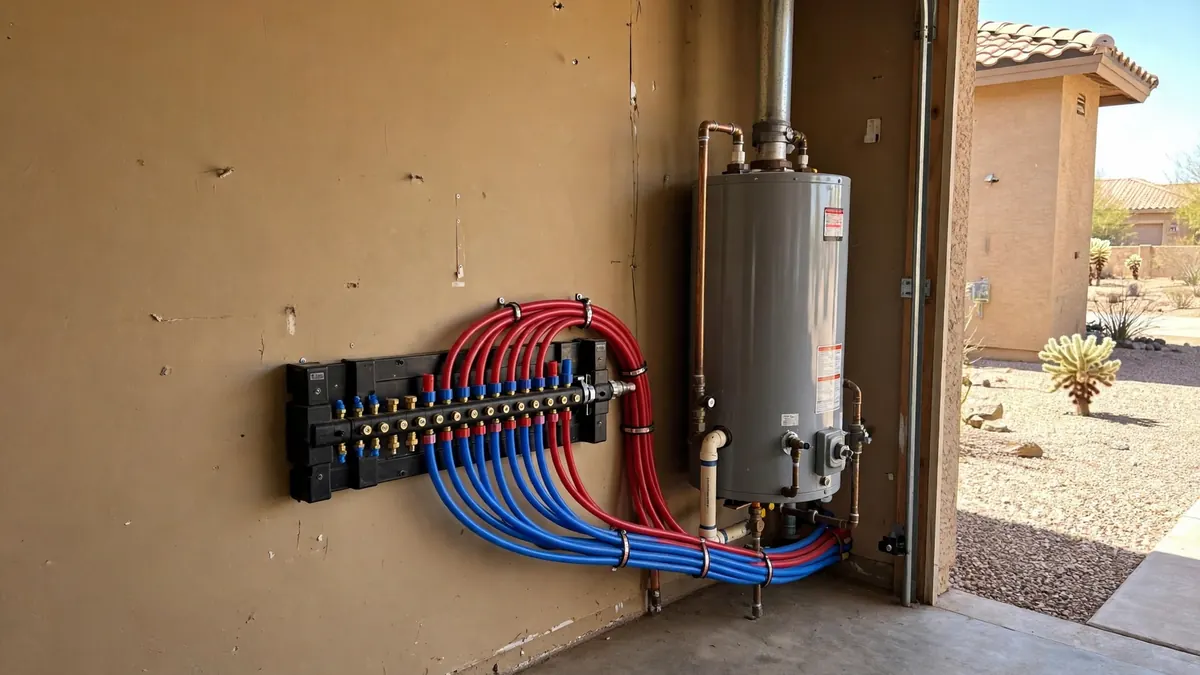
Look where the pipes come out of the wall or floor: under the kitchen and bathroom sinks, behind the toilets, and at the top of the water heater. Copper is a reddish or dull brown metal. PEX is flexible plastic tubing, usually red, blue, or white, often with printing along the side.
- Under sinks. Look at the stub-out behind the shutoff valve. A short copper stub can still lead to PEX inside the wall, so check other spots too.
- At the water heater. Many water heater connections are flexible braided lines, so look past them to the pipe they attach to. Those connections are also a common leak point, covered on our water heater leak page.
- In the garage. Many newer homes have a PEX manifold, a row of valves with tubing running out to each fixture, near the water heater or on a garage wall.
- Other materials. Some homes built in the 1980s and early 1990s have gray polybutylene tubing, which has a poor track record and is often replaced. Some have CPVC, a cream or tan rigid plastic. If you see either, it is worth asking a plumber about.
How do copper and PEX leaks look different?
They usually show up in different places and with different clues. Knowing which material you have tells you what to watch for.
| Copper | PEX | |
|---|---|---|
| Where it usually fails | Along the pipe, at bends, under the slab | At fittings, crimp rings, transitions and fixture connections |
| How it starts | A pinhole that weeps or sprays a fine stream | A slow weep at a fitting, or a sudden release if the fitting lets go |
| Early clues | Green or blue staining on exposed fittings, warm floor spots on a hot line | White or crusty buildup on brass fittings, damp spots near manifolds or fixtures |
| Freeze risk | Can split in a hard freeze | More tolerant, but fittings can still fail |
| Chance of a repeat leak | Higher, since the whole line has aged | Often lower if the problem was one bad fitting |
| Common repair | Spot repair, reroute, or repipe | Replace the fitting, or the section of tubing |
How can you lower the risk of a leak?
Control water pressure, keep an eye on the parts you can see, and know where your shutoff is. Those three things do more than anything else, whatever the pipe is made of.
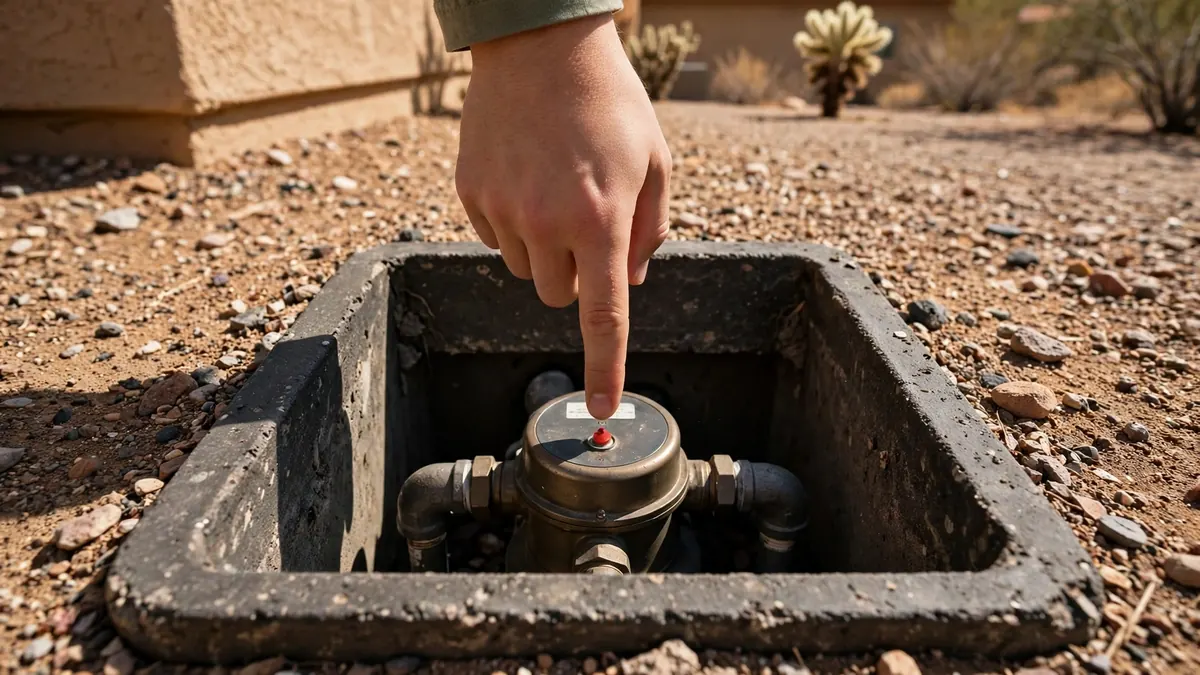
- Check the water pressure. A simple gauge on a hose bib reads house pressure. If it runs high, a pressure reducing valve near the main may need adjusting or replacing. High pressure stresses every joint and hose in the house.
- Look at the thermal expansion setup. Water expands when the heater warms it. An expansion tank near the water heater, if your home has one, absorbs that pressure. A plumber can check whether it still works.
- Inspect what you can see. Twice a year, open the sink cabinets, look at the water heater connections and the manifold, and check for crust, staining, or damp spots.
- Replace old supply hoses. Toilet, faucet, washing machine, and ice maker lines fail more often than the pipes in the walls.
- Consider leak sensors or an automatic shutoff. Small sensors under sinks and by the water heater, or a valve that closes the main when it detects a leak, are especially useful in homes that sit empty part of the year.
- Know your main shutoff. Find it and make sure it turns before you need it.
What should you do if your pipes leak?
Shut off the water, find out what failed, and get the wet areas dried. For copper, ask the plumber about the condition of the rest of the line before choosing a repair. For PEX, ask whether the failed fitting was a one-off or part of a pattern.
Keep the failed piece of pipe or fitting and photograph where it was. Most standard homeowners policies cover sudden water damage but not the pipe repair itself, and they often exclude damage from leaks that ran a long time. The failed part helps show what happened. If your home is new, check your builder warranty paperwork, since some plumbing defects may fall under it.
If water has reached floors, walls, or ceilings, call (520) 380-1551. The line is open 24/7 and connects you with the restoration companies we work with in Casa Grande and nearby Pinal County towns to extract and dry the damage. We do not handle the plumbing repair itself. Prices are set by each restoration company and vary with the job.
Questions homeowners ask
Is PEX better than copper for hard water?
Why does my copper pipe keep getting pinhole leaks?
Can PEX be used outside in Arizona?
What pipes do newer Casa Grande homes have?
More from the blog
 Leaks & PipesHow leak detection works: finding hidden leaks without tearing up your homeLeak detection finds hidden leaks without tearing up your home by narrowing the search step by step. A meter test confirms water is escaping, pressure tests...
 Leaks & PipesSlab leak signs in Casa Grande homes and what each one meansThe clearest slab leak signs are a warm spot on the floor, a water bill that rises with no change in habits, running water sounds with...
 Leaks & PipesBurst pipe in your house: what to do in the first 15 minutesIn the first 15 minutes after a pipe bursts, shut off the water at the main, keep away from water near outlets and cut power only...
Need help with damage right now?
Speak to a local restoration specialist on the 24/7 line, any time of day.
Call (520) 380-1551When you call: enter your ZIP code, then press 1 for water damage, 2 for fire damage or 4 for sewage backup.