Home › Blog › New-build homes near the Lucid plant: common water problems
New-build homes near the Lucid plant: common water problems
New homes around Casa Grande most often leak at PEX fittings that were not crimped right, at fixtures and appliance lines installed in a hurry, and at AC condensate lines. Settling and changed yard grading also send monsoon water toward the house. Report problems to the builder in writing and document everything. See water damage in Villago.
In this article
- What water problems show up most in new-build Casa Grande homes?
- Why do PEX fittings fail in newer homes?
- What other leaks are common in a home's first year?
- Does settling cause leaks in a new home?
- Why does drainage grading matter in a new subdivision?
- How does a builder warranty handle water problems?
- What should you document in a new home?
- What should you do when water shows up in a new home?
- Questions homeowners ask
What water problems show up most in new-build Casa Grande homes?
The most common water problems in new homes are PEX fittings that were not made up right, supply lines and drains installed in a hurry, AC condensate lines that were never fully connected, and yards graded or reworked so water runs toward the house. Most show up in the first year or two, often during the first monsoon.
The growth around the Lucid Motors plant and along the I-10 and I-8 corridor has filled Casa Grande with new subdivisions. New construction is good news for plumbing in general. The pipe is new, there are no decades of hard water scale, and the water heater has years left. The risk is different, not gone. A new house is the product of many trades working fast, and a single missed step by one of them can hide behind drywall until it leaks.
Our neighborhood pages for Villago and McCartney Ranch describe what a flood in these homes looks like. This guide goes into why new homes leak, what the builder warranty usually covers, and what to document from the day you close.
Why do PEX fittings fail in newer homes?
PEX tubing itself holds up well, including in hard water. When a new PEX system leaks, it is usually at a fitting: a crimp or clamp ring that was not fully closed, a connection that was not seated, or tubing that got damaged during construction.
- Incomplete crimps or clamps. Each connection is made with a tool that squeezes a ring around the tubing and fitting. If the ring is not fully compressed or sits in the wrong spot, the joint can hold for months and then start to weep or let go.
- Fittings under stress. A line pulled too tight around a corner, or bent sharply right at a fitting, puts constant strain on the joint.
- Nails and screws. PEX runs through walls where later trades hang cabinets, baseboards, shelving and TV mounts. A screw that nicks a line may seal itself for a while, then leak.
- Sun exposure during the build. PEX is not meant to sit in direct sunlight for long. Tubing left exposed on a jobsite in Arizona sun can weaken before the walls go up.
- Water pressure. High water pressure strains every fitting in the house. If your home has a pressure regulator near the main, ask a plumber to check the pressure once in a while.
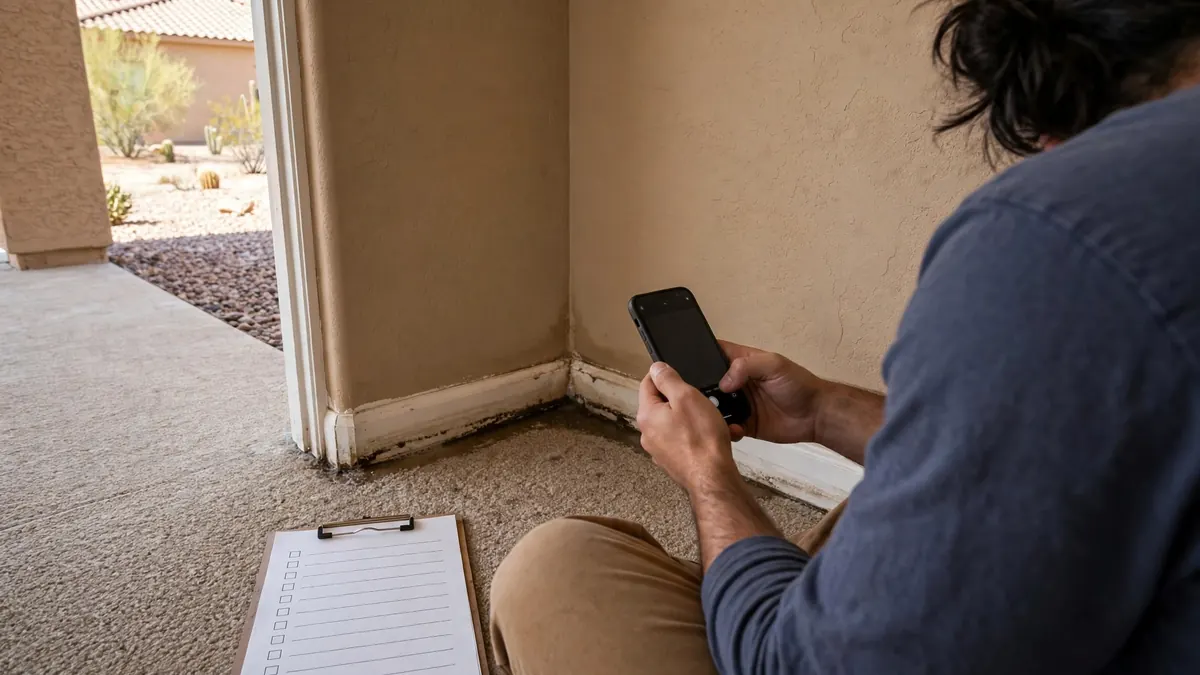
Most fitting failures happen behind drywall, under cabinets, or where lines come up through the slab. The first sign is often damp baseboard, a stain at the bottom of a wall, or a cabinet floor that feels soft.

What other leaks are common in a home's first year?
Beyond PEX fittings, the most common early leaks come from fixtures and appliances that were installed at the end of construction, when the schedule is tight. These are usually small leaks that run quietly until they stain something.
- Shower pans and tub drains. A drain connection or shower pan that was not sealed right leaks only when the shower runs, which makes it hard to trace.
- Toilet wax rings. A toilet that was set before the floor was finished, or not tightened evenly, can rock slightly and leak at the base.
- Refrigerator lines. Ice-maker lines are often connected by an appliance installer on move-in day. A loose compression fitting behind the fridge is a common slow leak.
- Washer boxes and hoses. The connection inside the wall box, or the hoses that came with the machine, can drip down into the wall.
- AC condensate lines. A drain line not glued at a joint, not sloped correctly, or not connected to the pan can drip into a closet or ceiling the first time the AC runs hard. See our page on AC condensation water damage.
- Windows and roof penetrations. A window without proper flashing, or a vent boot that was not sealed, may not leak until wind-driven monsoon rain hits that side of the house.
Does settling cause leaks in a new home?
Normal settling causes small cracks in drywall, stucco and concrete, and those are usually not leaks. Settling matters for water when it changes how the ground slopes around the house, cracks stucco where water can get in, or shifts soil over buried water and sewer lines.
- Hairline slab cracks. Concrete shrinks as it cures, and small cracks in the slab are common. They usually show up under flooring and in the garage. On a post-tension slab, nobody should cut or drill into the floor without first locating the tendons.
- Backfill settling. The soil put back around the foundation and over utility trenches settles over the first year or two. A low spot can form next to the house where water pools after storms.
- Stucco cracks. Small cracks are cosmetic, but cracks around windows, doors and wall penetrations can let rain behind the stucco.
- Doors and drywall. Doors that start to stick and nail pops in drywall are normal settling signs. A stain or damp spot near them is not, and should be checked.
Why does drainage grading matter in a new subdivision?
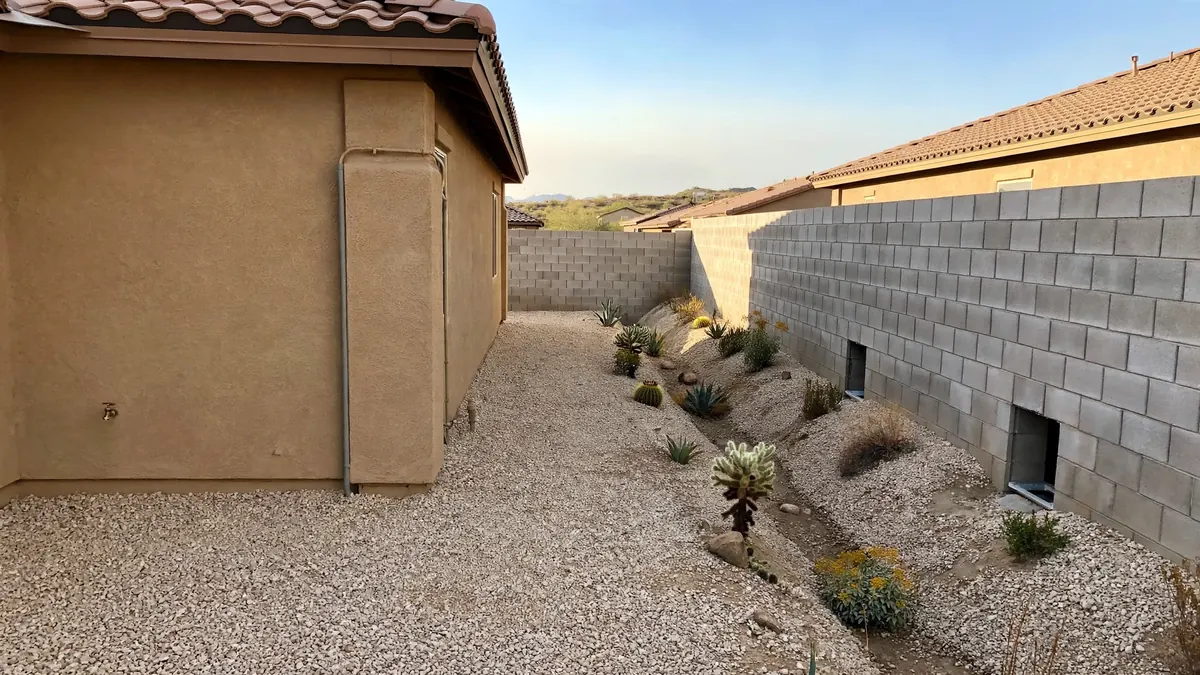
Every new lot is graded so water flows away from the house and toward the street or a retention area. When that slope gets changed, by settling or by new yard work, monsoon water can sit against the foundation or run into the garage and back patio.
Casa Grande soil sheds water fast during a heavy cell, so the grade around the house does a lot of work. The most common ways new homeowners undo it by accident:
- Building up planting beds or rock next to the house so the soil sits higher than it should against the stem wall.
- Installing pavers, turf or a patio extension that slopes back toward the house.
- Blocking side-yard swales or the drain openings at the bottom of block walls with plants, rock or storage.
- Putting drip emitters right next to the foundation.
- Pointing downspouts or roof drains at the base of the wall instead of out into the yard.
Your HOA or builder may have rules about lot drainage, and some builder warranties will not cover drainage problems once the owner has changed the grade. Before any yard work starts, take photos of how the yard drains after a hose test or a storm. Our monsoon preparation guide has a full pre-season checklist.
How does a builder warranty handle water problems?
Most builder warranties cover defects in how the house was built, such as a bad plumbing connection, for a set period, and many separate coverage into shorter terms for workmanship, longer terms for systems like plumbing, and the longest for major structure. Your warranty document sets the exact terms, so read it closely.
A few general points are worth knowing:
- Repair versus damage. A warranty may pay to fix the leaking fitting but treat the water damage it caused differently. Some cover resulting damage, some limit it, and some point you to your homeowners insurance.
- Written notice. Warranties usually require you to report problems in writing, often through a portal or form, within the coverage period. A phone call to the site office may not count.
- You still have to stop the water. Waiting for the builder's schedule while water sits on the floor can make things worse. Stop the leak, document it, and ask the builder in writing how they want you to handle emergency drying.
- Homeowners insurance still applies. Most standard policies cover sudden, accidental water damage regardless of the home's age, minus your deductible. Your insurer and the builder may sort out between themselves who pays in the end.
- Owner changes. Work you add after closing, such as a new water line to a fridge or a yard grading change, may not be covered by the builder.
What should you document in a new home?
Document the condition of the house at closing, keep every warranty request in writing, and photograph any water problem before it is repaired. Good records make warranty claims and insurance claims much easier.
| What to record | When | Why it helps |
|---|---|---|
| Walk-through photos of every room, ceiling, cabinet base and the garage | At closing | Shows the house was dry and undamaged when you took it |
| Photos of the yard grade and drainage paths | Before any yard work | Shows the original grade if drainage is disputed later |
| Location of the main shutoff, pressure regulator and water heater valves | Move-in week | Lets anyone in the house stop water quickly |
| Copies of warranty documents and the request process | At closing | Deadlines and rules are in the fine print |
| Every warranty request, with dates and the builder's response | Each time | Proves you reported the problem within the coverage period |
| Photos and video of any leak, the source and the wet area | Before cleanup | Shows cause and extent to the builder and insurer |
| Moisture readings and drying logs from the crew | During drying | Shows the house was dried properly |
| Water bills | Monthly | A sudden jump can point to a hidden leak |
Before your warranty periods end, walk the house and file a written request for anything that looks off: a damp baseboard, a stain under a sink, a toilet that rocks, a ceiling mark under the AC. Small water problems found late in a warranty period are easier to get fixed than ones found after it ends.
What should you do when water shows up in a new home?
Close the main shutoff, photograph the source and the wet area, and report it to the builder in writing if the home is under warranty. Then get the wet materials checked and dried, because drywall and baseboards on a slab hold water longer than they look.
- Close the main valve, usually near the garage or an outside wall.
- Photograph and video the leak, the source and every wet room.
- Submit a written warranty request and keep the confirmation.
- Call your insurer if the damage is significant, and ask how the claim interacts with the builder warranty.
- Have the wet area checked with a moisture meter and dried.
- Keep the failed fitting or part for the builder and adjuster.
Prices are set by the restoration company and vary. Most water damage jobs in the area run about $1,300 to $5,500, and one room of clean water caught early is often about $400 to $1,500. If you have water on the floor or a stain that keeps spreading in a new Casa Grande home, call (520) 380-1551. The line is open 24/7 and connects you with a local restoration crew for extraction and drying.
Questions homeowners ask
Are PEX pipes reliable in Arizona?
Will my builder warranty pay for water damage?
Is a crack in my new garage slab a leak?
Should I call the builder or a restoration crew first?
More from the blog
 Local GuidesWater damage restoration cost in Florence, AZMost water damage restoration jobs in Florence, AZ run about $1,300 to $5,500. One room of clean water caught early is often $400 to $1,500, and...
 Local GuidesWater damage in Maricopa, AZ homes: slab leaks, HOAs and newer buildsMost Maricopa homes were built in the 2000s and later on concrete slabs, and many are now old enough that original water heaters, supply lines, washer...
 Local GuidesSan Tan Valley water damage: what homeowners should knowSan Tan Valley is mostly newer slab homes in HOA subdivisions, so the common water problems are slab leaks, PEX fitting failures in walls and ceilings,...
Need help with damage right now?
Speak to a local restoration specialist on the 24/7 line, any time of day.
Call (520) 380-1551When you call: enter your ZIP code, then press 1 for water damage, 2 for fire damage or 4 for sewage backup.