Home › Blog › Manufactured and mobile home water damage in Pinal County
Manufactured and mobile home water damage in Pinal County
In a manufactured home, leaks soak particleboard or OSB floors and collect in the belly wrap under the home, while monsoon rain gets in at roof seams, vents and the marriage line. Check for a sagging belly, soft floors and musty vents, and shut off the water first. See mobile home water damage.
In this article
- Why does water damage a manufactured home differently?
- How can you tell if water is trapped in the belly?
- Can a wet particleboard floor be saved?
- Where do manufactured home roofs leak during the monsoon?
- What does skirting have to do with water damage?
- Which leaks are most common inside a manufactured home?
- Who is responsible for a leak in a park home?
- How does insurance work for manufactured home water damage?
- What should you do first when you find a leak?
- Questions homeowners ask
Why does water damage a manufactured home differently?
A manufactured home sits above the ground on piers, with its plumbing and ducts in a sealed belly underneath and floors often made of particleboard or OSB. Water that would run across a concrete slab in a site-built house instead soaks into the floor and collects under it, out of sight.
That changes what you look for and what gets replaced. In a slab home, the usual questions are how far the water spread across the floor and how high it wicked up the drywall. In a manufactured home, the bigger questions are how much water is sitting in the belly, whether the subfloor has gone soft, and whether the ducts under the floor got wet. Our mobile home water damage page lays out how a crew does the cleanup. This guide covers what you can check yourself and the parts specific to Pinal County homes and parks.
How can you tell if water is trapped in the belly?
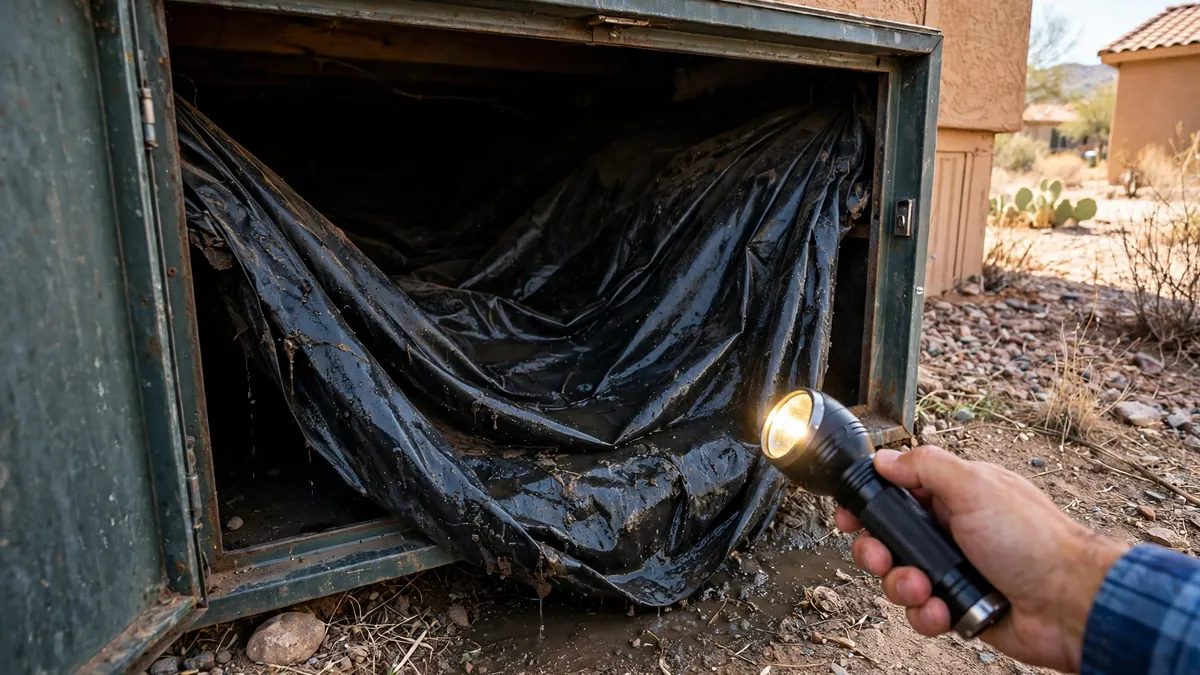
Look for a sagging spot in the belly wrap, water dripping from under the skirting, soft floors, or a musty smell coming out of the floor vents. Any one of these after a leak means water probably collected under the home.
The belly wrap, sometimes called the bottom board, is the fabric or plastic sheet stapled under the floor joists. It holds the insulation and usually the main heating and cooling duct. When a supply line or drain leaks, water runs down through the floor and lands on that sheet. Because the sheet is fairly tight, it can hold a surprising amount of water before it sags or tears.
You can do a careful look from outside without crawling under:
- Turn off the water at the home's main shutoff first.
- Open a skirting access panel, usually near the water heater or the plumbing side of the home.
- Shine a flashlight along the underside. Look for a low bulge, wet or stained fabric, and drips.
- Check the ground under the home for a wet or muddy patch.
- Press lightly on a bulge with a long stick. If it feels heavy and full, water is pooled there.
Do not crawl under the home if the ground is wet near any electrical lines, and watch for scorpions, black widows and snakes, which like the shade under Pinal County homes in summer. Do not cut the belly wrap yourself to drain it. Water mixed with wet insulation is heavy, and a crew can drain it in a controlled way and patch the wrap afterward.
Can a wet particleboard floor be saved?
Usually not if it has swollen or gone soft. Particleboard loses its strength once it soaks up water and does not recover when it dries. OSB holds up better and can often be dried if work starts early. Plywood, found in some homes, dries the best of the three.
To check your floor, walk the area slowly in socks. A soft or bouncy spot, a hump at a seam, or a floor that sinks slightly near the tub or toilet usually means the board underneath has swollen. Vinyl and laminate can hide damage for a while, so a crew may lift a corner or check from below with a moisture meter.
When a section has to go, the repair usually looks like this:
- The floor covering is pulled back past the damaged area.
- The soft subfloor is cut out between the floor joists.
- Joists are checked for rot and dried, and wet insulation below is removed.
- New subfloor is fastened and glued in, then the belly wrap is patched below.
- Floor covering goes back down after the area tests dry.
Bathrooms and the laundry area are the most common spots, because slow drips from toilets, tubs and washers soak the same small area for months. A floor that flexes near the toilet is often an old leak rather than a new one.
Where do manufactured home roofs leak during the monsoon?
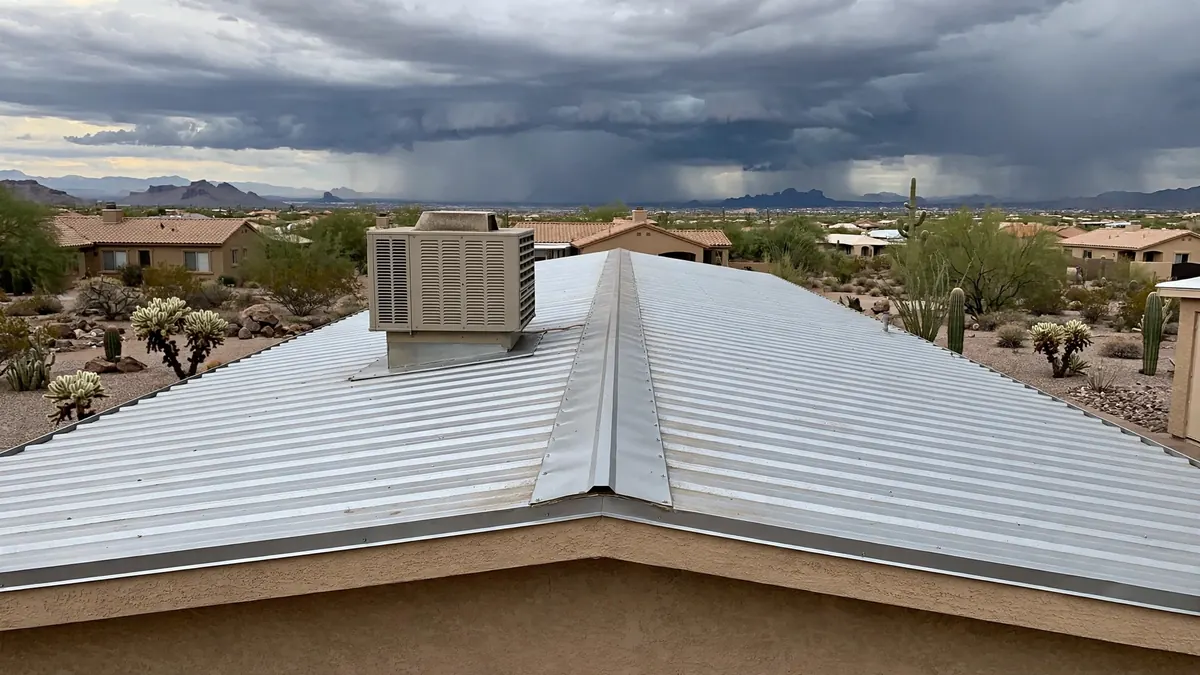
Most monsoon roof leaks on manufactured homes start at seams, screws and anything mounted on the roof. Pinal County sun breaks down sealants and coatings over a few summers, and a fast, wind-driven storm finds the weak spot.
- Metal roof seams and screws. Older homes often have metal roofs. The seams and fasteners expand and contract in the heat, which works sealant loose over time.
- Roof coatings. Many owners coat the roof to reflect heat. Coatings crack and peel in UV, and a cracked coating over a seam lets water straight in.
- The marriage line. On a double-wide, the two halves meet at a center seam along the roof. If the cap or sealant there fails, water runs down the center of the home and shows up in a hallway ceiling.
- Vents and stacks. Plumbing vents, bath fans and range hood vents each have a boot or flashing that dries out.
- Coolers and AC units. A rooftop evaporative cooler leaks from its pan, float or supply line, and its weight on a light roof can stress the area around it. See our evaporative cooler leak page for those parts.
- Roof-over systems. Some older homes have a second roof built over the original. Water that gets between the two can travel a long way before it shows.
Check the roof in spring, before storms begin, from a ladder or by hiring it out. Manufactured home roofs are not built to carry much weight, so walking on them can cause damage.
What does skirting have to do with water damage?
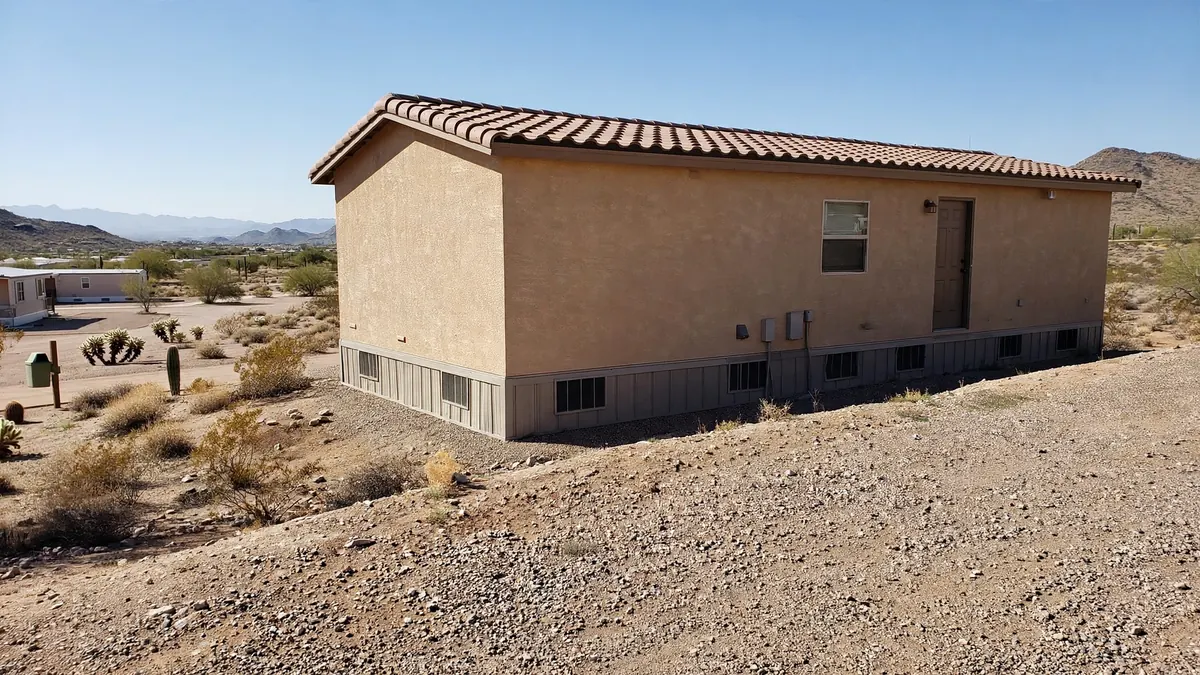
Skirting closes in the space under the home, and when it is damaged or blocked, it changes where water goes. Good skirting with working vents keeps runoff out and lets moisture escape. Broken or sealed-up skirting can let water in during storms and trap damp air under the floor.
- Monsoon runoff. If the ground around the home slopes toward it, storm water runs under the skirting and pools around the piers. Over time that soil can soften and let piers settle, which puts stress on plumbing joints and doors.
- Vents. Skirting vents let air move. When they are blocked by dirt, plants or storage, moisture from a leak stays under the home much longer.
- Gaps and holes. Damaged skirting lets in pests and, in a rare winter cold snap, cold air that can freeze exposed lines under the home.
- Roof runoff. If the home has no gutters, water from the roof edge drops right next to the skirting. A splash block or gutter that carries water away helps.
Which leaks are most common inside a manufactured home?
Water heaters, plumbing fittings, toilets and appliances cause most interior leaks. In a manufactured home, each one tends to soak the floor and drain into the belly rather than spread across the room.
| Source | Where the water goes | What to check |
|---|---|---|
| Water heater | Floor of the heater closet, then the belly below it | Rust at the tank base, drips from the relief valve, a soft closet floor |
| Polybutylene supply lines | Into walls and down to the belly at fittings | Gray plastic lines, drips at crimp rings |
| Toilet wax ring or supply | Subfloor around the toilet | A rocking toilet, a soft floor, a sewer odor |
| Tub and shower drains | Subfloor under the tub | Soft floor at the tub edge, musty smell |
| Washer hoses | Laundry floor and belly | Bulging or cracked hoses, a damp floor behind the machine |
| Kitchen sink and dishwasher | Cabinet floor, then subfloor | Swollen cabinet base, stains under the sink |
| AC condensate | Near the air handler or furnace closet | Water in the closet, rust on the pan |
Many manufactured homes have the water heater in a closet with an outside access door. That closet floor takes a beating, and it is a good place to start when you check for problems. Our water heater leak page covers that cleanup in more detail.
Who is responsible for a leak in a park home?
If you own the home and rent the lot, you are generally responsible for the plumbing inside and under your home, and the park is generally responsible for the lines it owns up to your connection. Your lease and park rules decide where that line falls, so read them.
The question usually comes up with leaks at the meter or the main connection, sewer backups from a shared line, and storm runoff that comes from park roads or neighboring lots. If you think the leak started on the park's side, tell park management in writing, take photos showing where the water came from, and keep a copy. If you own your lot outright, the whole system from the meter to the home is usually yours.
How does insurance work for manufactured home water damage?
Manufactured homes are usually covered by a mobile or manufactured home policy rather than a standard homeowners policy. Like most homeowners policies, these commonly cover sudden, accidental leaks and exclude slow leaks, wear and tear, and flooding from outside.
- Sudden versus gradual. A burst supply line is usually treated as sudden. A soft floor around a toilet that leaked for a year is usually treated as gradual.
- Replacement cost or actual cash value. Some policies on older homes pay actual cash value, which subtracts depreciation. Check which one applies to your home and contents.
- Flooding. Water that rises from the ground and flows under or into the home is flood, which most policies exclude.
- Documentation. Photos of the belly, the soft floor and the source, plus moisture readings, help an adjuster see what happened.
Every policy is different, so check your declarations page and the water damage section. For more on general coverage rules, see our guide to water damage insurance in Arizona.
What should you do first when you find a leak?
Shut off the water at the home's main, turn off power to any wet area if the panel is dry and safe to reach, and photograph the source before anything is moved. Then get the belly checked, even if the floor looks fine.
Costs are set by the restoration company and vary with the job. Most water damage jobs in the area run about $1,300 to $5,500, and one room of clean water caught early is often about $400 to $1,500. Subfloor replacement and belly repair add to that. If you have water under the home, a soft floor, or a musty smell from the vents, call (520) 380-1551. The line is open 24/7 and connects you with a local restoration crew that works on manufactured homes in Casa Grande, Arizona City, Eloy, Coolidge and across Pinal County.
Questions homeowners ask
How much water can a mobile home belly hold?
Is it safe to crawl under my manufactured home to look for a leak?
Why does my floor feel soft near the toilet?
Does skirting cause water problems?
More from the blog
 Local GuidesWater damage restoration cost in Florence, AZMost water damage restoration jobs in Florence, AZ run about $1,300 to $5,500. One room of clean water caught early is often $400 to $1,500, and...
 Local GuidesWater damage in Maricopa, AZ homes: slab leaks, HOAs and newer buildsMost Maricopa homes were built in the 2000s and later on concrete slabs, and many are now old enough that original water heaters, supply lines, washer...
 Local GuidesSan Tan Valley water damage: what homeowners should knowSan Tan Valley is mostly newer slab homes in HOA subdivisions, so the common water problems are slab leaks, PEX fitting failures in walls and ceilings,...
Need help with damage right now?
Speak to a local restoration specialist on the 24/7 line, any time of day.
Call (520) 380-1551When you call: enter your ZIP code, then press 1 for water damage, 2 for fire damage or 4 for sewage backup.