Home › Blog › Coolidge and Eloy: older homes, hard water and leaks
Coolidge and Eloy: older homes, hard water and leaks
Older homes in Coolidge and Eloy usually leak from age and hard water: galvanized or copper pipes that thin and clog, original water heaters, seized shutoff valves and evaporative cooler lines. Farm-area homes add long buried lines and wells, while Robson Ranch homes face PEX fittings and seasonal vacancy. See water damage in Coolidge.
In this article
- Why do older homes in Coolidge and Eloy leak differently than new builds?
- What kind of pipe does your house have, and how does it fail?
- How does hard water make older plumbing leak sooner?
- Where do evaporative coolers leak in older homes?
- What should owners of farm-area and rural homes watch for?
- What leaks are common in Robson Ranch and other newer Eloy homes?
- What does a yearly leak check look like for an older home?
- What should you do when you find water in an older home?
- Questions homeowners ask
Why do older homes in Coolidge and Eloy leak differently than new builds?
Older homes in Coolidge and Eloy tend to leak from age and minerals: pipes that have thinned or clogged from the inside, original valves and water heaters, and evaporative cooler lines on the roof. Newer homes usually leak from a single failed fitting.
Both towns grew in layers. Coolidge has decades-old homes around downtown and newer subdivisions further out. Eloy has its older core, rural homes out toward the fields, and the much newer Robson Ranch community. A leak in each looks different, and so does the fix.
What kind of pipe does your house have, and how does it fail?
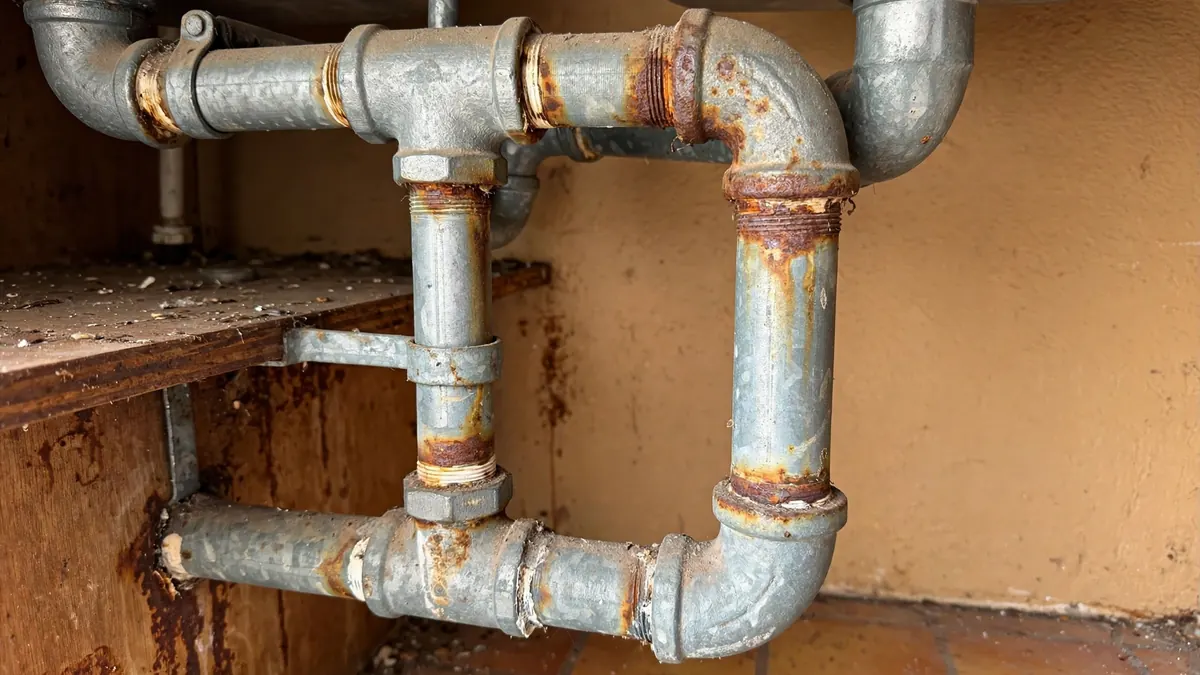
Look at the pipe where it comes out of the wall under a sink, at the water heater and at the hose bibs outside. The material tells you a lot about what kind of leak to expect. Many older homes have a mix, because past owners or plumbers replaced sections over the years.
| Pipe you see | How to recognize it | How it usually fails | Warning signs |
|---|---|---|---|
| Galvanized steel | Dull gray metal with threaded joints, a magnet sticks to it | Rusts and clogs from the inside, then leaks at threads and elbows | Low pressure, rust-colored water after it sits, weak hot water flow |
| Copper | Reddish brown or green-tinged metal with soldered joints | Pinhole leaks, especially in lines under the slab and on hot-water runs | Damp spots, green crust on fittings, a warm floor spot, a higher bill |
| Polybutylene | Gray, sometimes blue, flexible plastic, often stamped PB | Cracks at fittings and becomes brittle with age | Drips at crimp rings, sudden splits with little warning |
| PEX | Flexible red, blue or white tubing with metal or plastic fittings | Fitting or crimp failures more than the tubing itself | A sudden flow from one connection, often behind a wall or under the slab |
Galvanized lines are the biggest concern in the oldest houses. They rarely burst. They close up with rust and scale until pressure drops, and the threaded joints are where they finally weep. Polybutylene is known for failing at its fittings, and many insurers ask about it.
Copper under the slab is the classic slab leak setup. When one pinhole appears, the same line has often thinned in other spots, which is why plumbers often suggest a reroute. Our slab leak page explains what that job involves.
How does hard water make older plumbing leak sooner?
Hard water leaves mineral scale inside everything it touches, and in an older house that scale has had decades to build up. It wears out valves, clogs aerators and heater tanks, and puts extra strain on the parts that seal the system.
- Shutoff valves. The small valves under sinks and toilets, called angle stops, often seize in older homes. When a supply line bursts, a valve that will not turn means the whole house has to be shut off at the main.
- Water heaters. Sediment settles in the bottom of the tank, the burner or element works harder, and the steel tank corrodes from the inside. A tank that is rumbling or popping when it heats is carrying a lot of sediment.
- Toilet fill valves and flappers. Scale keeps them from sealing, which is why so many older homes have a toilet that runs on its own.
Many older water heaters sit in closets or garages with no drain pan. When the tank lets go, it keeps refilling until someone closes the cold supply. See our page on water heater leaks for that cleanup.
Where do evaporative coolers leak in older homes?
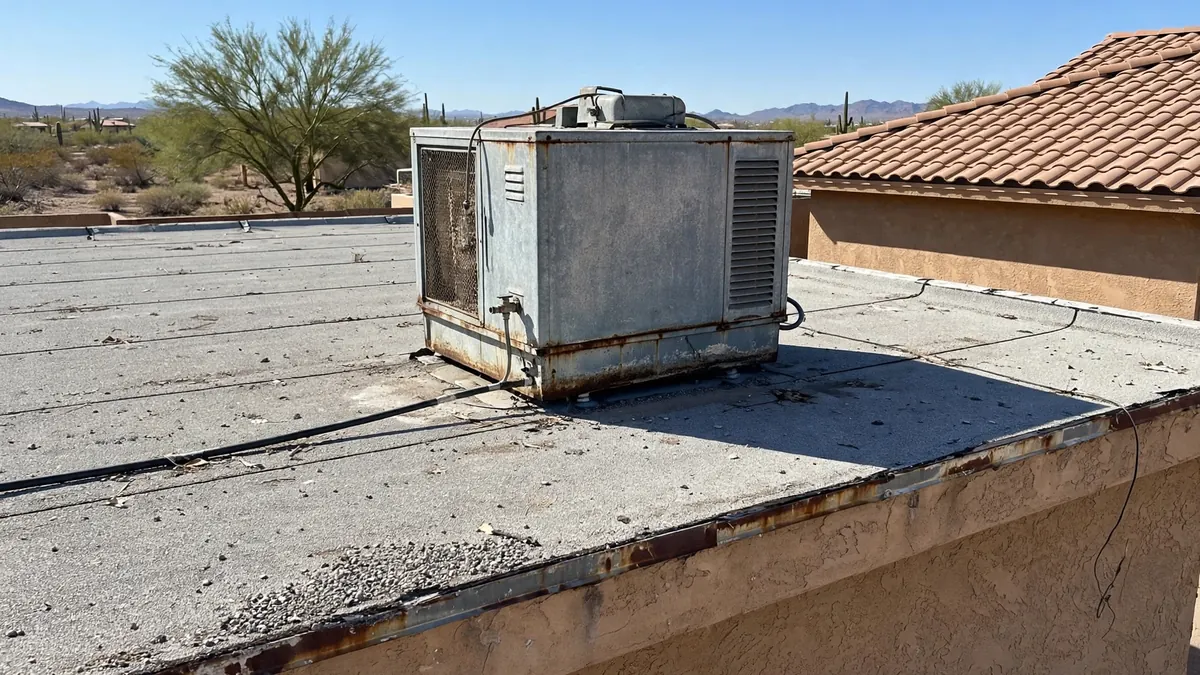
Evaporative coolers leak in three places: the pan that holds the water, the supply line that feeds it, and the roof penetration where the duct comes through. Because most of these coolers sit on the roof of older Coolidge and Eloy homes, the water usually shows up as a ceiling stain in the hallway or a room under the unit.
- The pan. Older metal pans rust through at the seams and corners, especially where scale collects. A small hole drips onto the roof every time the cooler runs.
- The float valve. If it sticks open, the pan overfills and spills over the edge or out the overflow. Scale is the usual cause.
- The supply line. The thin copper or plastic line that runs across the roof bakes in the sun and can crack at the fittings.
- The roof jack. This is the sheet metal collar where the duct passes through the roof. When its sealant cracks, monsoon rain and cooler overflow both get in.
Cooler leaks are slow, so the damage is often worse than it looks. Attic insulation soaks up the water first, and by the time a stain shows, the drywall has been wet for a while. See our evaporative cooler leak page for more on the parts and seasonal care.
What should owners of farm-area and rural homes watch for?
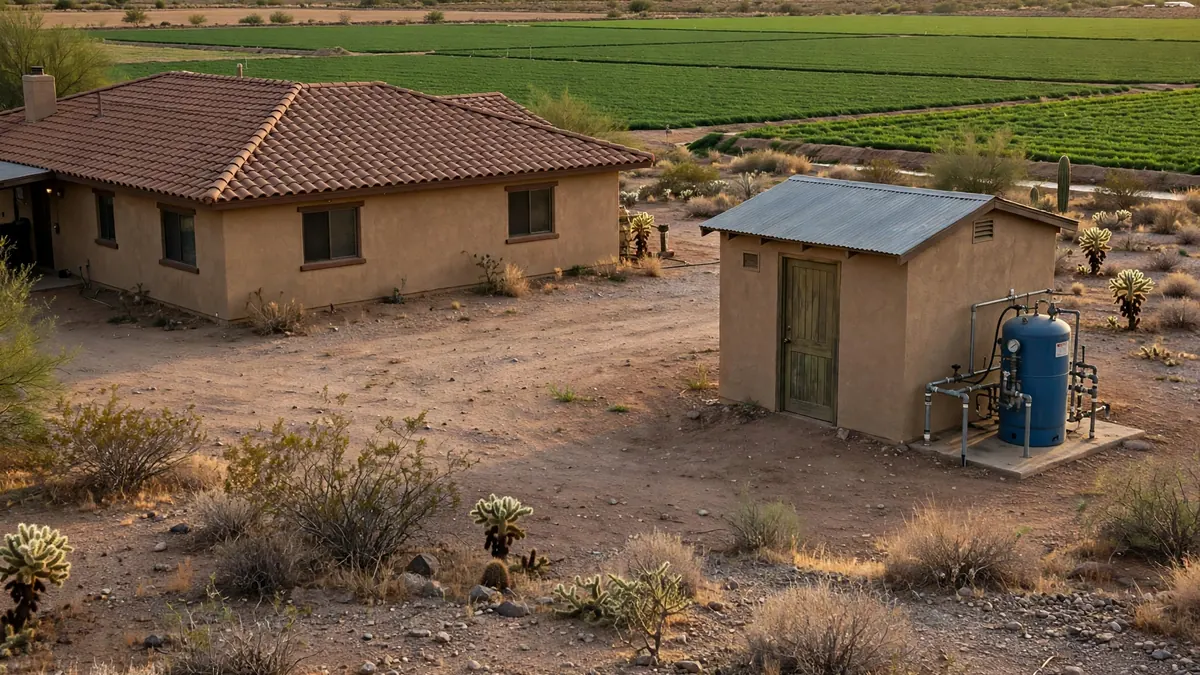
Homes out among the fields around Coolidge and Eloy have more plumbing outside the house and fewer people nearby to notice a problem. Long buried lines, outdoor hydrants, private wells and field runoff all add risk that town homes do not have.
- Long service lines. On a large lot, the line from the meter or well to the house can be a long run. A leak in that line may show up only as a soft, green or sunken spot in the yard, or a pump that runs more than it should.
- Private wells and pressure tanks. Homes on a private well have a pressure tank and pressure switch. If the pump is cycling on and off with no water being used, water is escaping somewhere. A failed pressure tank or a leaking fitting at the tank can flood a pump house or garage.
- Field and canal runoff. During a heavy monsoon cell, water running off flat farm ground can reach a home from a direction the owner never expected, carrying silt and whatever was on the field. That water is not clean, and anything porous it soaks is usually removed rather than dried.
- Septic systems. Some rural homes are on septic. A backup through a tub or floor drain is a sewage problem, not a plain water leak, and it is cleaned up very differently.
Know where every shutoff is, including the well pump breaker, before anything goes wrong.
What leaks are common in Robson Ranch and other newer Eloy homes?
Robson Ranch homes are newer than Eloy's older core, so the plumbing problems are different: PEX fitting failures, original water heaters and supply lines wearing out, and AC condensate overflows. The bigger factor is that many owners are away for part of the year, so a small leak runs much longer.
The Eloy page covers the basics of seasonal homes. A few details matter more as these homes age:
- Original equipment. Many homes here are no longer new. Water heaters, braided supply lines under sinks and toilets, and the ice-maker line behind the fridge are the parts most likely to fail first.
- PEX on post-tension slabs. A failed fitting under the floor can push water up through tile with no warning. Before anyone cuts into a post-tension slab for a repair, the tendons have to be located.
- Condensate lines. The AC runs for months. A clogged condensate line in a closet or attic overflows quietly, and in a closed-up house nobody hears it.
Shutting off the main before you leave, and turning off the water heater, prevents most of these from becoming a flood while you are gone.
What does a yearly leak check look like for an older home?
Once a year, ideally in spring before the cooler starts, walk the house with a flashlight and work through this list. It catches most problems while they are small.
- Run the meter test. Turn off every fixture and watch the leak indicator on the water meter for a few minutes. If it moves, something is leaking.
- Test every shutoff. Turn each angle stop under sinks and toilets off and back on. Note the ones that are stuck so a plumber can replace them.
- Look at the water heater. Check the base for rust, damp spots and white crust. Look at the relief valve discharge pipe for drips. Note the age on the label.
- Look under every sink. Feel the cabinet floor for soft or swollen spots and look for water stains.
- Check toilets. Put food coloring in the tank and wait 15 minutes without flushing. Color in the bowl means the flapper leaks.
- Inspect the cooler. Look at the pan, float, supply line and roof jack before you start it for the season.
- Walk the ceilings. Look for new stains under the cooler, near bathrooms and around the AC closet.
- Walk the yard. Look for wet or green patches over the service line and pooling against the foundation.
If you find a valve that will not turn, do not force it with a wrench. Old valve stems can snap and turn a drip into a spray. Leave it for a plumber and know where your main is in the meantime.
What should you do when you find water in an older home?
Stop the water at the closest working valve or the main, then find out how far it spread. In an older house, water usually travels further than it looks.
- Close the valve on the fixture, or the main if that valve is stuck.
- If the water heater is leaking, turn off its gas or power and close the cold supply above the tank.
- Take photos of the source and the wet area before moving anything.
- Keep the failed part, such as the burst supply line or a section of pipe, for the insurance adjuster.
- Get the leak repaired by a plumber, then have the wet materials checked with a moisture meter and dried.
Costs are set by the restoration company and vary with the job. Across the area, most water damage jobs run about $1,300 to $5,500, and one room of clean water caught early is often about $400 to $1,500. Most standard policies cover sudden, accidental leaks but not slow leaks or the pipe itself, so check your declarations page.
If you have water on the floor or a stain that keeps growing in a Coolidge or Eloy home, call (520) 380-1551. The line is open 24/7 and connects you with a local restoration crew that works across Coolidge, Eloy, Casa Grande and the rest of Pinal County.
Questions homeowners ask
How do I know if my Coolidge home has galvanized pipes?
Is it worth repiping an older home in Eloy or Coolidge?
Can an evaporative cooler cause water damage inside the house?
More from the blog
 Local GuidesWater damage restoration cost in Florence, AZMost water damage restoration jobs in Florence, AZ run about $1,300 to $5,500. One room of clean water caught early is often $400 to $1,500, and...
 Local GuidesWater damage in Maricopa, AZ homes: slab leaks, HOAs and newer buildsMost Maricopa homes were built in the 2000s and later on concrete slabs, and many are now old enough that original water heaters, supply lines, washer...
 Local GuidesSan Tan Valley water damage: what homeowners should knowSan Tan Valley is mostly newer slab homes in HOA subdivisions, so the common water problems are slab leaks, PEX fitting failures in walls and ceilings,...
Need help with damage right now?
Speak to a local restoration specialist on the 24/7 line, any time of day.
Call (520) 380-1551When you call: enter your ZIP code, then press 1 for water damage, 2 for fire damage or 4 for sewage backup.