Home › Blog › Water damage insurance claim checklist: photos, readings and receipts
Water damage insurance claim checklist: photos, readings and receipts
A water damage claim checklist covers five things: photos and video of the source and every wet room before cleanup, the date and time you found the water, daily moisture readings and drying logs from the crew, a room-by-room contents inventory, and receipts for every cost the loss caused. Keep the failed part too. See what insurance usually covers.
In this article
- What should a water damage claim checklist include?
- What photos and video should you take, and in what order?
- What will the adjuster ask you?
- How do you build a contents inventory that holds up?
- Which receipts should you keep after water damage?
- What should a drying log show?
- What paperwork should come from the plumber, roofer, or restoration company?
- How should you organize the claim file?
- What should you do today if you have water damage?
- Questions homeowners ask
What should a water damage claim checklist include?
A complete water damage claim file has five parts: proof of the source, proof of the damage before anything was removed, proof of when you found it and when drying started, a list of damaged belongings, and receipts for every dollar you spent because of the loss. If you can hand an adjuster all five, most of the questions they would otherwise ask are already answered.
The table below is the whole checklist in one place. Print it, or keep it open on your phone, and tick items off as you go. The sections after it explain how to do each one well.
| Item | When to get it | Why the adjuster wants it |
|---|---|---|
| Photos and video of the source (the split line, the failed tank, the roof opening) | Before anything is repaired or thrown out | Shows the cause was sudden and accidental, which is what most policies pay for |
| Wide and close photos of every wet room | Before extraction or tear-out | Sets the starting scope so nobody argues later about what was wet |
| Date and time you found the water, written down | The same day | Answers the gradual-leak question and starts your mitigation clock |
| The failed part itself (hose, supply line, valve, pipe section) | Keep it until the claim closes | Physical evidence of the cause, and sometimes needed if the insurer pursues a manufacturer |
| Restoration crew's initial moisture map and photos | First visit | Independent record of how far the water spread |
| Daily drying logs with readings and equipment counts | Every visit until dry | Supports the equipment days on the mitigation bill |
| Plumber, roofer or appliance tech invoice naming the cause | When the repair is done | A third party in writing on what failed and why |
| Contents inventory with age and cost | Start in the first week, finish before the contents payment | Required to be paid for belongings |
| Receipts for emergency supplies, hotel, meals and extra costs | As you spend | Reimbursement under mitigation or additional living expense coverage |
| Mitigation estimate and invoice, itemized | When the drying phase ends | The adjuster compares it line by line against their own estimate |
| Rebuild estimate, itemized | After drying, before repairs start | Sets the repair payment and any later supplement |
| A claim diary of every call, visit and email | From day one to the final check | Settles disputes about who said what and when |
For the coverage rules that sit behind this list, such as sudden versus gradual damage and how your deductible applies, read does homeowners insurance cover water damage in Arizona. This article stays on the paperwork.

What photos and video should you take, and in what order?
Shoot the source first, then each room from the doorway, then close-ups of damaged materials and belongings, then anything that shows time, like a water meter or a dated receipt. Take it all before cleanup starts. Once a crew pulls carpet or cuts drywall, the original condition is gone for good.
A phone is fine. What matters is that the set of pictures tells the story without you in the room to explain it. Work through this shot list:
- A short narrated video walk-through. Start outside the front door, say the date and time out loud, and walk slowly through every affected room. Talk about what you see. A two-minute video often answers more questions than fifty stills.
- The source, from three distances. One shot showing where the source sits in the room, one from arm's length, and one close enough to read a brand name or see the crack. For a water heater, get the data plate with the model, serial number and manufacture date. For a supply line, photograph the burst section and the connection on both ends.
- Each room from the doorway. Stand in the door and take one wide shot, then turn and shoot each wall. This shows how much of the floor was wet.
- The wet line on walls. Water wicks up drywall in a band. Photograph that band with a tape measure held against it so the height is clear.
- Close-ups of damaged materials. Swollen baseboards, lifted tile edges, cupped wood, soaked carpet pad, stained ceilings, swollen cabinet bases. Lift a corner of carpet and photograph the pad underneath.
- Belongings in place. Before you move furniture or boxes, shoot them where they sat in the water. Then shoot them again where you set them aside.
Keep your phone's date and location settings on so each file carries its own timestamp. Do not edit or filter the pictures. Back them up to a cloud folder the same day, because a phone that falls in a wet room is a common way to lose the only record.
What will the adjuster ask you?
Expect questions about when you found the water, when you last saw the area dry, what caused it, whether it happened before, and what you did to stop it. The adjuster is working out whether the loss was sudden, whether you limited the damage, and whether anything falls under an exclusion.
Write your answers down before the first call so you give the same answer every time. Common questions include:
- When did you first notice the water, and how? Be specific. "Tuesday at about 6 a.m., I stepped on wet carpet in the hall" is better than "earlier this week."
- When were you last in that room, or last used that fixture? This narrows the window for when the leak started.
- What do you think caused it? Say what you saw, not a guess. If a plumber has not looked yet, say so.
- Has this happened before? Prior leaks, stains you painted over, or past repairs at the same spot come up here. Answer honestly. A previous repair that was done properly is not a problem. A hidden one that comes out later is.
- What did you do once you found it? Shutting the main, turning off the water heater, moving belongings, and calling a crew all count.
- Was anyone living in the home? For seasonal homes in Mission Royale or Robson Ranch in Eloy, expect questions about how often the house was checked and whether the water was shut off while you were away.
It is fine to say "I don't know." Guessing at a date and correcting it later looks worse than an honest gap, and changing details between the adjuster, the crew and the plumber is one of the fastest ways to invite more questions.
How do you build a contents inventory that holds up?
Go room by room and list every damaged item with a description, brand or model, where you bought it, roughly when, and what you paid or what it would cost to replace. Attach a photo to each line. A spreadsheet works better than a notebook because you can sort it and send it.
Contents are where most homeowners leave money on the table, because a wet house is a stressful place to make lists. A simple structure helps:
| Column | What to put in it |
|---|---|
| Room | Where the item was when the water hit |
| Item and description | "Gray fabric 3-seat sofa," not "couch" |
| Brand and model | From the tag or label photo |
| Age | Year bought, or your best estimate |
| Original cost | From a receipt, bank statement, or online order history |
| Replacement cost | A current price for the same or similar item, with the link or store |
| Condition and damage | Wet, stained, swollen, moldy, or contaminated |
Where to find proof of what you owned
Online order histories, store loyalty accounts, card and bank statements, warranty registrations, and old family photos that show furniture and electronics in the background all count. For an item with no record, a clear photo and an honest estimate beats leaving it off. Small items add up, so list the towels, the printer on the floor and the pantry goods in the lower cabinet.
Do not throw items out yet
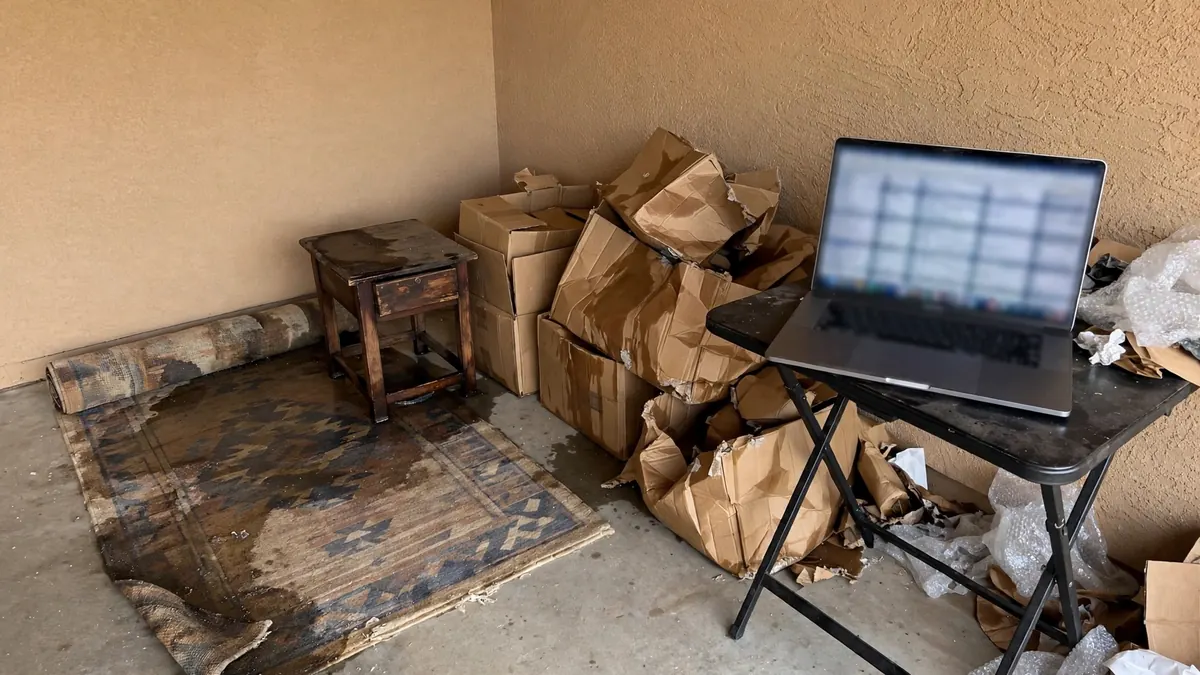
Set damaged belongings aside in the garage or a dry room until the adjuster says they can go. If something has to be discarded for health reasons, such as items soaked in water from a sewage backup or a toilet overflow, photograph it first and note why it was thrown out. Your adjuster may want to see the actual rug or mattress before agreeing it was a loss.
Which receipts should you keep after water damage?
Keep a receipt for every expense that exists only because of the water: tarps, towels, buckets, a wet-dry vacuum, a plumber's emergency call, a hotel if the home was unlivable, extra meals out, pet boarding, and storage. Many policies reimburse reasonable emergency costs and, when the home cannot be lived in, additional living expenses.
- Emergency supplies. Anything you bought to stop or limit the damage. Insurers expect you to protect the property, and they usually reimburse the reasonable cost of doing it.
- Emergency repairs. The plumber who capped the line, the roofer who tarped after a monsoon cell, the appliance tech who diagnosed the dishwasher.
- Additional living expenses. If the home is unlivable because of a covered loss, many policies pay the extra cost of living elsewhere. That means the difference over your normal costs, so keep your hotel folios and meal receipts, and note what you would normally spend.
- Higher utility bills. Dehumidifiers and air movers draw a lot of power, and in a Casa Grande summer the AC is running at the same time. Save the electric bill for the drying period next to a normal month for comparison, and ask your adjuster whether your policy reimburses it.
Photograph paper receipts as soon as you get them. Thermal paper receipts fade fast in a hot car, and summer in Pinal County can wipe one clean in a few weeks.
Ask your adjuster early what your policy allows for additional living expenses and whether there is a dollar or time limit. It is easier to plan a hotel stay around a known limit than to find out after the fact.
What should a drying log show?
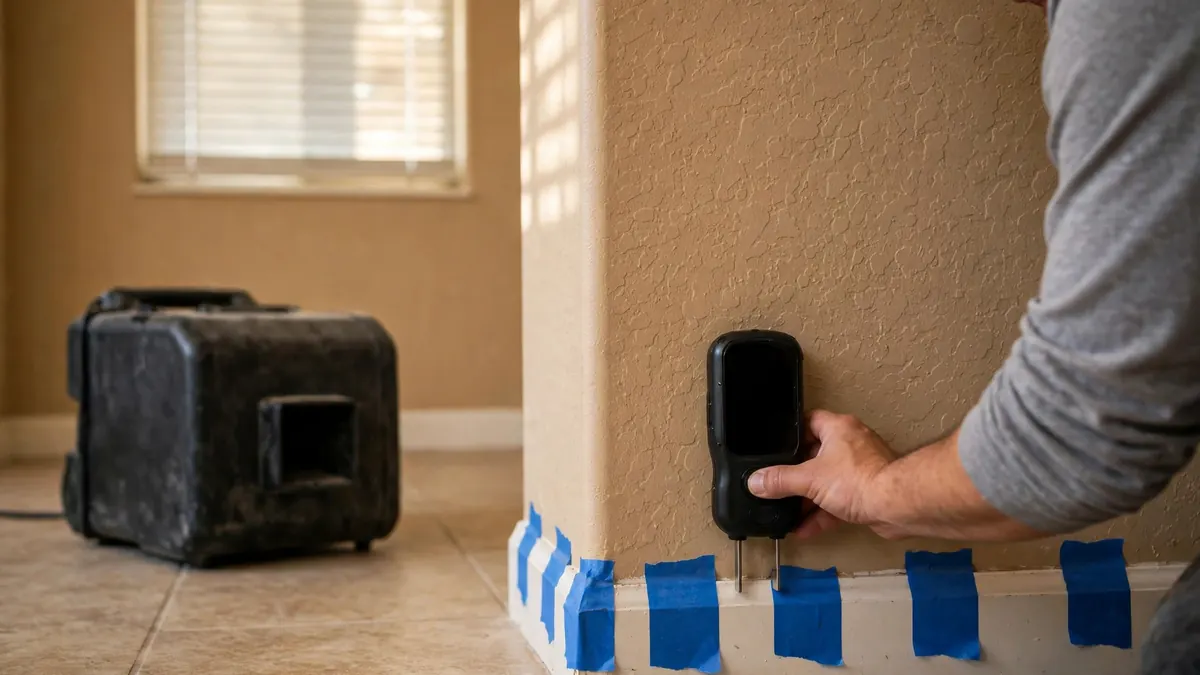
A useful drying log records moisture readings at the same marked spots on every visit, along with the temperature and humidity inside the drying area and outside it, the number and type of machines running, and the date each reading was taken. It should end with a final set of readings that meet the drying goal.
This is the document that proves the mitigation bill. An adjuster who sees eight air movers billed for four days will look for a log that shows eight air movers in place for four days, with readings that were still high on day three. Here is what to look for when the restoration company gives you copies:
- A sketch or map. The affected rooms with each reading point numbered.
- Baseline readings from dry material. A reading from an unaffected wall or floor of the same type, so "dry" has a real number to compare against.
- Daily readings at each point. The numbers should trend down over the visits. A point that stays flat suggests trapped water, such as under tile or inside a cabinet base.
- Air conditions. Temperature and relative humidity, and often a figure called grains per pound, which measures the actual amount of water in the air. Dropping grains inside the drying area show the dehumidifiers are working.
- Equipment record. How many air movers and dehumidifiers, where they sat, and when each was added or removed.
- Final readings. Every point at or near the dry baseline before the machines leave.
Concrete slabs are slow. A home in McCartney Ranch or Cottonwood Ranch with tile laid directly on a post-tension slab can show dry drywall well before the floor gives up its water, so the log may run longer at floor points. That is normal and it is exactly why the log matters. Our page on structural drying explains the equipment behind those numbers.
What paperwork should come from the plumber, roofer, or restoration company?
Ask every trade that touches the job for an invoice or written report that names what failed, where, and when they saw it. The plumber's or roofer's description of the cause carries a lot of weight with the adjuster because it comes from a professional who has no stake in your coverage.
- Plumber. An invoice that says, for example, "burst braided supply line at kitchen sink, cold side, replaced" or "pinhole leak in copper hot line under slab, located and repaired." Ask them to keep or hand you the failed piece. For a water heater leak, ask them to note whether the tank itself failed or a fitting or relief valve leaked.
- Roofer after a storm. A written note on whether the damage looks storm-related, such as lifted or broken tile, wind-torn flashing, or hail marks, as opposed to aged underlayment.
- Restoration company. The initial moisture map, the water category and class in writing, daily logs, photos, an equipment list, a written scope, and an itemized invoice for extraction, removal, cleaning and drying.
If you signed anything with the restoration company, such as a work authorization or a direction to pay the company from the claim, keep a copy in the file. You should know exactly what you agreed to before the checks start moving.
How should you organize the claim file?
Keep everything in one place, in one cloud folder with a paper backup, sorted by type and named by date. Add a running claim diary that logs every call, visit, email and payment. A neat file shortens calls with the adjuster and makes it obvious when something is missing.
A simple layout is one subfolder each for claim info (declarations page, claim number, adjuster contact), photos and video, cause of loss, mitigation and drying logs, contents, receipts, rebuild, and letters and payments from the insurer, including any denial or reservation-of-rights letters.
Name files so they sort in order, such as "2026-07-18 kitchen wide 01.jpg." In the claim diary, write the date, who you spoke with, what they said, and what happens next. After any important phone call, send a short email that sums it up: "Per our call today, you'll send the estimate by Friday." That turns a phone call into a written record.
Some insurers ask for a signed proof of loss form, a sworn statement of what you are claiming, within a set time after they request it. Check your policy's conditions section for the deadline, and ask the adjuster directly whether they need one.
What should you do today if you have water damage?
Stop the water, take the photos and video before anything moves, write down the time you found it, report the claim, and get drying started with readings recorded from the first visit. Then start the folder and the diary, and keep adding to them until the final payment arrives.
For the order of the first steps at home, see what to do after water damage. If water is still spreading or you want a local restoration crew to start the moisture readings your adjuster will ask for, call (520) 380-1551. The line is open 24/7 for Casa Grande and nearby Pinal County towns.
Questions homeowners ask
Should I take photos before the restoration crew starts?
Do I have to keep the broken pipe or supply line?
Can I throw out wet carpet and furniture before the adjuster comes?
What is a drying log and why does my insurer want it?
More from the blog
 Insurance & CostFlood vs water damage: how Arizona home insurance treats eachMost Arizona homeowners policies cover sudden water from inside the house, like a burst pipe, and often rain through a storm-damaged roof. Surface water that rises...
 Insurance & CostWhy insurers deny water damage claims, and how to avoid itInsurers deny water damage claims most often because the leak was long-term, the cause was wear and tear or poor maintenance, the water was flood or...
 Insurance & CostHow to choose a water damage restoration company: questions to ask and red flagsTo choose a water damage restoration company, pick one that takes moisture readings and photos on the first visit, gives you a written scope and itemized...
Need help with damage right now?
Speak to a local restoration specialist on the 24/7 line, any time of day.
Call (520) 380-1551When you call: enter your ZIP code, then press 1 for water damage, 2 for fire damage or 4 for sewage backup.