Home › Blog › How to choose a water damage restoration company: questions to ask and red flags
How to choose a water damage restoration company: questions to ask and red flags
To choose a water damage restoration company, pick one that takes moisture readings and photos on the first visit, gives you a written scope and itemized pricing, and explains insurance paperwork before you sign anything. Look the company up with the Arizona Registrar of Contractors, read its reviews, and walk away from on-the-spot pressure.
In this article
- What should a good water damage restoration company do on day one?
- What questions should you ask on the phone?
- What should you ask when the crew is at your door?
- What are the red flags with a restoration company?
- What drying documentation and insurance paperwork should you get?
- How do you check a restoration contractor in Arizona?
- What do IICRC standards mean for your job?
- Mitigation vs reconstruction: do you need one company or two?
- How do insurance and direct billing usually work?
- Why does a local water damage restoration company in Casa Grande matter?
- How can our line help you find a restoration company?
- Questions homeowners ask
What should a good water damage restoration company do on day one?
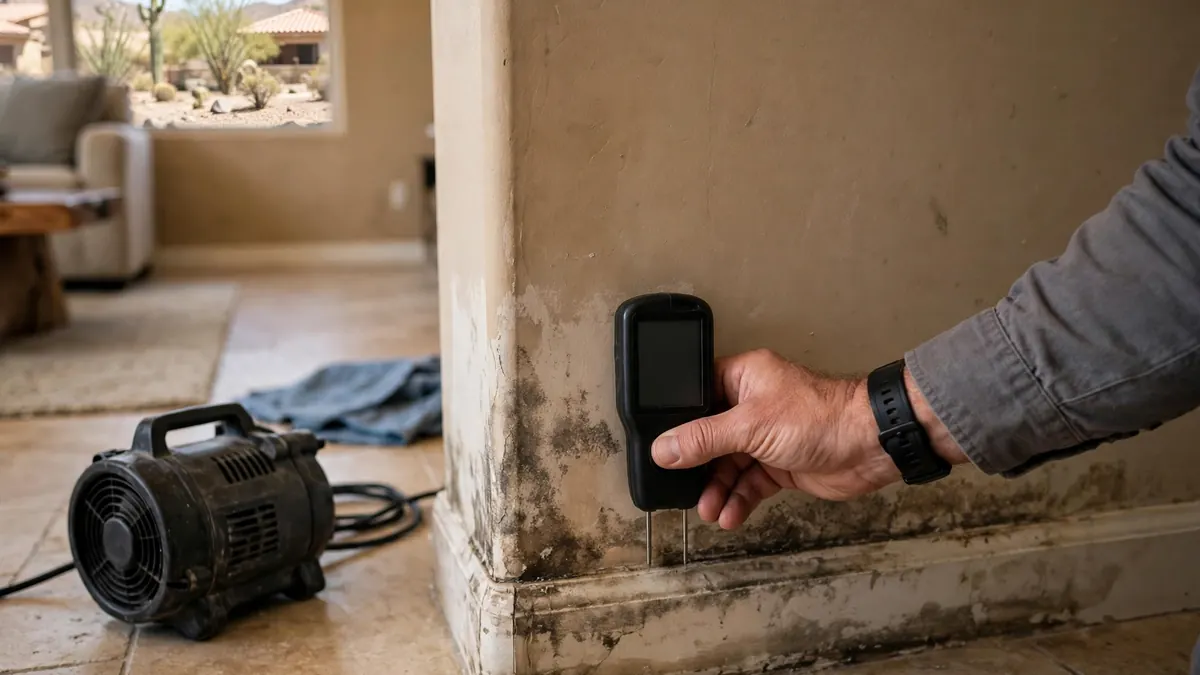
On the first visit, a good restoration company finds and confirms the source, measures how far the water traveled with moisture meters, photographs everything, removes standing water, and leaves you with a written drying plan. Then someone comes back every day to take new readings until the structure is dry.
- Assessment and safety check. The crew lead walks the house, looks for electrical hazards and sagging ceilings, and asks you when the water started and where you first saw it.
- Source confirmed and stopped. A burst supply line is easy. A slab leak under tile, an AC condensate pan in the attic, or a monsoon leak at a roof scupper takes more looking. If the source is still active, drying will not work, so a good crew will not skip this.
- Water category and class. They classify the water as clean, gray or black, and rate how much the building absorbed. Those two ratings decide what can be saved and how much equipment goes in.
- Moisture mapping. Using pin and pinless meters, and often a thermal camera, they trace the wet area past what you can see. Water on a slab floor tends to run under baseboards and wick up drywall in rooms you thought were dry.
- Photos and notes. Wide shots, close-ups and meter readings are recorded before anything is moved or torn out. This is the record your adjuster will ask for.
- Extraction. Truck-mounted or portable extractors pull water out of carpet and pad. Mopping the surface does not count as extraction.
- Drying plan. Air movers and dehumidifiers are set based on the readings, and you get an explanation of what stays, what may need to come out, and why.
- Daily monitoring. Someone returns to take readings at the same marked spots, adjust equipment, and log progress until materials reach a dry standard.
If a company shows up, sets a few fans and leaves without taking a single reading, that is not drying. That is guessing. Our water damage restoration page walks through each of these stages in more detail.
What questions should you ask on the phone?
On the first call, ask who will actually do the work, what the first visit includes, how they price, and how they handle insurance. A short, honest answer to each is a good sign. Dodging is not.
Keep this list near the phone or screenshot it.
- Is your company local, and what area do you cover? Do you serve Casa Grande, or are you sending someone from the Phoenix side?
- Will your own employees do the work, or do you subcontract it?
- What happens on the first visit? Will you take moisture readings and photos?
- Do you handle mitigation only (extraction and drying), or rebuild too?
- How do you price the work? Is it itemized by line item, equipment days and labor?
- Do you bill insurance directly, and what will you ask me to sign?
- What will I owe out of pocket, and when?
- Will I get copies of the moisture logs and photos?
- Can you give me the name of your company as it appears on your contractor registration so I can look it up?
What should you ask when the crew is at your door?
When the crew arrives, confirm the company name on the truck and paperwork matches who you called, ask to see the moisture readings as they take them, and ask for a written scope before any demolition starts.
A few more questions worth asking in person:
- Who is the project lead, and how do I reach them? You want one name and one phone number, not a general office line.
- Where is the wet line, and how did you find it? A good tech will show you the meter reading on the wall and mark the boundary.
- What are you removing, and why? Some materials do need to come out, especially after gray or black water. Ask which pieces, how much, and if drying in place was considered.
- How many days do you expect drying to take? An estimate is fine. A promise is not something anyone honest can make before the readings come in.
What are the red flags with a restoration company?
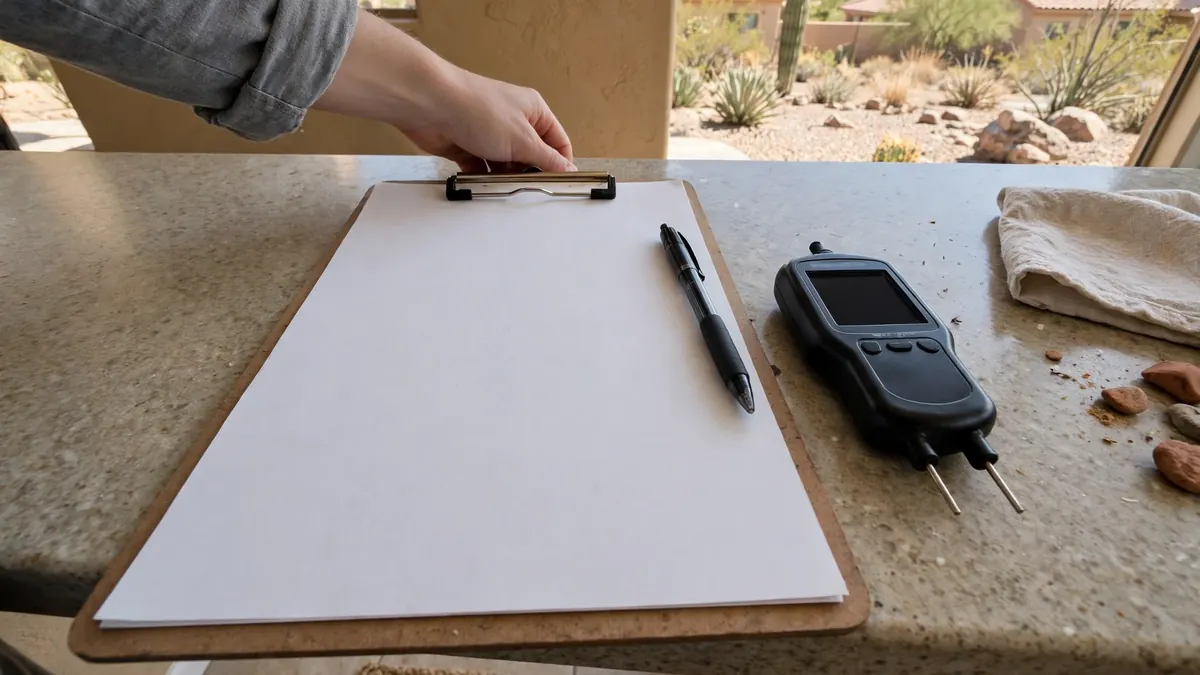
The biggest red flags are pressure to sign an assignment of benefits on the spot, no moisture readings, no written scope, demands for full payment upfront, and vague pricing. Storm chasers who show up uninvited after a monsoon and crews that push heavy demolition you do not need are close behind.
| Red flag | Why it matters | What to do |
|---|---|---|
| Pressure to sign an assignment of benefits (AOB) right now | An AOB can hand some of your claim rights, and sometimes your control over payments, to the contractor | Read it, ask what it covers, and take time to call your insurer before signing |
| No moisture readings | Without readings, nobody can prove where the water went or when it was dry | Ask for readings at the first visit and every day after |
| No written scope | Work without a scope is hard to check against the bill or the adjuster's estimate | Get a written scope before demolition |
| Full payment demanded upfront | Leaves you with no leverage if the job stalls or is done poorly | Ask how billing works with your deductible and insurer |
| Storm chasers after monsoons | Out-of-area crews may leave town when the busy season ends, along with any warranty | Check where they are based and look them up before you agree to anything |
| Vague pricing | "We'll see what it costs" makes it hard to compare or dispute | Ask for an itemized estimate |
| Pushing unneeded demolition | Tearing out more drywall, cabinets or flooring than needed can raise the bill and the rebuild | Ask what the readings show and whether drying in place is an option |
A closer look at the assignment of benefits
An assignment of benefits is a document that lets the contractor deal with your insurer and get paid directly from your claim. It is not automatically bad. Plenty of honest companies use some form of direct billing authorization. The problem is pressure. If someone wants it signed in your driveway before they have taken a single reading, slow down. Read every line, ask if you can cancel it, and call your insurance company first. You can usually authorize emergency extraction and drying without signing away more than that.
Storm chasers after monsoon storms
Every monsoon season, from mid-June to the end of September, a hard cell can put water through roofs and under doors across Casa Grande, Arizona City and Maricopa in one evening. Demand spikes, and some out-of-area outfits knock doors or flood search ads. Some are fine. Some are gone by October. A local company with a real address in Pinal County is easier to call back when a wall that "dried" starts to smell.
What drying documentation and insurance paperwork should you get?
You should get a moisture map or log with daily readings, dated photos of the damage and the work, an equipment list with dates set and removed, a written scope, and an itemized invoice. Ask for copies as the job goes, not only at the end.
Adjusters lean on this paperwork. A homeowner saying "it was soaked" carries less weight than a log showing a wall read wet on day one and dry on day four. Here is what a complete file usually includes:
- Initial readings and a sketch or map showing the affected rooms and the wet boundary.
- Daily drying logs with readings at the same points, plus temperature and humidity in the drying area.
- Photos of the source, the damage before work, any materials removed, and the equipment in place.
- Equipment records showing how many air movers and dehumidifiers ran, and for how many days.
- Water category and class noted in writing, since that affects what was removed.
- A final dry reading confirming the structure reached its drying goal before equipment left.
- An itemized estimate and invoice that lists extraction, equipment days, removal and cleaning separately.
Keep all of it in one folder with your own photos, receipts and the claim number. For more on how claims usually go, read whether homeowners insurance covers water damage in Arizona.
How do you check a restoration contractor in Arizona?
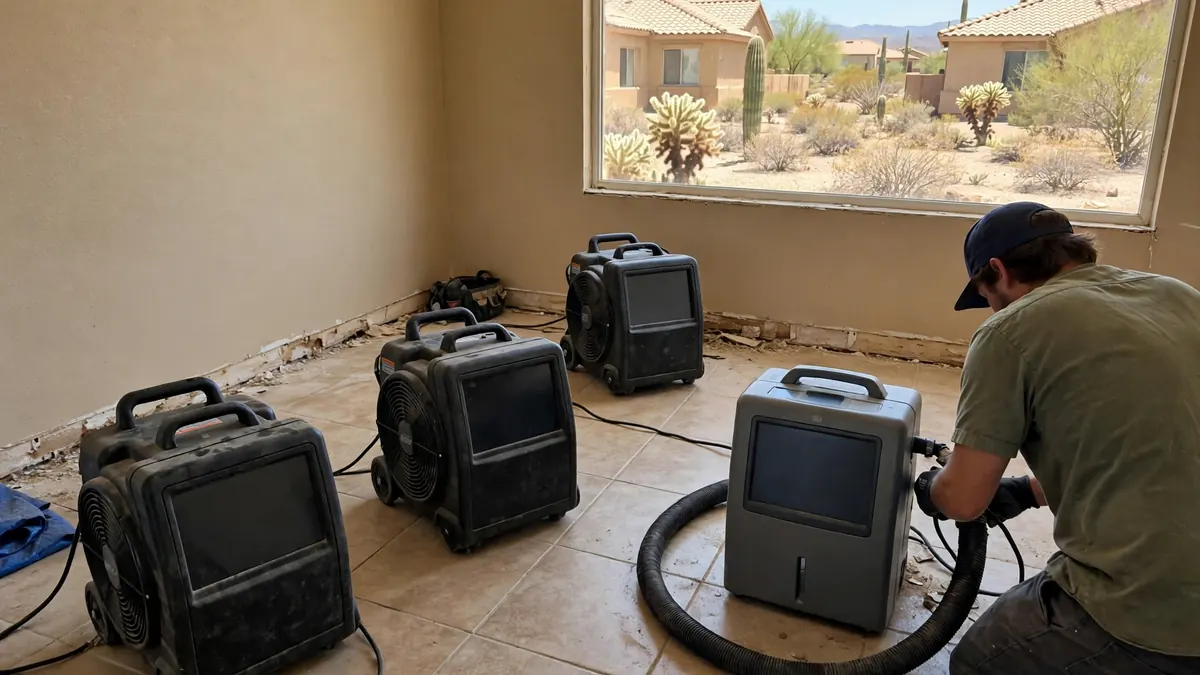
Look the company up on the Arizona Registrar of Contractors (ROC) website, then read its reviews on a few different sites yourself. The ROC search shows whether a contractor is registered, the license status, and any complaint history it has on file.
A few practical tips for doing this check:
- Search by the exact business name. Use the name on the estimate or truck. If the name on the paperwork does not match anything, ask why.
- Look at the status, not just the listing. A record that shows as expired, suspended or revoked is worth asking about.
- Check what type of work the license covers. Drying and cleaning are one kind of work. Rebuilding drywall, cabinets and flooring is another. If the company is doing the rebuild, ask which license covers that part, or which partner will do it.
- Read reviews for patterns. One angry review is normal for any busy company. Repeated complaints about surprise bills, unreturned calls or unfinished jobs are not.
This takes ten minutes on your phone, and you can do it while the first crew is on the way.
What do IICRC standards mean for your job?
The IICRC (Institute of Inspection, Cleaning and Restoration Certification) publishes industry guidelines that many restoration companies and insurers refer to. The ANSI/IICRC S500 covers professional water damage restoration, and the S520 covers mold remediation.
You do not need to read the standards to use them. What helps is knowing the ideas behind them, because they explain why a good crew does what it does:
- S500 (water). It lays out how water is categorized by contamination, how losses are classed by how much the building absorbed, and how drying should be measured with readings rather than judged by touch. When a crew talks about Category 2 water or a Class 3 loss, this is where those terms come from.
- S520 (mold). It describes how to contain an area with mold, remove contaminated materials, and confirm the area is clean afterward. It matters if your water sat long enough, often 24 to 48 hours in warm Casa Grande homes, for growth to start.
A fair question for any company is, "Do you follow the S500 for drying, and how will I see that in the paperwork?" The answer should point you back to readings, logs and a written scope.
Mitigation vs reconstruction: do you need one company or two?
Mitigation is the emergency part: extraction, drying, removal of ruined materials and cleaning. Reconstruction is putting the house back: new drywall, paint, baseboards, flooring and cabinets. Some companies do both, and some do only mitigation and hand you off to a contractor for the rebuild.
You are allowed to use one company for drying and another for the rebuild. Ask early which way a company works, so you are not surprised when drying ends and the next step is unclear.
How do insurance and direct billing usually work?
With most standard policies, you report the loss, the insurer assigns an adjuster, and the restoration company documents the damage and the drying. Many companies will bill the insurer directly for the covered portion, and you pay your deductible plus anything the policy does not cover.
- You can usually start emergency mitigation before the adjuster visits. Most policies expect you to prevent further damage. Check your policy and let the insurer know you are doing it.
- Direct billing is an authorization, not a guarantee. The insurer decides what is covered. If part of the job is denied, you may owe that part.
- Your deductible is yours. Be careful with anyone who offers to "waive" or "absorb" it. That can create problems with your claim.
- Check your declarations page. It shows your deductible and any endorsements, like sewer backup coverage, that affect what gets paid.
Prices are set by the restoration company and vary with the job. As a rough guide from our area, most water damage jobs land around $1,300 to $5,500, and one room of clean water caught early is often about $400 to $1,500. Our water damage restoration cost guide for Casa Grande breaks down what moves the number.
Why does a local water damage restoration company in Casa Grande matter?
A local company already knows Casa Grande houses, is usually a shorter drive away than a Phoenix-based crew, and is easier to reach for the daily moisture checks and any follow-up. That matters most during monsoon season, when demand jumps across the whole Valley at once.
The bigger outfits are often based up in Phoenix, roughly 45 minutes up I-10 on a normal day. That drive happens again for every daily monitoring visit. When a July storm hits Maricopa, San Tan Valley and Casa Grande the same night, crews coming from far away get stretched thin.
Local knowledge helps too. A crew that works here regularly has seen post-tension slabs with leaks under tile, PEX lines in newer subdivisions like Mission Royale and Cottonwood Ranch, flat roofs with clogged scuppers, and evaporative coolers leaking on older homes. They know a snowbird house that sat closed all summer may have been wet for weeks before anyone noticed. That background makes the first assessment better.
How can our line help you find a restoration company?
Our 24/7 line connects you with an independent local restoration company that serves Casa Grande and the surrounding Pinal County towns. We do not do the work ourselves, and you stay in control of who you hire.
When you are connected, use the questions on this page. Ask about readings, the written scope, pricing and insurance paperwork. Look the company up with the ROC. If the answers do not sit right, you can say no. You can read more about how the service works on our about page.
Found water and not sure who to call? Call (520) 380-1551 any time, day or night, to be connected with a local restoration company, then ask them everything on this list.
Questions homeowners ask
Should I sign an assignment of benefits with a restoration company?
How do I look up a contractor in Arizona?
What paperwork should a water damage company give me?
Is it a bad sign if a company only does drying and not rebuild?
More from the blog
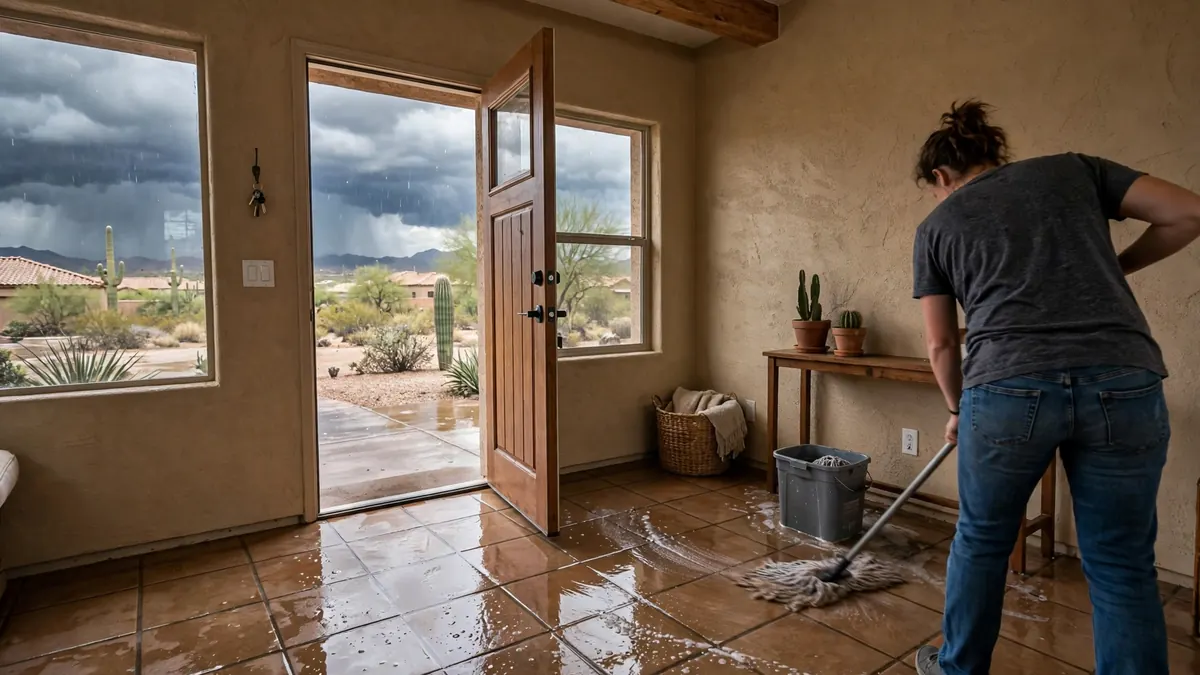 Insurance & CostFlood vs water damage: how Arizona home insurance treats eachMost Arizona homeowners policies cover sudden water from inside the house, like a burst pipe, and often rain through a storm-damaged roof. Surface water that rises...
 Insurance & CostWater damage insurance claim checklist: photos, readings and receiptsA water damage claim checklist covers five things: photos and video of the source and every wet room before cleanup, the date and time you found...
 Insurance & CostWhy insurers deny water damage claims, and how to avoid itInsurers deny water damage claims most often because the leak was long-term, the cause was wear and tear or poor maintenance, the water was flood or...
Need help with damage right now?
Speak to a local restoration specialist on the 24/7 line, any time of day.
Call (520) 380-1551When you call: enter your ZIP code, then press 1 for water damage, 2 for fire damage or 4 for sewage backup.